
Non-FictionTechnical GuideTutorial
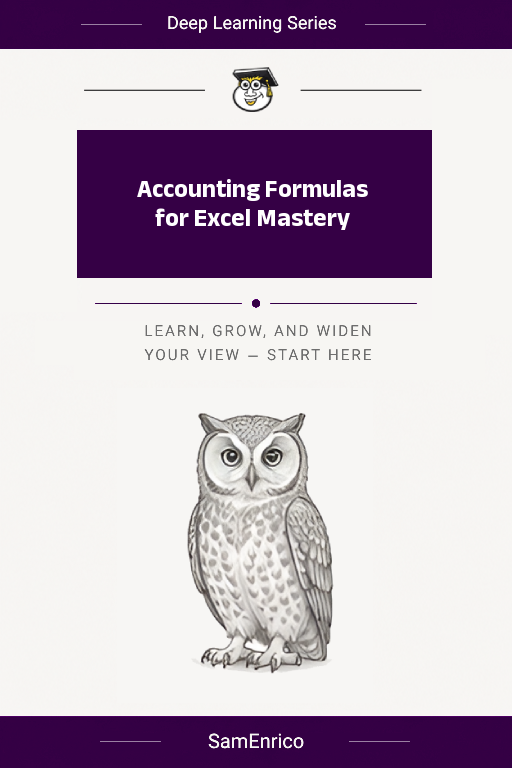
Accounting Formulas for Excel Mastery
Translate accounting formulas into Excel functions
Translate accounting formulas into Excel functions. Learn to build dynamic models that automatically calculate ratios and key metrics.
Formats
About this book
Free sample
Chapter 1: The Cell That Changed Everything--–- The first time I watched a senior accountant weep over a spreadsheet, I assumed it was the pressure of a billion-dollar valuation. It wasn’t. She was crying because a single cell, deep in a 50-megabyte Excel file, contained a hardcoded “4” instead of a formula linking to the correct input sheet. That “4” had overwritten a critical growth assumption, and the resulting forecast had just been presented to the board. The error cost her team three weeks of rework, her manager’s trust, and nearly her own confidence.
The number itself was trivial. The system that allowed it to happen was not.Most accountants learn Excel the same way they learn to reconcile a bank statement: by doing it, making mistakes, and eventually developing a set of survival habits. Those habits keep you employed. But they do not make you a master. The difference between a competent spreadsheet user and a true Excel accountant is not speed.
It is not knowing more functions. It is a fundamental shift in how you think about the relationship between cells.This chapter demolishes the single most destructive myth in financial modeling: that Excel is just a digital calculator. A calculator is a tool for static arithmetic. You type two numbers, press a button, and receive a single answer. Excel, when used correctly, is something else entirely.
It is a dynamic accounting ledger where every cell can have a deliberate, purposeful relationship with every other cell. Change one number, and the entire system responds. That is not calculation. That is modeling.The difference between “casting” and “modeling” separates the accountants who work late from those who leave at five o’clock. Casting is the manual, repetitive, error-prone process of typing numbers into new locations every month.
Modeling is the disciplined practice of building interconnected logic that updates itself automatically. This chapter teaches you to stop casting and start modeling.The Accounting Equation as Your First Dynamic Model Before you write a single formula, you must internalize the most important relationship in all of accounting: Assets equal Liabilities plus Equity.…
This is the end of the free sample. Get the eBook to keep going. Buy now
Contents
- Chapter 1
- Chapter 2
- Chapter 3
- Chapter 4
- Chapter 5
- Chapter 6
- Chapter 7
- Chapter 8
- Chapter 9
- Chapter 10
- Chapter 11
- Chapter 12
Details
- Author
- Ainsworth Mariko
- Publisher
- SamEnrico
- Language
- English
- Genre
- Non-Fiction, Technical Guide, Tutorial
- Released
- 2026-06-01
- Pages (approx.)
- 151
- Available as
- eBook, Audiobook

Read better in the ZLOADR app
Your eBooks on your phone or tablet. Sign in with your SamEnrico account and start reading.
More by Ainsworth Mariko
 Senior Media Esteem GuideAinsworth Mariko$11.99
 Gratitude for the BodyAinsworth Mariko$11.99
 Childcare Cost CrisisAinsworth Mariko$11.99
 Assertiveness Training for MenAinsworth Mariko$11.99
 Mindfulness for Stress Reduction BasicsAinsworth Mariko$11.99
 The Unseen War: How a Forgotten Conflict Shaped the Modern WorldAinsworth Mariko$11.99
 Behavior AnalystAinsworth Mariko$11.99
 Netflix SWOT Analysis Library GuideAinsworth Mariko$12.99
 Understanding Myoclonic Progressive Familial EpilepsyAinsworth Mariko$17.99
 How to Become a Documentation EngineerAinsworth Mariko$11.99
You may also like
 Hong Kong Handover 1997Dunn Johnnie$11.99
 Zumba For Postnatal Recovery CourseNeal Christian$11.99
 Zumba for BeginnersLadner Nikia$11.99
 YouTube Comment Mining GuideHumes Pandora$12.99
 Worry Box MeditationCarlin Rudy$11.99
 Workplace Stress MeditationNguyen Lynn$11.99
 Workplace Stress and Sleep RepairHawley Ivory$11.99
 Workplace Perfectionism CureDelaney Jeffry$11.99
 Workplace Injustice Anger GuideWallen Isabelle$11.99
 Work Addiction and Burnout LinkGreenwood Ester$11.99
 Women in Yoga and WellnessBeattie Galina$11.99
 Women in Stand Up ComedyChun Evangeline$11.99