
Non-FictionInformativeEducational
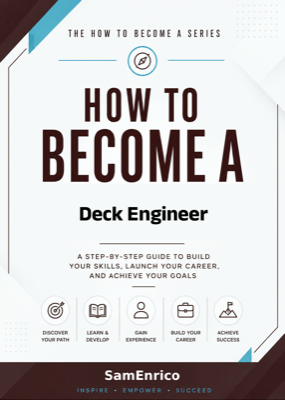
How to Become a Deck Engineer Paperback
How to Become a Deck Engineer
by Ruth Jodee
How to Become a Deck Engineer
Formats
Free sample
Chapter 1: The Hybrid Awakening--–- The engine room alarm shrieked at 0247, jolting Third Engineer Marcus Webb from his chair in the control room. On the screen, the number two auxiliary engine had tripped offline. Bearing temperature. Overheat. Before he could reach for the radio, the bridge called.
"Engine room, we lost our port thruster. Are you seeing this? We're in the middle of a docking sequence." Marcus replied, "That's not the thruster. That's your auxiliary power source. You've lost half your electrical capacity.
The thruster will come back when I restart the engine." The voice on the bridge said, "How long?" Marcus said, "Ten minutes." The bridge said, "We have six."This exchange, recounted to me by a chief engineer on a 350-gross-ton research vessel, illustrates the central problem that this book exists to solve. The deck officer on the bridge understood the effect (thruster failure) but not the cause (auxiliary engine trip). The engineer in the control room understood the cause but not the urgency of the docking maneuver. Both were competent professionals. Both held valid licenses.
Neither was wrong. But the gap between them—the gap created by a training system that separates deck and engine functions into two distinct universes—nearly put a vessel onto the rocks.The maritime industry is changing faster than its training system. Vessels are smaller, crews are leaner, and technology is erasing the physical and informational boundaries that once separated the bridge from the engine room. And yet, the pathway to becoming a deck officer remains almost entirely separate from the pathway to becoming an engineer. A young person entering maritime academy must choose: bridge or engine room.
That choice, made at eighteen or twenty years old, determines the entire trajectory of their career. It determines which courses they take, which certificates they earn, which watches they stand, and ultimately how much they earn. It also determines what they are not allowed to do. A deck officer cannot sign off on an engine room maintenance item. An engineer cannot approve a passage plan.
Each is locked into a silo, and the silos are watertight.This book is for those who refuse to choose.The Myth of the Pure Specialist The separation of deck and engine functions made sense in the era of steam. The coal-fired boiler room was a hellscape of heat, noise, and brute physical labor. Navigating required mastery of celestial calculations, paper charts, and visual pilotage. There was almost no overlap between the knowledge required to shovel coal and the knowledge required to shoot a star sight. Few individuals possessed the temperament, let alone the training, to do both.
So the industry specialized, and the specialization became enshrined in regulation, tradition, and culture.But the era of coal and sextants is over. It has been over for decades. The modern vessel is an integrated electromechanical system. The same display on an Integrated Bridge System shows radar targets, electronic chart data, engine RPM, fuel consumption, exhaust temperature, and the position of every valve on the fire main. The same network cable carries navigational data and engine telemetry.
The same lithium-ion battery bank that powers the emergency navigation lights also starts the emergency generator. The boundaries have dissolved, but the training system stubbornly maintains them.Consider the case of the bunkering operation. A traditional deck officer's role during bunkering is to supervise the hose connection, monitor the tank levels, and ensure no oil goes overboard. A traditional engineer's role is to manage the pump, the filter, and the transfer sequence. Neither is trained to understand the other's half of the operation fully.
Now consider a methanol bunkering operation on a modern dual-fuel vessel. Methanol is toxic, burns with an invisible flame, and…
This is the end of the free sample. Get the Paperback to keep going. Buy now
About this book
Details
- Author
- Ruth Jodee
- Publisher
- SamEnrico
- Language
- English
- ISBN
- 9781505740103
- Genre
- Non-Fiction, Informative, Educational
- Released
- 2026-06-02
- Pages (approx.)
- 156
- Available as
- eBook, Paperback, Audiobook

Read better in the ZLOADR app
Your eBooks on your phone or tablet. Sign in with your SamEnrico account and start reading.
More by Ruth Jodee
 Parent Loss Journal PromptsRuth Jodee$11.99
 Peer Support Group MethodRuth Jodee$11.99
 The Blood Draw BreathRuth Jodee$11.99
 CrossFit Injury PreventionRuth Jodee$11.99
 The Midday Reset ProtocolRuth Jodee$11.99
 Sciatica MeditationRuth Jodee$11.99
 Amazon Reselling RestrictionsRuth Jodee$11.99
 Therapy After Child DeathRuth Jodee$11.99
 Boundary Setting For DoctorsRuth Jodee$11.99
 The Golden Notes of Joseph Bologne: Chevalier de Saint-Georges and the Birth of Classical BrillianceRuth Jodee$11.99
 The Ale of Alexandria: Euclid's Theorem and the Birth of Mathematical PrecisionRuth Jodee$11.99
 Operation Midnight Sun: The Untold Story of How a Single Leak Exposed a Decade of EspionageRuth Jodee$11.99
You may also like
 Hong Kong Handover 1997Dunn Johnnie$11.99
 Zumba For Postnatal Recovery CourseNeal Christian$11.99
 Zumba for BeginnersLadner Nikia$11.99
 YouTube Comment Mining GuideHumes Pandora$12.99
 Worry Box MeditationCarlin Rudy$11.99
 Workplace Stress MeditationNguyen Lynn$11.99
 Workplace Stress and Sleep RepairHawley Ivory$11.99
 Workplace Perfectionism CureDelaney Jeffry$11.99
 Workplace Injustice Anger GuideWallen Isabelle$11.99
 Work Addiction and Burnout LinkGreenwood Ester$11.99
 Women in Yoga and WellnessBeattie Galina$11.99
 Women in Stand Up ComedyChun Evangeline$11.99