
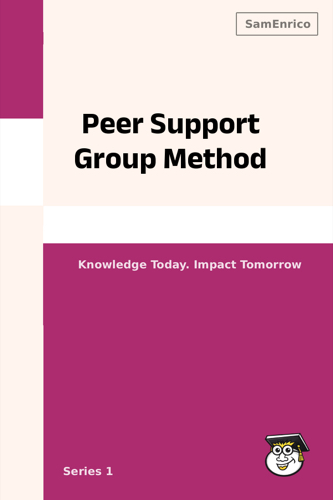
Peer Support Group Method
Structures accountability partnerships and group m
by Ruth Jodee
Structures accountability partnerships and group meetings for long-term abstinence.
Formats
About this book
Free sample
Chapter 1: The Empathy Trap--Every Monday night for eighteen months, David sat in the same church basement, in the same metal folding chair, and told the same story. He spoke about his last drink—a Thursday, cheap vodka, a fight he couldn't remember. The group nodded. Someone said, "Thank you for sharing." Someone else said, "Keep coming back." Then David drove home, past the same liquor store, and thought about stopping. He didn't.
Not that night. But the craving sat with him in the passenger seat, patient and familiar.David was not failing. By the standards of traditional peer support, he was succeeding. He attended regularly. He shared honestly.
He did not drink. But after eighteen months, he could not explain why he was still abstinent, nor could he predict whether he would remain so. His recovery was a black box: inputs unknown, processes invisible, outputs fragile. He had support, but he did not have accountability. He had empathy, but he did not have structure.
And when a financial crisis hit in month nineteen—a layoff, a divorce filing, a landlord's notice—David's support network had nothing to offer him except more nods and more invitations to share. He relapsed within a week.David's story is not unusual. It is not a failure of character, nor a lack of willpower, nor a deficiency in his commitment to recovery. It is a failure of design. The traditional peer support model—what this book calls the "talk circle"—is built on a flawed assumption: that emotional ventilation, shared suffering, and unconditional positive regard are sufficient to produce long-term behavioral change.
They are not. They are necessary, but they are not sufficient. And pretending otherwise has cost countless people their recovery.This chapter dismantles that assumption. It begins by examining why traditional support groups so often produce what we will call "support group burnout"—a state of high attendance, high emotional engagement, but low behavioral outcomes. It then introduces the core distinction that will guide this entire book: the difference between support (emotional validation) and accountability (behavioral structure).
Finally, it presents the three pillars of the Peer Support Group (PSG) Method—Consistency, Measurable Contracts, and Mutual Responsibility—and argues that…
This is the end of the free sample. Get the eBook to keep going. Buy now
Contents
- Chapter 1
- Chapter 2
- Chapter 3
- Chapter 4
- Chapter 5
- Chapter 6
- Chapter 7
- Chapter 8
- Chapter 9
- Chapter 10
- Chapter 11
- Chapter 12
Details
- Author
- Ruth Jodee
- Publisher
- SamEnrico
- Language
- English
- Genre
- Non-Fiction, Self-Help, Support Groups
- Released
- 2026-06-10
- Pages (approx.)
- 128
- Available as
- eBook, Audiobook

Read better in the ZLOADR app
Your eBooks on your phone or tablet. Sign in with your SamEnrico account and start reading.
More by Ruth Jodee
 Parent Loss Journal PromptsRuth Jodee$11.99
 The Blood Draw BreathRuth Jodee$11.99
 CrossFit Injury PreventionRuth Jodee$11.99
 The Midday Reset ProtocolRuth Jodee$11.99
 Sciatica MeditationRuth Jodee$11.99
 Amazon Reselling RestrictionsRuth Jodee$11.99
 Therapy After Child DeathRuth Jodee$11.99
 Boundary Setting For DoctorsRuth Jodee$11.99
 The Golden Notes of Joseph Bologne: Chevalier de Saint-Georges and the Birth of Classical BrillianceRuth Jodee$11.99
 The Ale of Alexandria: Euclid's Theorem and the Birth of Mathematical PrecisionRuth Jodee$11.99
 Operation Midnight Sun: The Untold Story of How a Single Leak Exposed a Decade of EspionageRuth Jodee$11.99
 How to Become a Deck EngineerRuth Jodee$11.99
You may also like
 Spending Addiction Support GroupsFulmer Rosita$11.99
 Cocaine Community Support GuideConroy Lourdes$11.99
 Parental Anger Support Group ManualGeorge Rosalie$11.99
 Grief Support Groups PGDBerrios Lavone$11.99
 Workaholic Support GroupsCambell Tyesha$11.99
 Support Groups for ApathyRoberge Codi$11.99
 Support Group Memory SharingCass Zandra$11.99
 Spouse Loss Support GroupsMeeks Zana$11.99
 Pregnancy Loss Support GroupDyer Saturnina$11.99
 Pet Support Group GuideBeckett Mardell$11.99
 Workaholics Anonymous GuideFolse Mozell$11.99
 Caregiver Support Group GuideKnowlton Ngoc$11.99