
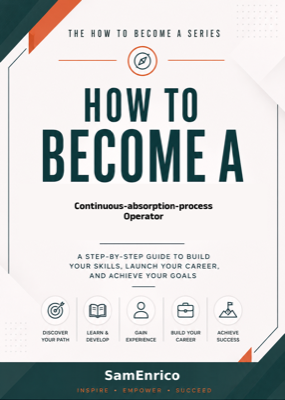
How to Become a Continuous-absorption-process Operator eBook
How to Become a Continuous-absorption-process Oper
How to Become a Continuous-absorption-process Operator
Formats
Free sample
Chapter 1: The Six-Figure Secret--–- The first time I walked into a continuous processing plant, I almost walked right back out. The noise hit me first—a low, omnipresent rumble that vibrated through the concrete floor and settled in my chest like a second heartbeat. Then came the smell: not of chemicals or danger, but of heat. Hot metal, hot oil, the subtle sweetness of steam escaping from a thousand tiny seams. Above me, a maze of pipes, ladders, and catwalks stretched toward a ceiling lost in shadow.
And in the center of it all, behind three-inch-thick glass, sat a man in a hard hat drinking coffee while twelve screens glowed with data I could not yet read.That man was Mike. Five years earlier, Mike had been driving a delivery truck for 22anhour,wonderinghowhewouldeveraffordadownpaymentonahouse.Today,hewasa Continuous−absorption−process Operatoratamid−sizedchemicalplantinthe Gulf Coast,pullingdown22 an hour, wondering how he would ever afford a down payment on a house. Today, he was a Continuous-absorption-process Operator at a mid-sized chemical plant in the Gulf Coast, pulling down 22anhour,wonderinghowhewouldeveraffordadownpaymentonahouse.Today,hewasa Continuous−absorption−process Operatoratamid−sizedchemicalplantinthe Gulf Coast,pullingdown128,000 base salary plus overtime that regularly pushed him past $150,000. He had no college degree. He had never written a line of code.
He had simply stumbled into a profession that almost no one talks about—and that is exactly why it pays so well.This book exists because of Mike, and because of the ten thousand Mikes who are going to retire in the next five years, leaving behind jobs that pay six figures and require no four-year degree. Jobs that most people have never heard of. Jobs that you can qualify for in ninety days if you know exactly what to study, what to say in an interview, and how to convince a plant manager that you are worth training.Let me be brutally honest with you from page one. This is not a chemistry textbook disguised as a career guide. You do not need to understand molecular orbital theory or calculate adiabatic flame temperatures to do this job.
What you need is a specific set of practical skills—monitoring gauges, following procedures, staying calm when alarms go off, noticing when something sounds different than it did yesterday—and a willingness to work in an environment where mistakes can cost millions of dollars or, in the worst case, lives.The money is real. The job security is real. The barrier to entry is lower than you think. But the catch is that no one is going to find you. You have to find this profession.
You have to know what to search for, what to study, and how to present yourself. That is what this book provides: a map to a destination you did not even know existed.So let us start at the beginning. What exactly is a Continuous-absorption-process Operator? Why does this job exist? And why, in an era of automation and artificial intelligence, are plants desperate to hire humans for this role?The Job That Has No Single Name If you search job boards for "Continuous-absorption-process Operator," you will find surprisingly few results.
But if you search for "Chemical Process Operator," "Plant Operator," "Unit Operator," "Refinery Operator," or "Control Room Technician," you will find thousands. The continuous absorption process is a specific type of operation within a much larger family of industrial processes. Think of it this way: "cardiologist" is a specific job, but you will find more jobs searching for "doctor." Similarly, "continuous-absorption-process operator" is a specialty within the broader world of process operations.So why focus on absorption specifically? Two reasons.First, absorption is everywhere. If you have ever used activated carbon to filter water, you have performed absorption.
If you have ever scrubbed a smell out of a room using baking soda, you have performed absorption. In industry, absorption removes hydrogen sulfide from natural gas so that your stove burns clean. It removes color from sugar so that your coffee looks white instead of brown. It captures valuable solvents from exhaust streams before they escape into the atmosphere. Absorption is the quiet workhorse of the chemical, petrochemical, food, and pharmaceutical industries.
Learn absorption, and you can work in any of them.Second, mastering absorption unlocks every other process. Once you understand how to control temperature, pressure, and flow in an absorption column, you understand 80 percent of what you need to operate distillation columns, reactors, and dryers. The skills transfer. The knowledge compounds. Start with absorption, and you can move anywhere.Batch Versus Continuous: Why the Difference Matters To understand what a continuous-absorption-process operator does, you first need to understand the distinction between batch processing and continuous processing.
This distinction shapes everything about the job: the pace, the stress level, the skills required, and the paycheck.Batch processing is what most people imagine when they think of manufacturing. You start with raw materials. You load them into a vessel. You cook them, mix them, react them, or separate them for a specific amount of time. Then you empty the vessel, clean it, and start over.
Think of baking bread: you mix the dough, let it rise, bake it, and then you have a batch of bread. The oven sits idle while you prepare the next batch. Every batch is slightly different because every batch depends on the skill of the baker that day.Continuous processing is entirely different. Raw materials flow into the system at one end, and finished product flows out the other end, twenty-four hours per day, seven days per week, three hundred sixty-five days per year. The only stops are for scheduled maintenance—typically two weeks in the spring and two weeks in the fall.
The rest of the time, the plant runs. It runs on Christmas morning. It runs at three AM. It runs through thunderstorms and heat waves and power flickers. Your job as an operator is to keep it running, to keep product quality within specification, and to do it all without damaging equipment or injuring yourself or your coworkers.The difference in mindset is profound.
A batch operator has a beginning, a middle, and an end to every cycle. There is a natural pause to reset, to check quality, to make adjustments. A continuous operator has no pause. The process is always happening. A problem that goes unnoticed for thirty minutes does not just ruin one batch—it ruins hours or days of production.
The pressure is constant. The vigilance must be relentless. And that is exactly why continuous process operators are paid more than batch operators.What Does Absorption Actually Mean?Let us define our terms clearly. In industrial processing, absorption refers to the transfer of one substance (the solute) from a gas or liquid stream into a second substance (the absorbent) where it becomes trapped or dissolved. The absorbent is then separated, regenerated, or disposed of, leaving the original stream purified.There are two main types of absorption relevant to this book, and understanding the difference will help you recognize job opportunities across industries.Gas absorption occurs when a gas mixture passes through a liquid absorbent.
One component of the gas dissolves into the liquid, while the rest continues through. The classic example is removing hydrogen…
This is the end of the free sample. Get the eBook to keep going. Buy now
About this book
Details
- Author
- Lowell Jaymie
- Publisher
- SamEnrico
- Language
- English
- ISBN
- 9781505808391
- Genre
- Non-Fiction, Informative, Educational
- Released
- 2026-05-02
- Pages (approx.)
- 142
- Available as
- eBook, Paperback, Audiobook

Read better in the ZLOADR app
Your eBooks on your phone or tablet. Sign in with your SamEnrico account and start reading.
More by Lowell Jaymie
 Inclusive Language Cheat SheetLowell Jaymie$11.99
 Financial Literacy LegacyLowell Jaymie$11.99
 Celebrating Longevity MilestonesLowell Jaymie$11.99
 Walking Program for SeniorsLowell Jaymie$11.99
 The Postpartum Depression GuideLowell Jaymie$11.99
 The Serpent’s Gambit: How the Trickster Stole the World’s SecretsLowell Jaymie$11.99
 Web Authentication EngineerLowell Jaymie$11.99
 Nonprofit Climate InsuranceLowell Jaymie$12.99
 Estate Tax Payment PlansLowell Jaymie$12.99