
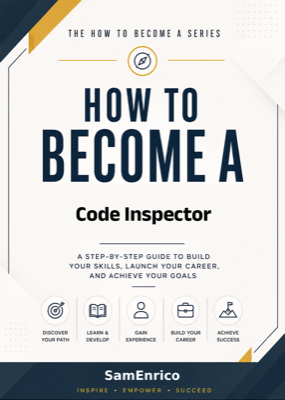
How to Become a Code Inspector Paperback
How to Become a Code Inspector
by Marcum Tula
How to Become a Code Inspector
Formats
Free sample
Chapter 1: The Body in the Rubble...--A single human life hangs on a nail—the right nail, driven to the right depth, into the right material, at the right spacing. Get any of those wrong, and the balcony fails. The railing gives way. The ceiling collapses. And someone, somewhere, never comes home.This is not hyperbole.
This is the quiet, invisible truth of building codes and the men and women who enforce them. The code inspector stands between a contractor's corner-cutting and a family's safety. Between a forgotten fire block and a house that becomes a chimney. Between undersized wire and an electrical fire that starts at 2:00 AM while children sleep.Most people never think about building codes until something falls, burns, or floods. By then, it is too late.
The inspector's job is to prevent the disaster before it has a name. And to do that, you must understand not just the rules written in thick books, but the history of blood that wrote them.The First Building Code Was Written in Blood Long before the International Code Council existed, before there were permits or plans examiners, there was Hammurabi. The Babylonian king, who reigned from 1792 to 1750 BCE, carved his legal code into a seven-foot diorite stele. Among the 282 laws were some of the earliest recorded building standards.Law 229 read: "If a builder builds a house for a man and does not make its construction firm, and the house which he has built collapses and causes the death of the owner of the house, that builder shall be put to death."Law 230 added: "If it causes the death of the son of the owner of the house, they shall put to death the son of that builder."The penalty for shoddy construction was not a fine or a license suspension. It was execution.
And if the owner's son died, the builder's son also died. This was not cruelty for its own sake. It was a recognition that buildings kill people, and someone must be accountable.Civilization has spent four thousand years learning that lesson over and over again. Each time, we forget. Each time, we learn again through disaster.The Great Fires That Built Modern America The 19th and early 20th centuries were brutal teachers.
Cities grew faster than the knowledge of how to build them safely. Wooden structures packed tightly together. Candles, kerosene lamps, and gaslights inside. No fire escapes. No sprinklers.
No compartmentalization.The Great Chicago Fire of 1871 is famous for the apocryphal story of Mrs. O'Leary's cow. What is less famous is that the fire killed approximately 300 people, destroyed over 17,000 buildings, and left 100,000 homeless. The city had no building code worth the name. Wooden sidewalks, wood shingle roofs, and wood-frame construction turned a small barn fire into an inferno that jumped the Chicago River.After the ashes cooled, Chicago adopted some of the first comprehensive building codes in the United States.
The lesson seemed learned.Then came the Iroquois Theatre fire of 1903 in Chicago—the same city, just 32 years later. The theatre was advertised as "absolutely fireproof." But fireproof only meant the structure itself would not burn. The curtains, scenery, and seats were not fireproof. Exit doors opened inward. Some were locked to prevent ticketless patrons from sneaking in.
Emergency lights did not exist. Fire extinguishers were empty.The fire started when a stage light shorted against a curtain. Within minutes, the auditorium filled with smoke and flames. Patrons rushed for exits that would not open. More than 600 people died, many trampled or suffocated.
The disaster led to nationwide reforms: outward-opening exit doors, panic bars, fire curtains, and mandatory emergency lighting.But blood continued to…
This is the end of the free sample. Get the Paperback to keep going. Buy now
About this book
Details
- Author
- Marcum Tula
- Publisher
- SamEnrico
- Language
- English
- ISBN
- 9781505802207
- Genre
- Non-Fiction, Informative, Educational
- Released
- 2026-06-02
- Pages (approx.)
- 142
- Available as
- eBook, Paperback, Audiobook

Read better in the ZLOADR app
Your eBooks on your phone or tablet. Sign in with your SamEnrico account and start reading.
More by Marcum Tula
 Burnout In Sales ProfessionalsMarcum Tula$11.99
 Senior Gardening Self Esteem GuideMarcum Tula$11.99
 Anger and Sexual Orientation ShiftMarcum Tula$11.99
 Speaker's Temperature DropMarcum Tula$11.99
 Breaking the Need for External ValidationMarcum Tula$11.99
 The Siege of Syracuse: Archimedes vs. the Romans (214-212 BC)Marcum Tula$11.99
 Proportional Data VisualizationMarcum Tula$12.99
 Healthcare Hospital Investment GuideMarcum Tula$12.99
 Understanding Lysosomal Glycogen Storage Disease With Normal ACID Maltase ActivityMarcum Tula$17.99
 Key Account ManagerMarcum Tula$11.99