
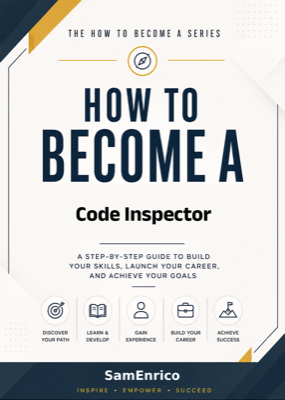
Non-FictionInformativeEducational
How to Become a Code Inspector eBook
How to Become a Code Inspector
by Marcum Tula
How to Become a Code Inspector
Formats
Free sample
Chapter 1: The Body in the Rubble...--A single human life hangs on a nail—the right nail, driven to the right depth, into the right material, at the right spacing. Get any of those wrong, and the balcony fails. The railing gives way. The ceiling collapses. And someone, somewhere, never comes home.This is not hyperbole.
This is the quiet, invisible truth of building codes and the men and women who enforce them. The code inspector stands between a contractor's corner-cutting and a family's safety. Between a forgotten fire block and a house that becomes a chimney. Between undersized wire and an electrical fire that starts at 2:00 AM while children sleep.Most people never think about building codes until something falls, burns, or floods. By then, it is too late.
The inspector's job is to prevent the disaster before it has a name. And to do that, you must understand not just the rules written in thick books, but the history of blood that wrote them.The First Building Code Was Written in Blood Long before the International Code Council existed, before there were permits or plans examiners, there was Hammurabi. The Babylonian king, who reigned from 1792 to 1750 BCE, carved his legal code into a seven-foot diorite stele. Among the 282 laws were some of the earliest recorded building standards.Law 229 read: "If a builder builds a house for a man and does not make its construction firm, and the house which he has built collapses and causes the death of the owner of the house, that builder shall be put to death."Law 230 added: "If it causes the death of the son of the owner of the house, they shall put to death the son of that builder."The penalty for shoddy construction was not a fine or a license suspension. It was execution.
And if the owner's son died, the builder's son also died. This was not cruelty for its own sake. It was a recognition that buildings kill people, and someone must be accountable.Civilization has spent four thousand years learning that lesson over and over again. Each time, we forget. Each time, we learn again through disaster.The Great Fires That Built Modern America The 19th and early 20th centuries were brutal teachers.
Cities grew faster than the knowledge of how to build them safely. Wooden structures packed tightly together. Candles, kerosene lamps, and gaslights inside. No fire escapes. No sprinklers.
No compartmentalization.The Great Chicago Fire of 1871 is famous for the apocryphal story of Mrs. O'Leary's cow. What is less famous is that the fire killed approximately 300 people, destroyed over 17,000 buildings, and left 100,000 homeless. The city had no building code worth the name. Wooden sidewalks, wood shingle roofs, and wood-frame construction turned a small barn fire into an inferno that jumped the Chicago River.After the ashes cooled, Chicago adopted some of the first comprehensive building codes in the United States.
The lesson seemed learned.Then came the Iroquois Theatre fire of 1903 in Chicago—the same city, just 32 years later. The theatre was advertised as "absolutely fireproof." But fireproof only meant the structure itself would not burn. The curtains, scenery, and seats were not fireproof. Exit doors opened inward. Some were locked to prevent ticketless patrons from sneaking in.
Emergency lights did not exist. Fire extinguishers were empty.The fire started when a stage light shorted against a curtain. Within minutes, the auditorium filled with smoke and flames. Patrons rushed for exits that would not open. More than 600 people died, many trampled or suffocated.
The disaster led to nationwide reforms: outward-opening exit doors, panic bars, fire curtains, and mandatory emergency lighting.But blood continued to spill.The Triangle Shirtwaist Factory fire of 1911 killed 146 garment workers, mostly young immigrant women. The factory occupied the eighth, ninth, and tenth floors of a building in Greenwich Village. The owners had locked the stairwell doors to prevent theft and unauthorized breaks. When fire broke out on the eighth floor, workers on the ninth floor had no way down. Some jumped from windows.
Others burned. The fire escape collapsed under their weight.That fire gave birth to modern fire codes, sprinkler requirements, and labor laws. It also gave us a question that every inspector should ask themselves daily: Who is locked in right now, and does anyone care?The San Francisco Earthquake: The Other Teacher On April 18, 1906, a 7.9 magnitude earthquake struck San Francisco. The shaking itself destroyed thousands of buildings. But the fire that followed—ignited by ruptured gas lines and overturned stoves—burned for four days.
An estimated 3,000 people died. Over 80% of the city was destroyed.The tragedy revealed something horrifying: unreinforced masonry buildings collapse like houses of cards when shaken. Brick walls have no tensile strength. They crumble. They fall outward.
They kill people on sidewalks. And when they fall, they block streets, preventing fire engines from reaching other buildings.The lesson was clear: buildings need steel reinforcement. They need flexible connections. They need foundations that move with the earth rather than fight it. California began developing seismic codes that would eventually spread to every earthquake-prone region in the world.But here is the haunting part.
In 2011, a 6.3 magnitude earthquake struck Christchurch, New Zealand. The city had modern seismic codes. But many older buildings had not been retrofitted. One hundred eighty-five people died. The same lesson, a century later, unlearned and relearned.The code inspector is not a historian.
But you must understand that every rule you enforce was written because someone died. Every exception you deny is a potential disaster averted. Every correction notice you write is a small act of prevention against a history of forgetting.The Legal Framework: Who Makes the Rules?Today, building codes in the United States are not federal law. They are not created by Congress or signed by the President. Instead, they are developed by a private non-profit organization: the International Code Council (ICC).The ICC publishes a family of codes every three years.
The most important are:International Building Code (IBC): For commercial buildings, multi-family residential (apartments, condos over three stories), and all structures not covered by the residential code.International Residential Code (IRC): For one- and two-family dwellings and townhouses up to three stories. This is the code you will use most often if you work in residential inspection.International Existing Building Code (IEBC): For renovations, additions, and changes of use in existing structures. Different rules apply when you are not building from scratch.International Fire Code (IFC): For fire prevention, suppression systems, access roads, and hazardous materials storage.International Mechanical Code (IMC): For heating, ventilation, and air conditioning systems.International Plumbing Code (IPC): For sanitary drainage, venting, and water supply.International Energy Conservation Code (IECC): For insulation, windows, air sealing, and HVAC efficiency.There are others: the National Electrical Code (NEC) is published by the National Fire Protection Association (NFPA), not the ICC, but is adopted alongside ICC codes in most jurisdictions.Here is the crucial point: None of these codes become law until a state or local government adopts them. Your city council votes to adopt the 2021 IBC with local amendments. The state legislature adopts the NEC with modifications.
The county commission adopts the IRC but removes the appendix for accessory dwelling units.This means the code is different in…
This is the end of the free sample. Get the eBook to keep going. Buy now
About this book
Details
- Author
- Marcum Tula
- Publisher
- SamEnrico
- Language
- English
- ISBN
- 9781505802207
- Genre
- Non-Fiction, Informative, Educational
- Released
- 2026-06-02
- Pages (approx.)
- 142
- Available as
- eBook, Paperback, Audiobook

Read better in the ZLOADR app
Your eBooks on your phone or tablet. Sign in with your SamEnrico account and start reading.
More by Marcum Tula
 Burnout In Sales ProfessionalsMarcum Tula$11.99
 Senior Gardening Self Esteem GuideMarcum Tula$11.99
 Anger and Sexual Orientation ShiftMarcum Tula$11.99
 Speaker's Temperature DropMarcum Tula$11.99
 Breaking the Need for External ValidationMarcum Tula$11.99
 The Siege of Syracuse: Archimedes vs. the Romans (214-212 BC)Marcum Tula$11.99
 Proportional Data VisualizationMarcum Tula$12.99
 Healthcare Hospital Investment GuideMarcum Tula$12.99
 Understanding Lysosomal Glycogen Storage Disease With Normal ACID Maltase ActivityMarcum Tula$17.99
 Key Account ManagerMarcum Tula$11.99
You may also like
 Hong Kong Handover 1997Dunn Johnnie$11.99
 Zumba For Postnatal Recovery CourseNeal Christian$11.99
 Zumba for BeginnersLadner Nikia$11.99
 YouTube Comment Mining GuideHumes Pandora$12.99
 Worry Box MeditationCarlin Rudy$11.99
 Workplace Stress MeditationNguyen Lynn$11.99
 Workplace Stress and Sleep RepairHawley Ivory$11.99
 Workplace Perfectionism CureDelaney Jeffry$11.99
 Workplace Injustice Anger GuideWallen Isabelle$11.99
 Work Addiction and Burnout LinkGreenwood Ester$11.99
 Women in Yoga and WellnessBeattie Galina$11.99
 Women in Stand Up ComedyChun Evangeline$11.99