
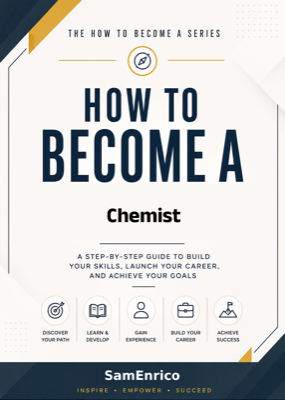
How to Become a Chemist eBook
How to Become a Chemist
How to Become a Chemist
Formats
Free sample
Chapter 1: The Invisible Engine...--–- Most people go their entire lives without ever seeing the moment chemistry reaches out and touches them. They wake up to the smell of coffee—a volatile bouquet of over eight hundred aromatic compounds, each one the product of precise thermal decomposition during roasting. They brush their teeth with fluoride, which works by replacing hydroxyl groups in tooth enamel to form a more acid-resistant mineral called fluorapatite. They flip on a light switch, sending electrons through copper wires into a lithium-ion battery whose layered metal oxides were engineered at the atomic scale. They step into a car, where a catalytic converter transforms nitrogen oxides into harmless nitrogen and oxygen using platinum, palladium, and rhodium—metals so precious that thieves frequently saw them off from underneath vehicles.
They swallow a pill whose shape was designed to fit a specific protein receptor like a key into a lock, a concept chemists call stereospecific binding.Not once, on any ordinary morning, does the average person stop and think: chemistry did all of this.This book exists because you are not that person. You are someone who looks at the foam on a latte and wonders about surface tension and colloidal dispersions. You are someone who sees rust on a bicycle and thinks about oxidation states and electron transfer. You are someone who has caught a glimpse of the invisible engine that drives the universe—and you want to learn how to build, repair, and improve that engine for a living.Becoming a chemist is not about memorizing the periodic table or learning to balance equations, though you will do both. Becoming a chemist is about learning to see the world differently.
It is about developing the ability to look at a glass of water and perceive trillions upon trillions of molecules in constant motion, hydrogen-bonding networks forming and breaking in femtoseconds, dissolved ions carrying charges, and entropy driving everything toward equilibrium. It is about understanding that the chair you are sitting on is mostly empty space—atomic nuclei surrounded by electron clouds—yet feels solid because of electromagnetic repulsion. It is about recognizing that the boundary between alive and not alive is, at its core, a chemical distinction involving complex organic molecules capable of self-replication.This chapter will answer a question that most career guides never bother to ask: Why chemistry? Not "why is chemistry important" in some abstract, textbook sense, but why should you—with your specific curiosities, fears, and aspirations—devote your life to this discipline? We will dismantle the stereotypes that keep talented people away from the lab.
We will explore the five major branches of chemistry and show you how each one offers a different way of thinking about problems. We will reveal why chemistry is called "the central science" and how that centrality translates into career flexibility, job security, and intellectual satisfaction. And we will begin the process of transforming you from someone who is curious about chemistry into someone who is beginning to think like a chemist.The Stereotype and the Reality Let us start by naming the elephant in the laboratory. When most people picture a chemist, they conjure an image from movies or television: a wild-eyed figure in a stained white coat, hunched over a table of bubbling, brightly colored liquids, cackling maniacally as something explodes in the background. Alternatively, they imagine a sterile, soulless environment—row after row of identical fume hoods, workers in full hazmat gear measuring powders into vials with robotic precision, a place where creativity goes to die.Neither image could be further from the truth.The real chemistry laboratory is not a place of chaos.
It is a place of controlled reaction—the art of setting conditions so precise that molecules do exactly what you predict. The best chemists are not mad scientists; they are disciplined, methodical, and deeply respectful of the materials they handle. They are also profoundly creative. Designing a synthesis—a sequence of chemical reactions that transforms a simple starting material into a complex target molecule—requires spatial reasoning, strategic planning, and the kind of lateral thinking you might associate with chess or architecture.Consider the synthesis of a cancer drug called paclitaxel (Taxol). When scientists first discovered that this molecule, found in the bark of the Pacific yew tree, could shrink tumors, they faced an immediate problem: it took six trees—each over a century old—to produce a single gram of the drug.
Harvesting enough bark to treat all the patients who needed it would have destroyed the species. So chemists did what chemists do. They figured out how to build the molecule from scratch.The total synthesis of paclitaxel took more than a decade to perfect. It required forty separate chemical reactions, each one designed and optimized to work in sequence without interfering with the others. The final synthesis involved controlling the stereochemistry at eleven different chiral centers—atoms where the three-dimensional arrangement of bonds matters enormously, because the wrong arrangement produces a molecule that does nothing (or worse, causes toxicity).
Today, paclitaxel is synthesized in commercial quantities and has saved countless lives. That is not the work of a mad scientist. That is the work of a master builder.So the first stereotype to discard is the notion that chemistry is about chaos or memorization. It is about design, prediction, and control.The second stereotype to discard is that chemistry is "too hard" or "only for geniuses." This belief keeps more talented people out of the field than any other single factor. And it is a lie, though it is a seductive one.
Chemistry is challenging, no doubt. It requires you to think across multiple scales—from the subatomic to the macroscopic—and to integrate concepts from physics, biology, and mathematics. But difficulty is not the same as impossibility. Tens of thousands of people earn chemistry degrees every year. Most of them are not prodigies.
They are ordinary people who showed up, did the work, asked for help when they got stuck, and refused to let the hard parts defeat them.The single greatest predictor of success in chemistry is not IQ. It is grit—the willingness to watch a reaction fail for the fifth time, troubleshoot what went wrong, adjust a variable, and try again. As one Nobel laureate put it, "An experiment that works the first time is either trivial or lucky. The real learning happens when it doesn't work."What Chemists Actually Do All Day If you asked a hundred working chemists to describe a typical day, you would get a hundred different answers. But certain patterns emerge.The analytical chemist spends her morning preparing samples—dissolving them in solvents, filtering out particulates, diluting them to precise concentrations.
She loads the samples into an instrument called a high-performance liquid chromatograph (HPLC), which separates mixtures into their individual components by exploiting differences in how strongly each component sticks to a solid column versus dissolving in a flowing liquid. She spends the afternoon analyzing the resulting data, looking for peaks that indicate the presence of a target compound. She is not trying to discover anything new; she is trying to measure something with extreme accuracy. Is…
This is the end of the free sample. Get the eBook to keep going. Buy now
About this book
Details
- Author
- Leone Sherley
- Publisher
- SamEnrico
- Language
- English
- ISBN
- 9781505795646
- Genre
- Non-Fiction, Informative, Educational
- Released
- 2026-05-02
- Pages (approx.)
- 159
- Available as
- eBook, Paperback, Audiobook

Read better in the ZLOADR app
Your eBooks on your phone or tablet. Sign in with your SamEnrico account and start reading.
More by Leone Sherley
 Anger And Child OCD SymptomsLeone Sherley$11.99
 Task Switching Cost ReductionLeone Sherley$11.99
 Cultural Anger Trigger GuideLeone Sherley$11.99
 Internal Comms Scaling GuideLeone Sherley$11.99
 Gilgamesh's Shadow: The Untold Mentor of the Wild ManLeone Sherley$11.99
 The Silk Road's Shadow: How a Tech Whiz Cracked the Dark Web's Drug EmpireLeone Sherley$11.99
 Residential SurveyorLeone Sherley$11.99
 Climate Policy And Advocacy HandbookLeone Sherley$12.99
 Synthetic Identity Fraud DetectionLeone Sherley$12.99
 Understanding Hyperlipoproteinemia Type VLeone Sherley$17.99