
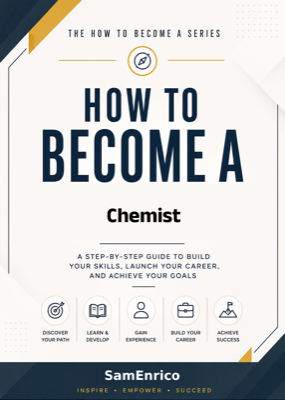
How to Become a Chemist Audiobook
How to Become a Chemist
How to Become a Chemist
Formats
Free sample
Chapter 1: The Invisible Engine...--–- Most people go their entire lives without ever seeing the moment chemistry reaches out and touches them. They wake up to the smell of coffee—a volatile bouquet of over eight hundred aromatic compounds, each one the product of precise thermal decomposition during roasting. They brush their teeth with fluoride, which works by replacing hydroxyl groups in tooth enamel to form a more acid-resistant mineral called fluorapatite. They flip on a light switch, sending electrons through copper wires into a lithium-ion battery whose layered metal oxides were engineered at the atomic scale. They step into a car, where a catalytic converter transforms nitrogen oxides into harmless nitrogen and oxygen using platinum, palladium, and rhodium—metals so precious that thieves frequently saw them off from underneath vehicles.
They swallow a pill whose shape was designed to fit a specific protein receptor like a key into a lock, a concept chemists call stereospecific binding.Not once, on any ordinary morning, does the average person stop and think: chemistry did all of this.This book exists because you are not that person. You are someone who looks at the foam on a latte and wonders about surface tension and colloidal dispersions. You are someone who sees rust on a bicycle and thinks about oxidation states and electron transfer. You are someone who has caught a glimpse of the invisible engine that drives the universe—and you want to learn how to build, repair, and improve that engine for a living.Becoming a chemist is not about memorizing the periodic table or learning to balance equations, though you will do both. Becoming a chemist is about learning to see the world differently.
It is about developing the ability to look at a glass of water and perceive trillions upon trillions of molecules in constant motion, hydrogen-bonding networks forming and breaking in femtoseconds, dissolved ions carrying charges, and entropy driving everything toward equilibrium. It is about understanding that the chair you are sitting on is mostly empty space—atomic nuclei surrounded by electron clouds—yet feels solid because of electromagnetic repulsion. It is about recognizing that the boundary between alive and not alive is, at its core, a chemical distinction involving complex organic molecules capable of self-replication.This chapter will answer a question that most career guides never bother to ask: Why chemistry? Not "why is chemistry important" in some abstract, textbook…
This is the end of the free sample. Get the Audiobook to keep going. Buy now
About this book
Details
- Author
- Leone Sherley
- Publisher
- SamEnrico
- Language
- English
- ISBN
- 9781505795646
- Genre
- Non-Fiction, Informative, Educational
- Released
- 2026-05-02
- Pages (approx.)
- 159
- Available as
- eBook, Paperback, Audiobook

Listen in the VoxFlicks app
Audiobooks and audio dramas wherever you go. Sign in with your SamEnrico account and press play.
More by Leone Sherley
 Anger And Child OCD SymptomsLeone Sherley$11.99
 Task Switching Cost ReductionLeone Sherley$11.99
 Cultural Anger Trigger GuideLeone Sherley$11.99
 Internal Comms Scaling GuideLeone Sherley$11.99
 Gilgamesh's Shadow: The Untold Mentor of the Wild ManLeone Sherley$11.99
 The Silk Road's Shadow: How a Tech Whiz Cracked the Dark Web's Drug EmpireLeone Sherley$11.99
 Residential SurveyorLeone Sherley$11.99
 Climate Policy And Advocacy HandbookLeone Sherley$12.99
 Synthetic Identity Fraud DetectionLeone Sherley$12.99
 Understanding Hyperlipoproteinemia Type VLeone Sherley$17.99