
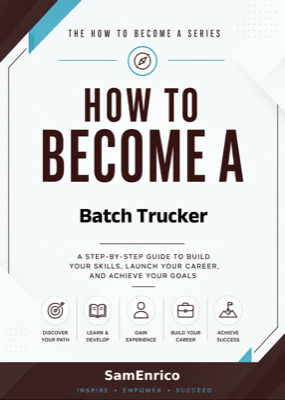
Non-FictionInformativeEducational
How to Become a Batch Trucker eBook
How to Become a Batch Trucker
How to Become a Batch Trucker
Formats
Free sample
Chapter 1: The Concrete Millionaire--The richest man I ever met drove a truck covered in dried gray mud.His name was Pete. I met him at a concrete batch plant outside Phoenix, Arizona, on a morning when the temperature was already ninety-eight degrees at six a.m. Pete was sixty-two years old, lean as a fence post, with forearms like twisted rope and eyes that had squinted through a decade of desert sun. His mixer truck was a 2007 Mack Granite with three hundred thousand miles on the odometer, peeling paint, and a cracked windshield held together with duct tape on the inside. By any external measure, Pete looked like a working-class guy who had barely scraped by.When he retired six months later, he sold his house for cash, bought an RV, and started driving around the country visiting national parks.
His pension from the Teamsters paid him 4,200permonth.His401(k)had4,200 per month. His 401(k) had 4,200permonth.His401(k)had890,000 in it. His Social Security would add another $2,100 per month starting at sixty-five. Pete was a millionaire. He just never looked like one.“You want to know the secret?” Pete asked me, leaning against his mud-caked truck.
“The secret is that nobody wants this job. Everyone wants to sit in an air-conditioned office and push papers. They want to be managers. They want to be ‘content creators.’ They want a title that sounds impressive at a cocktail party. But a concrete truck?
That’s beneath them. So the money just sits there, waiting for the few people smart enough to reach out and take it.”That conversation changed how I think about work. It also planted the seed for this book.Pete was not lucky. He was not born rich. He did not have a college degree or family connections.
He simply found a trade that most people ignore, mastered it, and collected the paycheck that everyone else left on the table. This chapter—and this entire book—will show you how to do the same thing.The Million-Dollar Misunderstanding Let me start with a question. When you hear the word “trucker,” what image comes to mind?For most people, the answer is a long-haul driver: someone who spends weeks away from home, sleeps in a sleeper cab, eats at truck stops, and struggles with loneliness, poor health, and strained family relationships. That image is not entirely wrong—for long-haul trucking, that is often the reality. But that image is also completely irrelevant to batch trucking.A batch trucker is not a long-haul driver.
You will not sleep in your truck. You will not eat at Pilot or Love’s except on rare occasions. You will not be away from your family for weeks at a time. You will drive local routes, return to the plant at the end of your shift, and sleep in your own bed every single night.This misunderstanding is the single biggest reason that batch trucking pays so well. Most people assume that all trucking jobs are the same.
They hear “CDL driver” and think “long-haul misery.” So they never investigate concrete mixing, never apply to a batch plant, and never discover the local, home-every-night, six-figure career that has been sitting there the whole time.The concrete industry has a marketing problem. It has never figured out how to tell young workers that batch trucking is different from long-haul trucking. The result is a perpetual labor shortage, which means wages stay high for the people who do show up. Simple supply and demand: fewer applicants mean higher pay for those who apply.What Exactly Is a Batch Trucker?Let me give you a precise definition before we go any further.A batch trucker is a professional who operates a concrete mixer truck—also called an agitator truck or ready-mix truck—and understands the process of concrete batching. Batching is the measurement and mixing of raw materials—cement, sand, stone, water, and chemical admixtures—to create a specific concrete recipe that meets customer requirements for strength, workability, and setting time.SIDEBAR: "Batching" Defined Once and for All Throughout this book, you will see the word “batching.” It simply means measuring and mixing concrete ingredients according to a recipe.
A “batch” is one load of concrete, typically eight to twelve cubic yards, weighing sixteen to twenty-four tons. A batch trucker is someone who can both batch concrete and drive the truck.Here is what makes batch trucking different from every other CDL job.First, you are not just transporting a product. You are participating in a chemical reaction. Concrete begins to harden the moment water touches cement. That reaction generates heat, changes the material’s consistency, and creates a time limit.
You have approximately ninety minutes from the moment you add water until the concrete becomes unworkable—less time in hot weather, more time in cold weather. You are not a delivery driver; you are a chemist racing a clock.Second, you are responsible for quality control. If the concrete arrives at the job site too dry (low slump), you need to know whether you can add water and how much. If it arrives too wet (high slump), you need to know whether the customer can use it or whether you must reject the load and return to the plant. These decisions require knowledge, not just experience.Third, you are a customer service professional.
You will unload concrete directly into forms while construction crews watch. Sometimes the foreman will be happy to see you. Sometimes he will be angry, exhausted, and looking for someone to blame. Your job is to pour the concrete, leave the site clean, and not make anything worse. That requires emotional self-control that most jobs never demand.SIDEBAR: Small Plant vs.
Large Plant – The Hybrid Reality In smaller concrete plants (one to five trucks), the batch trucker truly does both jobs. You will operate the batching software, fill the hoppers, mix the concrete, drive the truck, and pour at the job site. In larger metropolitan plants (twenty or more trucks), a dedicated plant batcher handles the software, and you focus on driving, pouring, and customer interaction. The book teaches both sides because understanding batching makes you a better driver regardless of plant size.The Numbers That Matter Let me give you the numbers that matter most. I will put them right up front so there is no confusion.Starting wages for batch truckers with a Class B CDL and no concrete experience range from 45,000to45,000 to 45,000to60,000 per year.
This is what you will earn while you learn. Most concrete companies will pay for your ACI certification and loader ticket during this period. You are not expected to know everything on day one.Experienced batch truckers with two to four years in the industry earn 65,000to65,000 to 65,000to90,000 per year. At this level, you can batch without supervision, handle difficult job sites, and train new drivers. You qualify for the best shifts—early morning pours that finish by early afternoon.Top earners with five or more years of experience exceed 100,000annually.How?Overtime,nightpours,andunionpremiums.Abatchtruckerworkingfiftyhoursperweekatthirty−twodollarsperhourearns100,000 annually.
How? Overtime, night pours, and union premiums. A batch trucker working fifty hours per week at thirty-two dollars per hour…
This is the end of the free sample. Get the eBook to keep going. Buy now
About this book
Details
- Author
- Blanco Tashina
- Publisher
- SamEnrico
- Language
- English
- ISBN
- 9781505776553
- Genre
- Non-Fiction, Informative, Educational
- Released
- 2026-05-11
- Pages (approx.)
- 125
- Available as
- eBook, Paperback, Audiobook

Read better in the ZLOADR app
Your eBooks on your phone or tablet. Sign in with your SamEnrico account and start reading.
More by Blanco Tashina
 Metta for Inner ChildBlanco Tashina$11.99
 Occupation Duty Japan 1945Blanco Tashina$11.99
 Seminole Black Maroon CommunityBlanco Tashina$11.99
 Buffett's Retail Annual MeetingsBlanco Tashina$11.99
 When the Sky Split Open: The Mayan Birth of the WorldBlanco Tashina$11.99
 Collecting LunchboxesBlanco Tashina$11.99
 Franchise Advisory CouncilBlanco Tashina$12.99
 How to Produce Bows and CrossbowsBlanco Tashina$11.99
You may also like
 Hong Kong Handover 1997Dunn Johnnie$11.99
 Zumba For Postnatal Recovery CourseNeal Christian$11.99
 Zumba for BeginnersLadner Nikia$11.99
 YouTube Comment Mining GuideHumes Pandora$12.99
 Worry Box MeditationCarlin Rudy$11.99
 Workplace Stress MeditationNguyen Lynn$11.99
 Workplace Stress and Sleep RepairHawley Ivory$11.99
 Workplace Perfectionism CureDelaney Jeffry$11.99
 Workplace Injustice Anger GuideWallen Isabelle$11.99
 Work Addiction and Burnout LinkGreenwood Ester$11.99
 Women in Yoga and WellnessBeattie Galina$11.99
 Women in Stand Up ComedyChun Evangeline$11.99