
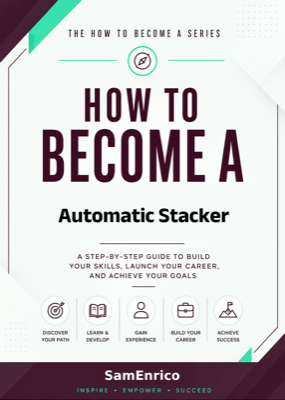
Non-FictionInformativeEducational
How to Become a Automatic Stacker eBook
How to Become a Automatic Stacker
How to Become a Automatic Stacker
Formats
Free sample
Chapter 1: The Effort Trap...--–- The warehouse was loud, hot, and smelled of cardboard dust and ambition. At 6:45 AM, James pulled on his gloves for the tenth time that week. He was twenty-three years old, strong, and determined to prove himself. By 7:00 AM, the conveyor belt began its relentless march. Boxes arrived in a steady gray stream—each one weighing between twelve and forty pounds, each one requiring placement on a pallet that would eventually reach eight feet high.
James attacked the stack like a boxer attacking a heavy bag. He grabbed, lifted, turned, placed, and pressed. Grab, lift, turn, place, press. His muscles burned. His breathing quickened.
Sweat beaded on his forehead within fifteen minutes. By 9:00 AM, he had stacked three hundred and ten boxes. His supervisor nodded approvingly. James felt proud. He was working hard.
He was earning his pay.Twenty feet away, Mia worked the same belt with a completely different body. She stood with her feet shoulder-width apart, her spine neutral, her shoulders relaxed. She did not attack the stack. She seemed to barely touch it. Her hands moved in small, precise arcs.
Her eyes never left the target zone. Every few seconds, a box left the belt and appeared on her pallet as if by magic. She did not grunt. She did not rush. She did not sweat.
At 9:00 AM, her count read four hundred and twenty-seven boxes. One hundred and seventeen more than James. With visible ease.James noticed her numbers at lunch. He said nothing, but something shifted inside him. He had been taught his entire life that hard work was the answer.
His father had told him, “Nobody ever went broke working hard.” His coaches had told him, “Effort beats talent when talent doesn't work hard.” His first warehouse trainer had said, “Just keep moving, kid. Speed comes from trying harder.” But here was Mia, who seemed to be trying less, producing more. Not a little more. A lot more.James asked her, finally, “How do you do that?”Mia looked up, mid-bite of her sandwich. “Do what?”“Stack that fast.”She chewed, swallowed, and said something that would haunt James for the next six months.
“I don't stack fast. I barely stack at all. The stack builds itself. I just get out of the way.”James didn't understand those words at first. He thought she was being modest, or cryptic, or withholding some secret technique she had learned in a special training program.
But over the following weeks, watching her from across the warehouse, he began to see what she meant. She wasn't moving faster than him. She was moving less. Her hands traveled shorter distances. Her corrections were smaller.
Her pauses were shorter. Her mistakes were rarer. And at the end of every shift, her numbers were higher. Not by a little. By a lot.This chapter is about why James was wrong—and why you might be wrong, too.
It is about the most fundamental error that almost every stacker makes, from warehouses to kitchens to data centers to assembly lines. The error is this: believing that more effort produces more output. It sounds obvious. It sounds like physics. But it is not true.
Not in stacking. Not in any repetitive physical task. And the sooner you unlearn this belief, the sooner you will stop being a hard worker and start becoming an Automatic Stacker.The Law of Diminishing Returns in Manual Effort Let us begin with a simple fact that economics students learn in their first semester but warehouse workers rarely hear: the law of diminishing returns. In its classic form, it states that adding more of one input—say, labor or effort—while holding other inputs constant will eventually produce smaller and smaller increases in output. Beyond a certain point, additional effort actually reduces output.In stacking, this looks like a bell curve.
On the left side of the curve, at very low effort, output is low because you are moving slowly. As you increase effort, output rises. Your speed increases. Your placement accuracy improves. You feel productive.
This is the zone where most stackers live. They believe that if a little effort is good, more effort is better. So they try harder. They grip tighter. They move faster.
They push through fatigue.But then something happens. The curve peaks. And after that peak, something strange and terrible occurs: more effort produces less output.Why does this happen? Because stacking is not a pure strength activity. It is a coordination activity.
It requires precision, timing, spatial awareness, and rhythm. Effort—especially muscular tension, hurried motion, and forced speed—destroys all of those things. When you grip a box too tightly, your wrist locks, and you cannot make micro-adjustments during placement. When you move faster than your visual system can process, you misjudge gaps and create crooked stacks. When you push through fatigue, your decision latency increases, and you start second-guessing every placement.
The result is a cascade of errors: crooked boxes that require adjustment, collapsed stacks that require rebuilding, and wasted motion that multiplies with every repetition.The warehouse champions—the true Automatic Stackers—operate on the left side of the curve's peak. They have discovered that less effort, intelligently applied, produces more output. They are not lazy. They are efficient. They have removed the waste that makes most stackers work hard.Strategic Stacking Versus Busy Stacking To understand this distinction, we need two new terms.
The first is busy stacking. Busy stacking is what James did. It is frantic, high-effort, low-output activity. It feels productive because it feels exhausting. Your heart rate is elevated.
Your muscles are engaged. You are moving constantly. But when you measure the results—stable stacks per hour, errors per stack, recovery time per interruption—busy stacking underperforms. Busy stacking is the enemy disguised as a friend. It gives you the emotional reward of effort without the actual reward of output.The second term is strategic stacking.
Strategic stacking is what Mia did. It is calm, low-effort, high-output activity. It feels almost lazy because it feels easy. Your heart rate stays moderate. Your muscles stay relaxed.
You move only when necessary, and only as much as necessary. But when you measure the results, strategic stacking outperforms by significant margins—often thirty to fifty percent higher output with half the perceived effort.The difference between these two approaches is not attitude. It is not willpower. It is not talent. It is system.
Strategic stacking is not a personality trait; it is a set of observable, learnable behaviors. Mia was not born with a magical ability to stack effortlessly. She had learned, through trial and error and coaching, a system that eliminated waste before it could slow her down. James, by contrast, was relying on the only strategy he knew: try harder.Here is the painful truth that this chapter asks you to accept: trying harder is almost never the answer. If you are already working hard and your numbers are not where you want them to be, more effort will not help you.
It will hurt you. You need a different approach. You need a system.The Unified Waste Framework Before we can eliminate…
This is the end of the free sample. Get the eBook to keep going. Buy now
About this book
Details
- Author
- Tejada Floretta
- Publisher
- SamEnrico
- Language
- English
- ISBN
- 9781505786293
- Genre
- Non-Fiction, Informative, Educational
- Released
- 2026-05-07
- Pages (approx.)
- 153
- Available as
- eBook, Paperback, Audiobook

Read better in the ZLOADR app
Your eBooks on your phone or tablet. Sign in with your SamEnrico account and start reading.
More by Tejada Floretta
 Pelvic Pain MindfulnessTejada Floretta$11.99
 Order Solar Temple Transits To Sirius GuideTejada Floretta$11.99
 Free Creator Link Management StackTejada Floretta$11.99
 LBO Model Quality Control GuideTejada Floretta$11.99
 Mindfulness for Tinnitus ReliefTejada Floretta$11.99
 The Phantom Trader: How a Rogue Analyst Cracked the Code on Wall StreetTejada Floretta$11.99
 The Day the Internet Broke: How a Single Bug Crashed the Digital WorldTejada Floretta$11.99
 Supply Chain ESG ComparisonTejada Floretta$12.99
 Russian University Dubai GuideTejada Floretta$12.99
 Understanding Cerebellar Ataxia Infantile With Progressive External OphthalmoplegiaTejada Floretta$17.99
 Analytics And Optimization ManagerTejada Floretta$11.99
You may also like
 Hong Kong Handover 1997Dunn Johnnie$11.99
 Zumba For Postnatal Recovery CourseNeal Christian$11.99
 Zumba for BeginnersLadner Nikia$11.99
 YouTube Comment Mining GuideHumes Pandora$12.99
 Worry Box MeditationCarlin Rudy$11.99
 Workplace Stress MeditationNguyen Lynn$11.99
 Workplace Stress and Sleep RepairHawley Ivory$11.99
 Workplace Perfectionism CureDelaney Jeffry$11.99
 Workplace Injustice Anger GuideWallen Isabelle$11.99
 Work Addiction and Burnout LinkGreenwood Ester$11.99
 Women in Yoga and WellnessBeattie Galina$11.99
 Women in Stand Up ComedyChun Evangeline$11.99