
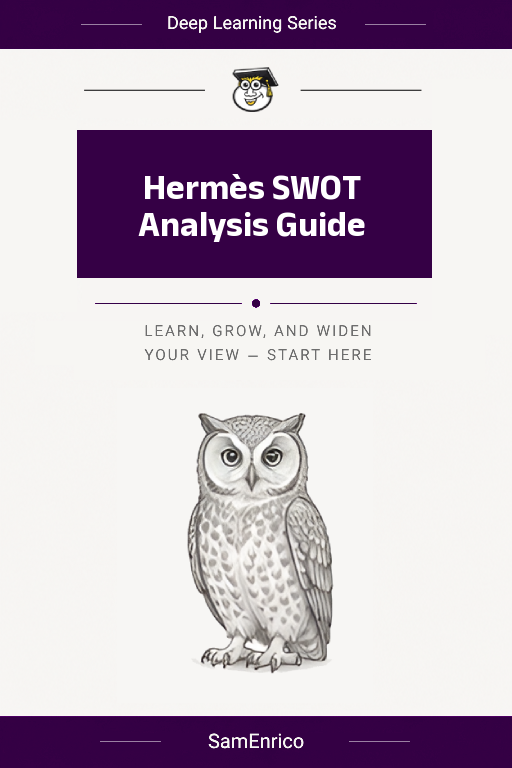
Non-FictionStrategic AtlasLuxury
Hermès SWOT Analysis Guide eBook
Assess exclusivity strategy, Birkin demand, produc
Assess exclusivity strategy, Birkin demand, production constraints, and brand power maintenance costs.
Formats
Free sample
Chapter 1: The Scarcity Engine--The most valuable product Hermès has ever manufactured is not a handbag. It is not a silk scarf, a cashmere coat, or a diamond-studded watch. The most valuable product Hermès has ever manufactured is the willingness to wait.This is the central paradox that defies every rule of modern business. In an era defined by Amazon Prime same-day delivery, Netflix autoplay, and the instant gratification of a smartphone tap-to-buy, Hermès has built a sixty-billion-dollar empire by doing the opposite of what every business school teaches. It deliberately produces less than customers demand.
It refuses to sell its most iconic products online. It ignores quarterly earnings pressure. It rejects volume growth as a measure of success. And year after year, it generates operating margins that would make a tech company envious.The Hermès paradox is simple to state but difficult to internalize: scarcity is not a byproduct of production limits. Scarcity is the core product.This chapter introduces the foundational framework that will guide the entire book—the "Scarcity Engine" and the "Four Costs of Staying at the Top." Understanding how Hermès transforms deliberate constraint into pricing power is the prerequisite for every subsequent chapter on strengths, weaknesses, opportunities, and threats.
Without this foundation, the rest of the analysis collapses into a collection of interesting but disconnected facts about leather sourcing and French apprenticeship laws.The Hermès Paradox: Thriving by Rejecting Modern Business Logic Let us begin with a simple comparison. In 2024, Hermès reported revenues of approximately fourteen billion euros. That is a substantial number, but it pales in comparison to LVMH's eighty-six billion euros or Kering's nineteen billion euros. By revenue, Hermès is not the largest luxury conglomerate. By market capitalization, however, Hermès trades at a valuation that regularly surpasses companies with four times its revenue.
Investors are not paying for what Hermès sells today. They are paying for the durability of the scarcity model.What makes this particularly remarkable is that Hermès achieves these valuations while violating nearly every tenet of modern management theory.Consider e-commerce. For most luxury brands, direct-to-consumer online sales are the fastest-growing channel. Gucci, Louis Vuitton, and Prada have all invested heavily in digital storefronts, same-day delivery in select cities, and seamless online-to-offline integration. Hermès does sell some products online—scarves, fragrances, home goods, and entry-level jewelry—but it refuses to sell its core leather goods, including the Birkin and Kelly bags, through its website.
To buy a Birkin, you must visit a physical store, establish a relationship with a sales associate, and demonstrate loyalty over time. This is not a technological limitation. It is a deliberate friction designed to slow down the transaction.Consider quarterly earnings. Publicly traded companies face enormous pressure to report consistent growth every three months. Miss a quarter, and the stock market punishes you.
Hermès operates under the same public company structure, yet management has repeatedly sacrificed short-term revenue for long-term brand integrity. In the early 2000s, when demand for Birkins exploded, the company could have doubled production almost overnight. It had the workshop space, the leather supply chain, and the waiting list to justify expansion. Instead, management capped annual production increases at five to seven percent, leaving billions of euros on the table. Shareholders did not revolt.
The stock price continued climbing because investors understood that the scarcity was the product.Consider marketing. The average luxury brand spends twelve to fifteen percent of revenue on advertising, celebrity endorsements, and influencer partnerships. Hermès spends four to six percent. It does not have celebrity brand ambassadors. It does not buy Super Bowl commercials.
It does not pay Tik Tok influencers to unbox their latest purchases. Instead, it invests in craftsmanship documentaries, atelier tours, and museum exhibitions. It lets silence generate hype. And it works precisely because the absence of marketing becomes its own form of marketing—a signal that the brand does not need to beg for attention.The Winning Pattern: Deliberate Constraint as Strategy What unites these three examples—e-commerce refusal, production caps, and anti-marketing—is a concept this book calls the "Winning Pattern." The term is deliberately provocative because it inverts the conventional understanding of winning. In most industries, winning means capturing market share, expanding distribution, and lowering costs through economies of scale.
In Hermès' world, winning means doing the opposite: constraining market share, limiting distribution, and accepting higher per-unit costs to preserve artisanal quality.The Winning Pattern has five core components that will reappear throughout this book:First, artificial scarcity. Hermès does not have to constrain production. It has the capital to build new workshops, hire more artisans, and shorten waiting lists. It chooses not to because scarcity creates desire. The moment a Birkin becomes easy to buy, it stops being a Birkin.Second, friction as feature.
Most companies measure success by how quickly a customer can complete a transaction. One-click purchasing, free returns, and chatbots are designed to remove friction. Hermès adds friction deliberately. You cannot buy a Birkin online. You cannot call a customer service hotline and order one.
You cannot walk into any store and leave with one. Every obstacle is a filter that separates serious collectors from casual shoppers.Third, price inelasticity. Normal luxury goods face demand elasticity: raise the price too high, and customers defect to competitors. Hermès has tested the limits of price inelasticity repeatedly. Between 2010 and 2024, the entry price for a Birkin increased by over one hundred fifty percent, yet waiting lists grew longer.
The bag functions less like a consumer good and more like an asset whose value increases with price.Fourth, vertical integration. Unlike competitors who outsource production to low-cost countries, Hermès owns its entire supply chain. It operates its own tanneries, trains its own artisans through in-house apprenticeship programs, and controls the distribution from workshop to boutique. This vertical integration is expensive and slow, but it prevents any external actor from diluting the brand's standards.Fifth, time as moat. The final component is the most difficult to replicate.
A competitor can buy better leather, hire better designers, and open nicer stores. But no competitor can buy twenty years of training culture. Hermès' master artisans have been teaching the saddle-stitch technique for generations. That institutional knowledge cannot be accelerated. It can only be accumulated over time.These five components form an interlocking system.
Artificial scarcity creates price inelasticity. Friction filters out casual buyers. Vertical integration ensures quality at every step. And time prevents competitors from copying the model. Remove any one component, and the system weakens.
Keep them all intact, and the system reinforces itself year after year.Scarcity as Core Product: Why Waiting Lists Generate Value The most counterintuitive insight in the entire Hermès strategy is that the waiting list is not a bug—it is a feature. In fact, the waiting list is arguably the most important product Hermès sells.Consider the psychology of a waiting list. When you sign up for a Birkin, you are told that delivery may take months or years. There is no guaranteed date. There is no tracking number.
There is no customer service portal where you can check your place in line. You simply wait. And during that…
This is the end of the free sample. Get the eBook to keep going. Buy now
About this book
Details
- Author
- Shifflett Gracie
- Publisher
- SamEnrico
- Language
- English
- Genre
- Non-Fiction, Strategic Atlas, Luxury
- Released
- 2026-06-01
- Pages (approx.)
- 150
- Available as
- eBook, Audiobook

Read better in the ZLOADR app
Your eBooks on your phone or tablet. Sign in with your SamEnrico account and start reading.
More by Shifflett Gracie
 Equifax's Cloud Migration LessonShifflett Gracie$11.99
 TM Experiences During First Week CourseShifflett Gracie$11.99
 The Daily Gratitude JournalShifflett Gracie$11.99
 Self Esteem for Stay at Home ParentsShifflett Gracie$11.99
 Leadership Self Talk GuideShifflett Gracie$11.99
 Love in the Ruins: The Architects of Wartime JapanShifflett Gracie$11.99
 How to Become a Sports-equipment RepairerShifflett Gracie$11.99
 Mandarin for the Modern TravelerShifflett Gracie$11.99
 Understanding Mycetoma[disambiguation Needed]Shifflett Gracie$17.99
 AI Financial Data RetentionShifflett Gracie$12.99
You may also like
 Hong Kong Handover 1997Dunn Johnnie$11.99
 Zumba For Postnatal Recovery CourseNeal Christian$11.99
 Zumba for BeginnersLadner Nikia$11.99
 YouTube Comment Mining GuideHumes Pandora$12.99
 Worry Box MeditationCarlin Rudy$11.99
 Workplace Stress MeditationNguyen Lynn$11.99
 Workplace Stress and Sleep RepairHawley Ivory$11.99
 Workplace Perfectionism CureDelaney Jeffry$11.99
 Workplace Injustice Anger GuideWallen Isabelle$11.99
 Work Addiction and Burnout LinkGreenwood Ester$11.99
 Women in Yoga and WellnessBeattie Galina$11.99
 Women in Stand Up ComedyChun Evangeline$11.99