
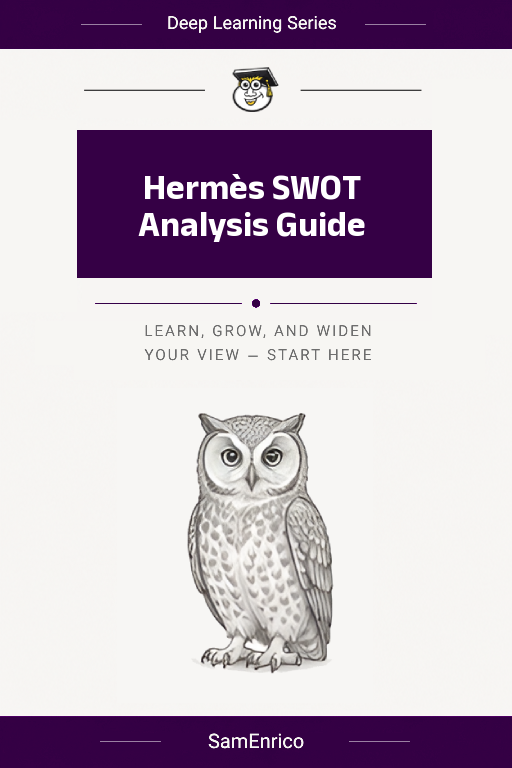
Non-FictionStrategic AtlasLuxury
Hermès SWOT Analysis Guide Audiobook
Assess exclusivity strategy, Birkin demand, produc
Assess exclusivity strategy, Birkin demand, production constraints, and brand power maintenance costs.
Formats
Free sample
Chapter 1: The Scarcity Engine--The most valuable product Hermès has ever manufactured is not a handbag. It is not a silk scarf, a cashmere coat, or a diamond-studded watch. The most valuable product Hermès has ever manufactured is the willingness to wait.This is the central paradox that defies every rule of modern business. In an era defined by Amazon Prime same-day delivery, Netflix autoplay, and the instant gratification of a smartphone tap-to-buy, Hermès has built a sixty-billion-dollar empire by doing the opposite of what every business school teaches. It deliberately produces less than customers demand.
It refuses to sell its most iconic products online. It ignores quarterly earnings pressure. It rejects volume growth as a measure of success. And year after year, it generates operating margins that would make a tech company envious.The Hermès paradox is simple to state but difficult to internalize: scarcity is not a byproduct of production limits. Scarcity is the core product.This chapter introduces the foundational framework that will guide the entire book—the "Scarcity Engine" and the "Four Costs of Staying at the Top." Understanding how Hermès transforms deliberate constraint into pricing power is the prerequisite for every subsequent chapter on strengths, weaknesses, opportunities, and threats.
Without this foundation, the rest of the analysis collapses into a collection of interesting but disconnected facts about leather sourcing and French apprenticeship laws.The Hermès Paradox: Thriving by Rejecting Modern Business Logic Let us begin with a simple comparison. In 2024, Hermès reported revenues of approximately fourteen billion euros. That is a substantial number, but it pales in comparison to LVMH's eighty-six billion euros or Kering's nineteen billion euros. By revenue, Hermès is not the largest luxury conglomerate. By market capitalization, however, Hermès trades at a valuation that regularly surpasses companies with four times its revenue.
Investors are not paying for what Hermès sells today. They are paying for the durability of the scarcity model.What makes this particularly remarkable is that Hermès achieves these valuations while violating nearly every tenet of modern management theory.Consider e-commerce. For most luxury brands, direct-to-consumer online sales are the fastest-growing channel. Gucci, Louis Vuitton, and Prada have all invested heavily in digital storefronts, same-day delivery in select cities, and seamless online-to-offline integration. Hermès does sell some products online—scarves, fragrances, home goods, and entry-level jewelry—but it refuses to sell its core leather goods, including…
This is the end of the free sample. Get the Audiobook to keep going. Buy now
About this book
Details
- Author
- Shifflett Gracie
- Publisher
- SamEnrico
- Language
- English
- Genre
- Non-Fiction, Strategic Atlas, Luxury
- Released
- 2026-06-01
- Pages (approx.)
- 150
- Available as
- eBook, Audiobook

Listen in the VoxFlicks app
Audiobooks and audio dramas wherever you go. Sign in with your SamEnrico account and press play.
More by Shifflett Gracie
 Equifax's Cloud Migration LessonShifflett Gracie$11.99
 TM Experiences During First Week CourseShifflett Gracie$11.99
 The Daily Gratitude JournalShifflett Gracie$11.99
 Self Esteem for Stay at Home ParentsShifflett Gracie$11.99
 Leadership Self Talk GuideShifflett Gracie$11.99
 Love in the Ruins: The Architects of Wartime JapanShifflett Gracie$11.99
 How to Become a Sports-equipment RepairerShifflett Gracie$11.99
 Mandarin for the Modern TravelerShifflett Gracie$11.99
 Understanding Mycetoma[disambiguation Needed]Shifflett Gracie$17.99
 AI Financial Data RetentionShifflett Gracie$12.99
You may also like
 Hong Kong Handover 1997Dunn Johnnie$11.99
 Zumba For Postnatal Recovery CourseNeal Christian$11.99
 Zumba for BeginnersLadner Nikia$11.99
 YouTube Comment Mining GuideHumes Pandora$12.99
 Worry Box MeditationCarlin Rudy$11.99
 Workplace Stress MeditationNguyen Lynn$11.99
 Workplace Stress and Sleep RepairHawley Ivory$11.99
 Workplace Perfectionism CureDelaney Jeffry$11.99
 Workplace Injustice Anger GuideWallen Isabelle$11.99
 Work Addiction and Burnout LinkGreenwood Ester$11.99
 Women in Yoga and WellnessBeattie Galina$11.99
 Women in Stand Up ComedyChun Evangeline$11.99