
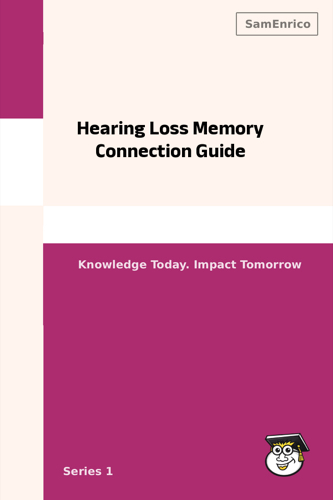
Hearing Loss Memory Connection Guide eBook
Treat hearing loss to reduce cognitive load and pr
Treat hearing loss to reduce cognitive load and prevent accelerated memory decline in seniors.
Formats
Free sample
Chapter 1: The Denial Trap...--–- Every three seconds, somewhere in the world, a brain begins to forget. A name slips away. A familiar street becomes unfamiliar. A grandchild's face loses its context. By the time you finish reading this paragraph, another person has joined the ranks of the fifty-five million people living with dementia globally.
But here is the truth that most doctors do not tell you, that most families discover too late, and that this entire book exists to reverse: one-third of those cases could have been delayed, or even prevented, by addressing a single, treatable condition that you have probably been ignoring for years.That condition is not a mystery gene. It is not an inevitable consequence of growing old. It is not Alzheimer's disease itself. It is hearing loss—and your denial about it is not protecting your ego. It is accelerating the destruction of your memory.The Epidemic We Pretend Does Not Exist Let us begin with a number: forty-eight million.
That is how many adults in the United States have some degree of hearing loss. To put that in perspective, that is more than the entire population of California, Texas, and Florida combined. Among adults over the age of seventy, two out of every three have clinically significant hearing loss. Walk into any senior center, any church social hall, any family Thanksgiving dinner, and two-thirds of the people in the room are struggling to hear—and most of them are pretending otherwise.This is not a niche problem. It is not a minor inconvenience.
Hearing loss is the most common sensory deficit in the aging population, and it is also the most neglected. The average person waits seven to ten years from the moment they first notice difficulty hearing to the moment they seek treatment. Seven to ten years of straining, of nodding along to conversations they cannot follow, of laughing at jokes they did not hear, of gradually retreating from the dinner table to the solitude of a quiet room.Why? Because we have been taught that hearing loss is a benign, almost laughable part of getting older. It is the old person shouting "What?" at the television.
It is the comedic trope of the grandfather who cannot hear the punchline. We treat hearing loss as a mild annoyance, a quirk of aging, a joke rather than a crisis.But here is what the joke conceals: untreated hearing loss is the single largest modifiable risk factor for dementia, according to the 2020 and 2024 Lancet Commissions on dementia prevention. Of all the lifestyle factors you can change—diet, exercise, smoking, social engagement—treating hearing loss has the greatest potential to reduce your cognitive decline. It outranks hypertension, obesity, and depression. It is not just about hearing better.
It is about remembering longer.The Myth of "Just Dealing With It"Let me introduce you to a man I will call Robert. Robert is seventy-four years old, a retired civil engineer, a former runner, a man who prided himself on his sharp mind and independent living. For about six years before he walked into my colleague's clinic, Robert had been "dealing with it." His wife had started repeating herself. His grandchildren complained that the television was too loud. He had stopped going to his weekly poker game because, in his words, "those guys mumble."Robert's solution was not a hearing test.
It was not hearing aids. It was a set of coping strategies that he believed made him resilient. He sat at the head of the dinner table so sound traveled toward him. He avoided restaurants with carpeting (too much echo, he said). He smiled and nodded through conversations he could not follow.
He told himself that everyone his age had the same problem and that he was handling it better than most.What Robert did not know was that his "coping strategies" were actually accelerating his cognitive decline. Every dinner party where he smiled and nodded while understanding half the conversation was a dinner party where his brain was scrambling, exhausting its resources, and stealing from his memory bank just to survive the moment. Every poker game he skipped was a missed opportunity for the social stimulation that keeps the aging brain healthy. Every time he blamed his wife for mumbling, he was not protecting his dignity—he was reinforcing his denial.When Robert finally took a hearing test, the results were unambiguous: moderate to severe sensorineural hearing loss, meaning his inner ear had sustained damage that could not be reversed medically but could be treated effectively with amplification. He walked out of the clinic that day with a pair of behind-the-ear hearing aids, grumbling about the cost and the hassle.Six months later, his wife called the clinic to thank the staff.
"I have my husband back," she said. "He's not exhausted after dinner anymore. He went back to his poker game. Last week, he corrected me on something I said three days earlier—and he never used to remember anything from one day to the next."Robert's story is not unusual. It is the rule.
The question is not whether hearing treatment helps—the evidence is overwhelming that it does. The question is why so many people wait so long to seek it. The answer is denial. And denial, as you will learn in this chapter, is not a harmless coping mechanism. It is the primary accelerant of memory loss.The Numbers That Demand Your Attention Let me put the risk in stark, numerical terms.
A landmark longitudinal study from Johns Hopkins University, led by Dr. Frank Lin, followed nearly two thousand older adults over a period of up to eighteen years. The researchers controlled for age, sex, education, and other health conditions. What they found was a dose-response relationship that should alarm every person over the age of fifty.Compared to older adults with normal hearing, those with mild hearing loss had approximately double the risk of developing dementia. Those with moderate hearing loss had triple the risk.
And those with severe hearing loss had five times the risk—a 500% increase in the likelihood of cognitive decline.Let those numbers land. Double. Triple. Five times. You are not just at risk of forgetting where you put your keys.
You are at risk of forgetting what keys are for.The study was not small. It was not ambiguous. It controlled for every major confounder: cardiovascular disease, diabetes, smoking, socioeconomic status, and baseline cognitive function. The association between hearing loss and dementia remained strong, persistent, and linear. The worse your hearing, the faster your brain declined.Since that study was published, the results have been replicated in multiple cohorts across the world—in Australia, in Europe, in South Korea.
The consistency is remarkable. Regardless of culture, regardless of healthcare system, regardless of genetics, untreated hearing loss predicts accelerated cognitive decline.But correlation is not causation, as every introductory statistics student learns. The question that haunted researchers for years was whether hearing loss actually caused dementia or whether both conditions were simply symptoms of a third, underlying process—perhaps a common genetic vulnerability or a shared inflammatory pathway.The answer, now supported by longitudinal data and randomized trials, is…
This is the end of the free sample. Get the eBook to keep going. Buy now
About this book
Details
- Author
- Furman Garnet
- Publisher
- SamEnrico
- Language
- English
- Genre
- Non-Fiction, Self-Help, Audiology
- Released
- 2026-06-07
- Pages (approx.)
- 139
- Available as
- eBook, Audiobook

Read better in the ZLOADR app
Your eBooks on your phone or tablet. Sign in with your SamEnrico account and start reading.
More by Furman Garnet
 Rain on Roof GuideFurman Garnet$11.99
 Exercise Based Alcohol RecoveryFurman Garnet$11.99
 Forgiveness for Childhood BullyingFurman Garnet$11.99
 Body Scan for Anxiety Relief GuideFurman Garnet$11.99
 Breaking the Barrier: How Hip-Hop Conquered the PacificFurman Garnet$11.99
 Understanding Non-small Cell Lung CancerFurman Garnet$17.99
 Parker Hannifin SWOTFurman Garnet$12.99
 College Essay Sandbox ModeFurman Garnet$12.99
 How to Become a Centrifugal-casting-machine Operator IiFurman Garnet$11.99
 Risk Assessment AnalystFurman Garnet$11.99
You may also like
 Hong Kong Handover 1997Dunn Johnnie$11.99
 Zumba For Postnatal Recovery CourseNeal Christian$11.99
 Zumba for BeginnersLadner Nikia$11.99
 YouTube Comment Mining GuideHumes Pandora$12.99
 Worry Box MeditationCarlin Rudy$11.99
 Workplace Stress MeditationNguyen Lynn$11.99
 Workplace Stress and Sleep RepairHawley Ivory$11.99
 Workplace Perfectionism CureDelaney Jeffry$11.99
 Workplace Injustice Anger GuideWallen Isabelle$11.99
 Work Addiction and Burnout LinkGreenwood Ester$11.99
 Women in Yoga and WellnessBeattie Galina$11.99
 Women in Stand Up ComedyChun Evangeline$11.99