
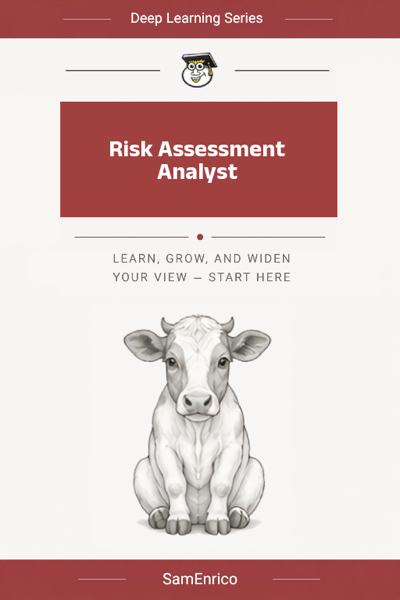
Non-FictionInformativeEducational
Risk Assessment Analyst
A Coursebook on Risk Assessment Analyst
A Coursebook on Risk Assessment Analyst
Formats
About this book
Free sample
Chapter 1: The Day Probability Saved Lives...--– In the predawn darkness of April 13, 1970, three astronauts drifted 200,000 miles from Earth inside a crippled spacecraft. An oxygen tank had exploded two days earlier, and with it, any reasonable hope of return. The world watched as mission control in Houston faced an impossible question: What are the chances that a untested, improvised repair procedure works on the first try? And what are the consequences of getting it wrong?The engineers did not pray. They did not guess.
They ran the numbers.Using nothing but slide rules, fragmented telemetry, and a deep understanding of probability, they calculated likelihoods for every failure mode, mapped consequences for every decision path, and ultimately gave Commander Jim Lovell a burn time accurate to within seconds. Apollo 13 returned safely not because of luck, but because a team of risk analysts asked—and answered—the three questions that form the bedrock of this book: What can go wrong? How likely is it? And what are the consequences?This is not a book about statistics. It is a book about thinking clearly under uncertainty.
Whether you are an aspiring risk analyst, a project manager juggling deadlines, a safety professional guarding against catastrophe, or an executive staring down a strategic gamble, the frameworks in these pages will transform how you see the world. You will learn to see hazards where others see routine. You will learn to quantify the unquantifiable. And you will learn to communicate risk so that people actually listen.But first, you must unlearn something.The Ancient Problem That Refuses to Die For most of human history, we did not analyze risk. We consulted oracles, read animal entrails, and trusted gut feelings.
The ancient Greeks had the Oracle of Delphi. The Romans interpreted the flight patterns of birds. Medieval merchants relied on superstition and insurance rates set by intuition rather than data. This approach worked—or at least, it did not fail catastrophically often enough to force a change—because the world moved slowly. Information traveled at the speed of a horse.
Supply chains were local. Disasters unfolded over weeks, not minutes.That world is dead.Today, a software vulnerability discovered in Singapore can…
This is the end of the free sample. Get the eBook to keep going. Buy now
Contents
- Chapter 1
- Chapter 2
- Chapter 3
- Chapter 4
- Chapter 5
- Chapter 6
- Chapter 7
- Chapter 8
- Chapter 9
- Chapter 10
- Chapter 11
- Chapter 12
Details
- Author
- Furman Garnet
- Publisher
- SamEnrico
- Language
- English
- Genre
- Non-Fiction, Informative, Educational
- Released
- 2026-05-04
- Pages (approx.)
- 150
- Available as
- eBook, Audiobook

Read better in the ZLOADR app
Your eBooks on your phone or tablet. Sign in with your SamEnrico account and start reading.
More by Furman Garnet
 Rain on Roof GuideFurman Garnet$11.99
 Exercise Based Alcohol RecoveryFurman Garnet$11.99
 Hearing Loss Memory Connection GuideFurman Garnet$11.99
 Forgiveness for Childhood BullyingFurman Garnet$11.99
 Body Scan for Anxiety Relief GuideFurman Garnet$11.99
 Breaking the Barrier: How Hip-Hop Conquered the PacificFurman Garnet$11.99
 Understanding Non-small Cell Lung CancerFurman Garnet$17.99
 Parker Hannifin SWOTFurman Garnet$12.99
 College Essay Sandbox ModeFurman Garnet$12.99
 How to Become a Centrifugal-casting-machine Operator IiFurman Garnet$11.99
You may also like
 Hong Kong Handover 1997Dunn Johnnie$11.99
 Zumba For Postnatal Recovery CourseNeal Christian$11.99
 Zumba for BeginnersLadner Nikia$11.99
 YouTube Comment Mining GuideHumes Pandora$12.99
 Worry Box MeditationCarlin Rudy$11.99
 Workplace Stress MeditationNguyen Lynn$11.99
 Workplace Stress and Sleep RepairHawley Ivory$11.99
 Workplace Perfectionism CureDelaney Jeffry$11.99
 Workplace Injustice Anger GuideWallen Isabelle$11.99
 Work Addiction and Burnout LinkGreenwood Ester$11.99
 Women in Yoga and WellnessBeattie Galina$11.99
 Women in Stand Up ComedyChun Evangeline$11.99