
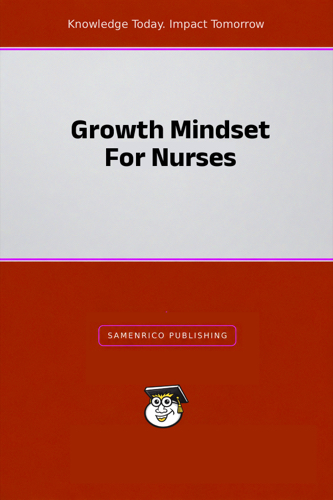
Growth Mindset For Nurses eBook
Continues learning new medical protocols and skill
by Hwang Connie
Continues learning new medical protocols and skills.
Formats
Free sample
Chapter 1: The Knife of Knowing--–- The call light blinked for the third time. Sharon, a critical care nurse with nineteen years of experience, stood frozen in the supply room. In her hand was a new hydrogel dressing for a stage 4 pressure injury. Her other hand hovered over a bottle of traditional wet-to-dry saline gauze—the protocol she had used successfully for nearly two decades. Her patient’s wound was deteriorating.
The new evidence-based protocol had been posted on the unit bulletin board three weeks ago. She had skimmed it. She had nodded at the in-service. But now, with the wound exposed and the patient watching, Sharon realized she could not remember the exact steps for the new biofilm management technique. She could feel the charge nurse’s eyes from the desk.
She could hear the patient’s labored breathing. And in that moment, Sharon made a choice that would haunt her for the rest of the shift: she reached for the old gauze. Not because she believed it was better. Because she was afraid to look like she didn’t know what she was doing.This is the knife of knowing. It cuts both ways.
On one edge, experience gives you confidence, pattern recognition, and the muscle memory of thousands of clinical decisions. On the other edge, that same experience can become a prison—a fixed identity that makes you resistant to new evidence, fearful of temporary incompetence, and desperate to protect the title of “expert.” Sharon was not a bad nurse. She was not lazy or uncaring. She was trapped in what psychologist Carol Dweck calls a fixed mindset: the belief that your abilities are static, that struggling with a new skill means you lack fundamental talent, and that asking for help is a public confession of failure.This book exists because the landscape of nursing has changed forever. Twenty years ago, a nurse could learn a set of protocols in orientation and use them for a decade with only minor adjustments.
Today, medical knowledge doubles every seventy-three days. New infusion pumps arrive every eighteen months. Electronic health records update quarterly. Wound care guidelines shift with every major pressure injury conference. The nurse who graduated five years ago is already practicing in a different world.
The nurse who graduated twenty years ago is practicing in a different universe. The question is not whether you will need to learn new protocols. The question is whether you will learn them with curiosity or with dread, with openness or with resistance, with a growth mindset or a fixed one.The Paradox of the Expert Let us name the central contradiction of modern nursing: the more you know, the harder it can become to learn something new. This is not a character flaw. It is a neurological and psychological reality.
When you have performed a skill thousands of times—starting IVs, programming a specific pump, assessing lung sounds in a particular sequence—your brain builds what neuroscientists call a thick myelin sheath around those neural pathways. The skill becomes automatic, effortless, unconscious. You can do it while holding a conversation, while managing a crisis, while charting with one hand. This automaticity is the gift of experience. But it is also the trap.When a new protocol arrives—a new IV insertion device, a different sedation scale, an updated sepsis bundle—your brain cannot simply overwrite the old pathway.
The old pathway is a superhighway. The new pathway is a dirt trail through the woods. To learn the new skill, you must deliberately slow down, attend to every step, tolerate clumsiness, and risk making errors that would never happen with the old method. This feels, to the experienced nurse, like regression. It feels like incompetence.
And the fixed mindset interprets that feeling as evidence: “See? I’m not good at this. I should just stick with what I know.”But the growth mindset offers a different interpretation. The feeling of awkwardness is not evidence of inability. It is evidence of neuroplasticity at work.
Your brain is literally rewiring itself. The discomfort is the price of admission to a new level of competence. The problem is that nursing culture has not made space for this discomfort. In fact, it has done the opposite.The Culture of Certainty Nursing is a high-stakes profession where errors can kill. That reality has produced a professional culture that punishes uncertainty, rewards immediate answers, and treats “I don’t know” as a dangerous admission rather than an honest beginning.
Consider your own unit. When a new protocol is announced, who speaks first? Often it is the most senior nurse, the one whose opinion carries weight, the one who has “seen it all.” And what do they say? Sometimes they say, “Let’s give it a try.” But just as often—and you have heard this—they say, “That’s not how we do it here,” or “Another flavor of the month,” or “If it ain’t broke, don’t fix it.” These are not neutral statements. They are fixed mindset declarations that shape the emotional temperature of the entire unit.New graduates absorb this climate immediately.
A new grad named Marcus, bright and eager, once told me about his first week on a medical-surgical floor. He had learned a new protocol for inserting nasogastric tubes using a stylet and a specific measurement technique. On his third day, a patient needed an NG tube. Marcus set up the equipment according to the new protocol. A veteran nurse walked by, glanced at his setup, and said, “Oh honey, we don’t do it that way here.
Let me show you the real way.” The veteran then demonstrated an older method that had been replaced by evidence two years prior. Marcus nodded, thanked her, and used the old method. He never asked about the discrepancy. He never looked up the evidence. He learned, in that moment, that fitting in was more important than being right.This is how fixed mindsets spread.
Not through malice. Through social survival. The nurse who asks a “stupid” question in shift report risks eye rolls and whispered comments. The nurse who admits they haven’t mastered a new protocol risks being seen as behind, slow, or incompetent. The nurse who fails a skills check-off faces not just remediation but shame.
So nurses hide. They nod at in-services and then practice the old way. They memorize answers for the annual competency exam and then return to the unit and do what they have always done. They protect their identity as “a good nurse” by avoiding any situation that might challenge that identity.Your Personal Trigger Points Before we go any further, I want you to pause and take a honest inventory. Not of your skills or your knowledge, but of your emotional reactions.
Think about the last time a new protocol was announced on your unit. What was your first internal response? Not the one you said out loud, but the one that flickered through your mind before you caught it. Did you think, “Finally, evidence has caught up with what I’ve been seeing”? Or did you think, “Great, another thing to learn when I’m already drowning”?…
This is the end of the free sample. Get the eBook to keep going. Buy now
About this book
Details
- Author
- Hwang Connie
- Publisher
- SamEnrico
- Language
- English
- Genre
- Non-Fiction, Self-Help, Nursing
- Released
- 2026-06-08
- Pages (approx.)
- 128
- Available as
- eBook, Audiobook

Read better in the ZLOADR app
Your eBooks on your phone or tablet. Sign in with your SamEnrico account and start reading.
More by Hwang Connie
 Collaborative Learning GuideHwang Connie$11.99
 Self Esteem for InternsHwang Connie$11.99
 Lateral Thinking for BusinessHwang Connie$11.99
 Gobi Desert NomadsHwang Connie$11.99
 The OKR for Engineering TeamsHwang Connie$11.99
 Outsourcing for House CleaningHwang Connie$11.99
 Mindfulness for Teens BeginnersHwang Connie$11.99
 When the World Was Carved from Bone: The Tezcatlipoca’s Cosmic VisionHwang Connie$11.99
 Blood and Ink: The Forgotten War of the QuillHwang Connie$11.99
 Squash: Summer & Winter SquashHwang Connie$11.99
 South Africa Business Credit Fast Track GuideHwang Connie$12.99
 Mailchimp Pop Up Form GuideHwang Connie$12.99
You may also like
 Hong Kong Handover 1997Dunn Johnnie$11.99
 Zumba For Postnatal Recovery CourseNeal Christian$11.99
 Zumba for BeginnersLadner Nikia$11.99
 YouTube Comment Mining GuideHumes Pandora$12.99
 Worry Box MeditationCarlin Rudy$11.99
 Workplace Stress MeditationNguyen Lynn$11.99
 Workplace Stress and Sleep RepairHawley Ivory$11.99
 Workplace Perfectionism CureDelaney Jeffry$11.99
 Workplace Injustice Anger GuideWallen Isabelle$11.99
 Work Addiction and Burnout LinkGreenwood Ester$11.99
 Women in Yoga and WellnessBeattie Galina$11.99
 Women in Stand Up ComedyChun Evangeline$11.99