
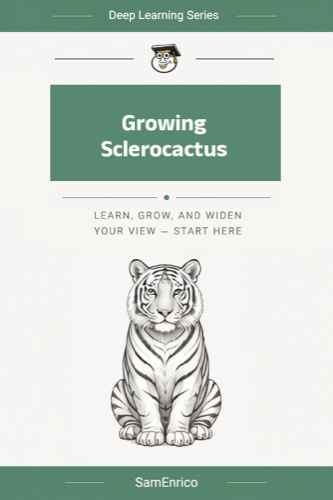
Non-FictionInformativeEducational
Growing Sclerocactus eBook
This publication, published by SamEnrico, covers G
This publication, published by SamEnrico, covers Growing Sclerocactus
Formats
Free sample
Chapter 1: The Spine’s Secret...--–- Most cactus lovers, even experienced ones, approach a Sclerocactus with a mixture of awe and dread. They see the dense, bone-white spines, the blood-red fishhooks that curve backward like talons, and the impossibly delicate pink or yellow blossoms that emerge from such a fortress. They know, vaguely, that these plants come from somewhere harsh—perhaps Utah, perhaps the Mojave—and that they are notoriously difficult to keep alive. But what they do not see, what the books on ordinary succulents never explain, is that the hooked central spine is not merely a weapon. It is a story.
It is an evolutionary memoir written in calcium carbonate, a record of survival in landscapes that would kill a human within days. And if you learn to read that story, you will understand why Sclerocactus cannot be grown like a Mammillaria, why it defies the logic of desert gardening, and why mastering it transforms a collector into a true steward of the arid earth.This chapter is not a watering guide or a soil recipe. Those will come. This chapter is about seeing the genus for what it truly is: a group of hyper-specialized geophytes that have spent millions of years negotiating a contract with stone, ice, and fire. To grow them, you must first respect them.
And to respect them, you must understand their anatomy, their taxonomy, and their precarious place in a world that is rapidly erasing their habitat.The Anatomy of a Survivor: Reading the Hooked Spine At first glance, the hooked central spine of a Sclerocactus looks like a cruelty of nature—a fishhook designed to snag anything that brushes against it. And indeed, it serves that purpose. Cattle, deer, and even careless hikers learn quickly to avoid these plants, which cling to clothing and skin with remarkable tenacity. But evolutionary biologists have uncovered a far more subtle function. In the wild, Sclerocactus seedlings almost never emerge in open ground.
They germinate under the protective canopy of a "nurse plant"—a shadscale (Atriplex), a sagebrush (Artemisia), or a rabbitbrush (Chrysothamnus). These shrubs provide shade, trap windblown organic matter, and moderate soil temperatures. But they also shift in the wind, their branches brushing against the young cactus. The hooked spine evolved to grapple onto these branches, anchoring the cactus to its nurse even as the shrub moves. Over time, as the cactus grows, the nurse plant may die, but the spines remain as a record of that early alliance.Furthermore, the hooked spine aids in a behavior unique to this genus: self-burial.
During extreme drought, Sclerocactus contracts its body downward, pulling itself into the soil using its taproot. The hooked spines act as tiny anchors, hooking onto gravel and root hairs to facilitate this descent. When rain returns, the plant re-expands. No other North American cactus performs this combination of grappling and retraction. Once you understand this, you realize that a Sclerocactus growing in a pot without a nurse plant, without a deep mineral substrate, and without seasonal drought is not a Sclerocactus at all.
It is a ghost.Taxonomy Made Simple: Distinguishing Sclerocactus from Its Impostors The literature on North American cacti is littered with misidentifications. For decades, Sclerocactus was lumped with Pediocactus, Ancistrocactus, and Echinomastus. Even today, reputable nurseries occasionally sell one for the other. This matters because each genus has different cultivation requirements. You can water an Echinomastus in summer.
You cannot water a Sclerocactus. You can repot a Pediocactus annually. A Sclerocactus may die from the shock.To distinguish Sclerocactus, use the following four-part key, adapted from the British Cactus & Succulent Society (BCSS) morphology database and verified against herbarium specimens at the Desert Botanical Garden.First, examine the central spine. In Sclerocactus, the primary central spine is always hooked at the tip. The hook is sharp, often reddish or dark brown, and curves through an arc of 90 to 180 degrees.
Pediocactus may have curved spines but never a true fishhook. Ancistrocactus has a hook, but the spines are generally thinner and more numerous. Echinomastus lacks a hook entirely.Second, look at the flower. Sclerocactus flowers are funnelform (shaped like a narrow trumpet), with petals that are fringed or dentate (toothed) at the margins. They emerge from the apex of the plant, often before the new spines have fully developed.
Flower colors range from deep magenta to pale yellow to pure white, but all share a distinctive central column of stamens that turns a deep burgundy red as the flower ages. Pediocactus flowers are larger relative to the body and lack the fringed petal margins.Third, examine the fruit. Sclerocactus produces a dry, indehiscent fruit—meaning it does not split open when ripe. The fruit remains attached to the plant for months, sometimes years, and is covered in woolly hairs and small scales. Inside, the seeds are black, reticulated (net-patterned), and remarkably hard.
Pediocactus and Echinomastus produce fleshy, dehiscent fruits that split open to reveal juicy pulp.Fourth, and most reliably for the grower without a flowering plant, examine the ribs and tubercles. Sclerocactus has ribs that are distinctly tuberculate (bumpy) but arranged in vertical or slightly spiraling rows. The areoles—those small, felt-like pads from which spines emerge—are elongated and produce a dense cluster of radial spines that lie flat against the body, with the hooked central spine protruding outward. In Pediocactus, the tubercles are more pronounced and confluent (merged together), giving the plant a cobblestoned appearance.If you have a plant that matches all four characteristics—hooked central spine, fringed funnelform flower, dry indehiscent fruit, and tuberculate ribs with elongated areoles—you have a true Sclerocactus. If one or more characteristics are missing, you are likely dealing with a look-alike that requires different care.The Allure of Contrast: Why We Chase the Most Difficult Cactus There is a reason, beyond botanical curiosity, that collectors pay premium prices for Sclerocactus seeds and spend years coaxing them to germination.
It is the same reason that mountaineers climb Everest and that sailors circumnavigate Cape Horn. The difficulty is the point. But in the case of Sclerocactus, there is also an aesthetic logic that borders on the sublime.Consider Sclerocactus polyancistrus, the Mojave mound. Its spines are not merely white; they are a chalky, bone-white that seems to glow under morning light. Overlaid on this are central spines of translucent red, like frozen blood.
The body of the plant, when healthy, is a deep blue-green, almost glaucous (covered in a waxy bloom that repels water). And then, in April or May, if you have provided the correct winter chill and spring watering, the apex erupts with flowers the color of flamingo feathers—a shocking, almost obscene pink against the monochrome spines. The contrast is not accidental. It is a signal to pollinators—native bees and small beetles—that says, "I am here, in this sea of stone and gravel, and I am worth the journey."Or consider Sclerocactus mesae-verdae, the Mesa Verde cactus. Its flowers are a creamy white with a faint greenish throat, and they open so briefly—sometimes only for a single afternoon—that missing them means waiting another year.
The plant itself is small, rarely exceeding two inches in diameter, and blends into the gypsum-rich soils of its native…
This is the end of the free sample. Get the eBook to keep going. Buy now
About this book
Details
- Author
- Hanna Herminia
- Publisher
- SamEnrico
- Language
- English
- Genre
- Non-Fiction, Informative, Educational
- Released
- 2026-05-07
- Pages (approx.)
- 127
- Available as
- eBook, Audiobook

Read better in the ZLOADR app
Your eBooks on your phone or tablet. Sign in with your SamEnrico account and start reading.
More by Hanna Herminia
 Team Creative Feedback CircleHanna Herminia$11.99
 Workplace Stress for ImmigrantsHanna Herminia$11.99
 Carson DDT CrusadeHanna Herminia$11.99
 Warm Outreach Validation GuideHanna Herminia$11.99
 Habit JournalHanna Herminia$11.99
 Terrorism Attack Dream WorkHanna Herminia$11.99
 Software Developer Crunch CultureHanna Herminia$11.99
 Bipolar Support Group Facilitation GuideHanna Herminia$11.99
 Vietnamese Green IncentivesHanna Herminia$11.99
 The Silent Banquet: A Royal Feast of BetrayalHanna Herminia$11.99
 Beneath the Glass: The Unseen Metropolis of Venice's Forgotten FoundationsHanna Herminia$11.99
 The Silent Betrayal: How a Whistleblower Exposed the World’s Largest Corporate Cover-UpHanna Herminia$11.99
You may also like
 Hong Kong Handover 1997Dunn Johnnie$11.99
 Zumba For Postnatal Recovery CourseNeal Christian$11.99
 Zumba for BeginnersLadner Nikia$11.99
 YouTube Comment Mining GuideHumes Pandora$12.99
 Worry Box MeditationCarlin Rudy$11.99
 Workplace Stress MeditationNguyen Lynn$11.99
 Workplace Stress and Sleep RepairHawley Ivory$11.99
 Workplace Perfectionism CureDelaney Jeffry$11.99
 Workplace Injustice Anger GuideWallen Isabelle$11.99
 Work Addiction and Burnout LinkGreenwood Ester$11.99
 Women in Yoga and WellnessBeattie Galina$11.99
 Women in Stand Up ComedyChun Evangeline$11.99