
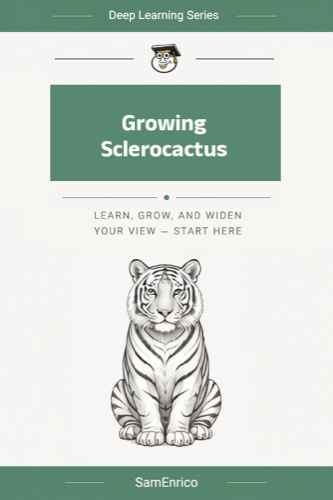
Non-FictionInformativeEducational
Growing Sclerocactus
This publication, published by SamEnrico, covers G
This publication, published by SamEnrico, covers Growing Sclerocactus
Formats
About this book
Free sample
Chapter 1: The Spine’s Secret...--–- Most cactus lovers, even experienced ones, approach a Sclerocactus with a mixture of awe and dread. They see the dense, bone-white spines, the blood-red fishhooks that curve backward like talons, and the impossibly delicate pink or yellow blossoms that emerge from such a fortress. They know, vaguely, that these plants come from somewhere harsh—perhaps Utah, perhaps the Mojave—and that they are notoriously difficult to keep alive. But what they do not see, what the books on ordinary succulents never explain, is that the hooked central spine is not merely a weapon. It is a story.
It is an evolutionary memoir written in calcium carbonate, a record of survival in landscapes that would kill a human within days. And if you learn to read that story, you will understand why Sclerocactus cannot be grown like a Mammillaria, why it defies the logic of desert gardening, and why mastering it transforms a collector into a true steward of the arid earth.This chapter is not a watering guide or a soil recipe. Those will come. This chapter is about seeing the genus for what it truly is: a group of hyper-specialized geophytes that have spent millions of years negotiating a contract with stone, ice, and fire. To grow them, you must first respect them.
And to respect them, you must understand their anatomy, their taxonomy, and their precarious place in a world that is rapidly erasing their habitat.The Anatomy of a Survivor: Reading the Hooked Spine At first glance, the hooked central spine of a Sclerocactus looks like a cruelty of nature—a fishhook designed to snag anything that brushes against it. And indeed, it serves that purpose. Cattle, deer, and even careless hikers learn quickly to avoid these plants, which cling to clothing and skin with remarkable tenacity. But evolutionary biologists have uncovered a far more subtle function. In the wild, Sclerocactus seedlings almost never emerge in open ground.
They germinate under the protective canopy of a "nurse plant"—a shadscale (Atriplex), a sagebrush (Artemisia), or a rabbitbrush (Chrysothamnus). These shrubs provide…
This is the end of the free sample. Get the eBook to keep going. Buy now
Contents
- Chapter 1
- Chapter 2
- Chapter 3
- Chapter 4
- Chapter 5
- Chapter 6
- Chapter 7
- Chapter 8
- Chapter 9
- Chapter 10
- Chapter 11
- Chapter 12
Details
- Author
- Hanna Herminia
- Publisher
- SamEnrico
- Language
- English
- Genre
- Non-Fiction, Informative, Educational
- Released
- 2026-05-07
- Pages (approx.)
- 127
- Available as
- eBook, Audiobook

Read better in the ZLOADR app
Your eBooks on your phone or tablet. Sign in with your SamEnrico account and start reading.
More by Hanna Herminia
 Team Creative Feedback CircleHanna Herminia$11.99
 Workplace Stress for ImmigrantsHanna Herminia$11.99
 Carson DDT CrusadeHanna Herminia$11.99
 Warm Outreach Validation GuideHanna Herminia$11.99
 Habit JournalHanna Herminia$11.99
 Terrorism Attack Dream WorkHanna Herminia$11.99
 Software Developer Crunch CultureHanna Herminia$11.99
 Bipolar Support Group Facilitation GuideHanna Herminia$11.99
 Vietnamese Green IncentivesHanna Herminia$11.99
 The Silent Banquet: A Royal Feast of BetrayalHanna Herminia$11.99
 Beneath the Glass: The Unseen Metropolis of Venice's Forgotten FoundationsHanna Herminia$11.99
 The Silent Betrayal: How a Whistleblower Exposed the World’s Largest Corporate Cover-UpHanna Herminia$11.99
You may also like
 Hong Kong Handover 1997Dunn Johnnie$11.99
 Zumba For Postnatal Recovery CourseNeal Christian$11.99
 Zumba for BeginnersLadner Nikia$11.99
 YouTube Comment Mining GuideHumes Pandora$12.99
 Worry Box MeditationCarlin Rudy$11.99
 Workplace Stress MeditationNguyen Lynn$11.99
 Workplace Stress and Sleep RepairHawley Ivory$11.99
 Workplace Perfectionism CureDelaney Jeffry$11.99
 Workplace Injustice Anger GuideWallen Isabelle$11.99
 Work Addiction and Burnout LinkGreenwood Ester$11.99
 Women in Yoga and WellnessBeattie Galina$11.99
 Women in Stand Up ComedyChun Evangeline$11.99