
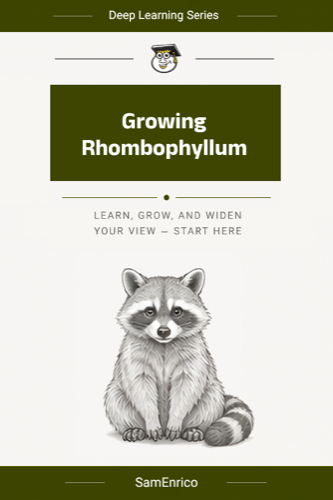
Non-FictionInformativeEducational
Growing Rhombophyllum Audiobook
This publication, published by SamEnrico, covers G
This publication, published by SamEnrico, covers Growing Rhombophyllum
Formats
Free sample
Chapter 1: The Living Geometry...--The first time you hold a mature Rhombophyllum in your hands, you are not holding a plant in any ordinary sense. You are holding a living expression of geometric principles that mathematicians spend lifetimes studying—angles that optimize light capture, curves that minimize water loss, and a structural logic that has been refined through millions of years of evolutionary pressure. This is not a succulent that simply tolerates difficult conditions. It is a masterwork of adaptation, a botanical survival machine whose unusual shape is not ornamental but functional, and understanding that function is the first step toward successful cultivation.For the uninitiated eye, a Rhombophyllum might appear as nothing more than an oddity—a cluster of fleshy, angular leaves that seem to have been carved by an unsteady hand. But look closer.
Each leaf is a study in precision: flattened into a distinct hatchet or axe-head shape, tapering to a point, and arranged in opposite pairs along branching stems that rise just a few inches above the soil. The leaves of Rhombophyllum dolabriforme, the most common species in cultivation, resemble the antlers of an elk—hence its common name, the Elkhorn plant. Rhombophyllum rhomboideum takes the geometry a step further, its leaves forming perfect diamond-shaped cross-sections that give the genus its name (from the Greek rhombos, meaning rhombus or spinning top). And Rhombophyllum nelii remains smaller and more compact, a miniature version of its cousins that fits comfortably in the smallest of succulent collections.But these are not mere botanical curiosities. They are survivors.
The genus Rhombophyllum belongs to the Aizoaceae family, a vast and diverse group of succulents known colloquially as "mesembs"—a name derived from Mesembryanthemum, the family's former classification. This family includes some of the most specialized succulents on Earth: Lithops (living stones), Conophytum (button plants), Fenestraria (baby toes), and dozens of other genera that have evolved extraordinary strategies for enduring some of the harshest environments on the planet. Within this family of specialists, Rhombophyllum occupies a unique niche, combining the leaf succulence of its relatives with a shrubby growth habit that allows it to colonize rocky crevices where few other plants can gain a foothold.The natural range of Rhombophyllum is remarkably restricted. All three species are endemic to South Africa, specifically the Eastern Cape and Karoo regions—an area known to botanists as a biodiversity hotspot for succulent plants. The Eastern Cape is a…
This is the end of the free sample. Get the Audiobook to keep going. Buy now
About this book
Details
- Author
- Oleary Remona
- Publisher
- SamEnrico
- Language
- English
- Genre
- Non-Fiction, Informative, Educational
- Released
- 2026-06-02
- Pages (approx.)
- 150
- Available as
- eBook, Audiobook

Listen in the VoxFlicks app
Audiobooks and audio dramas wherever you go. Sign in with your SamEnrico account and press play.
More by Oleary Remona
 Spiritual Dream JournalingOleary Remona$11.99
 PMS Irritability SolutionsOleary Remona$11.99
 Offensive Line Work EthicOleary Remona$11.99
 Music Theory Memory PalaceOleary Remona$11.99
 Study Life Balance WorkbookOleary Remona$11.99
 Growth Hormone Deficiency SymptomsOleary Remona$11.99
 Managing Emotions During ConflictOleary Remona$11.99
 Retirement Assets Disclaimer TrustOleary Remona$11.99
 Colombian KidnappingOleary Remona$11.99
 The Phantom Fleet: The Vanished Ships of the Bermuda TriangleOleary Remona$11.99
 The Academy of Plato: Birth of Western ThoughtOleary Remona$11.99
 AI Prompts for Public Data InterpretationOleary Remona$11.99
You may also like
 Hong Kong Handover 1997Dunn Johnnie$11.99
 Zumba For Postnatal Recovery CourseNeal Christian$11.99
 Zumba for BeginnersLadner Nikia$11.99
 YouTube Comment Mining GuideHumes Pandora$12.99
 Worry Box MeditationCarlin Rudy$11.99
 Workplace Stress MeditationNguyen Lynn$11.99
 Workplace Stress and Sleep RepairHawley Ivory$11.99
 Workplace Perfectionism CureDelaney Jeffry$11.99
 Workplace Injustice Anger GuideWallen Isabelle$11.99
 Work Addiction and Burnout LinkGreenwood Ester$11.99
 Women in Yoga and WellnessBeattie Galina$11.99
 Women in Stand Up ComedyChun Evangeline$11.99