
Non-FictionInformativeEducational
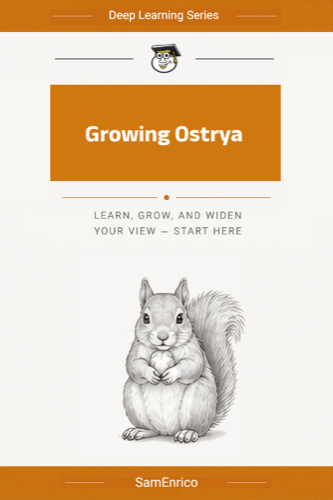
Growing Ostrya eBook
This publication, published by SamEnrico, covers G
This publication, published by SamEnrico, covers Growing Ostrya
Formats
Free sample
Chapter 1: Beyond the Bark...--The first time I held a piece of Ostrya wood, I understood why the ancients called it iron-wood. The billet was no larger than my forearm, freshly cut from a wind-thrown tree in the Ozarks, yet it weighed as much as a brick. When I tapped it against a granite boulder, the sound was not a thud but a ring—a clean, metallic ping that resonated through my fingers and up to my elbow. A piece of white oak the same size would have dented. The Ostrya was unmarked.That moment changed how I thought about trees.
I had spent years planting maples and oaks like everyone else, assuming that "hardwood" meant something consistent across species. I had never encountered a wood so dense that it felt like a different category of material altogether. And I had never considered that a tree with such remarkable physical properties might also possess remarkable horticultural virtues: drought tolerance, compaction resistance, pest resilience, and a stately beauty that unfolds slowly over decades.This chapter is about that wood, yes—about the Janka scale and the history of plane soles and wagon axles—but it is about much more. It is about the living tree that produces this extraordinary material. It is about the anatomy and taxonomy that make Ostrya one of the most distinctive and underappreciated genera in the temperate world.
And it is about why, after reading these pages, you will never look at a hophornbeam the same way again.By the time you finish this chapter, you will understand where Ostrya sits in the tree of life, how its wood achieves its legendary hardness, why its bark peels in those characteristic shaggy strips, and how to distinguish the different species at a glance. You will have the botanical foundation you need for every subsequent chapter—from propagation to pruning to landscape design. More than that, you will have developed an appreciation for the quiet resilience of a genus that asks for little and gives much.The Birch Family Connection To understand Ostrya, we must first understand its relatives. The genus belongs to the family Betulaceae, the birch family, a lineage that has existed since the late Cretaceous period approximately 70 million years ago. This family includes six extant genera, of which the most familiar to North American and European gardeners are Betula (birches), Alnus (alders), Corylus (hazelnuts), Carpinus (hornbeams), and Ostrya (hophornbeams).
The sixth genus, Ostryopsis, is restricted to East Asia and rarely cultivated outside its native range.Within this family, Ostrya and Carpinus are the closest relatives, having diverged from a common ancestor approximately 40 million years ago. This close relationship explains why the two genera share so many characteristics: both produce hard, dense wood; both have simple, alternate, serrated leaves; both bear their seeds in clusters that dangle from the branches; both are wind-pollinated and produce abundant pollen in early spring. In fact, the two genera are so similar that some early taxonomists argued—incorrectly, as modern genetic analysis has shown—that they should be merged into a single genus.But the similarities, however striking, are superficial. The differences between Ostrya and Carpinus run deep, from the molecular level of their DNA to the ecological level of their habitat preferences. Ostrya is a tree of dry uplands, rocky slopes, and thin soils—a pioneer of tough places where other trees struggle.
Carpinus is a tree of moist bottomlands, rich floodplains, and deep, loamy soils—a companion of sugar maples and basswoods in the climax forest. Understanding this ecological divergence is the key to understanding the anatomical differences we are about to explore.The Wood That Changed Trades The most remarkable feature of Ostrya—the feature that has earned it the name "ironwood" across multiple continents and multiple languages—is the extraordinary density of its wood. But density is not a single quality; it is the product of several interrelated anatomical characteristics that together produce a material unlike almost any other in the temperate forest.Let us begin with the numbers. The Janka hardness test, developed by the Austrian-born wood researcher Gabriel Janka in 1906, measures the force required to embed an 11.28-millimeter (0.444-inch) steel ball halfway into a sample of wood. The test is the industry standard for comparing the hardness of different species, and it reveals the remarkable position of Ostrya.The heartwood of Ostrya virginiana scores between 1,400 and 1,900 pounds-force (lbf) on the Janka scale.
For comparison:Eastern white pine (Pinus strobus): 380 lbf Black walnut (Juglans nigra): 1,010 lbf White oak (Quercus alba): 1,350 lbf Sugar maple (Acer saccharum): 1,450 lbf Eastern hophornbeam (Ostrya virginiana): 1,400–1,900 lbf Shagbark hickory (Carya ovata): 1,880 lbf Black locust (Robinia pseudoacacia): 1,700 lbf Osage orange (Maclura pomifera): 2,040 lbf In practical terms, this means that Ostrya is harder than white oak, harder than sugar maple, approximately equivalent to the hardest hickories, and surpassed only by a handful of tropical hardwoods and the legendary osage orange. A board of Ostrya sinks in water; it does not float. A nail driven into Ostrya will bend before the wood splits. A saw blade cutting Ostrya will dull twice as fast as one cutting oak.What accounts for this extraordinary density? The answer lies in three interconnected anatomical features: cell wall thickness, vessel density, and the presence of specialized structural cells called fibers.First, the cell walls of Ostrya wood are exceptionally thick.
In most hardwoods, the cells that conduct water (vessels) and the cells that provide structural support (fibers) have walls of moderate thickness, balancing the competing demands of water transport and structural integrity. In Ostrya, evolution has tipped the balance decisively toward structural integrity. The fibers that make up the bulk of the wood have walls that are nearly as thick as the diameter of the cell lumen (the hollow center that conducts water). This leaves less space for water, which is why the wood is so dense and why it sinks.Second, Ostrya wood has a high density of fibers relative to vessels. In many hardwoods, vessels account for 20–30 percent of the wood volume.
In Ostrya, vessels account for only 10–15 percent. The remaining volume is taken up by fibers—structural cells whose sole purpose is to provide mechanical support. This high fiber-to-vessel ratio is the primary reason Ostrya is so much harder than oak, which has larger and more numerous vessels.Third, the fibers themselves are not simple tubes; they are thick-walled cells with tapered ends that overlap and interlock, creating a composite material that is stronger than the sum of its parts. This interlocking fiber structure gives Ostrya wood its characteristic resistance to splitting and shock. When a mallet head made of Ostrya strikes a metal chisel, the energy of the impact is distributed across thousands of interlocking fibers rather than concentrated along a single plane of weakness.Historical Uses of Ironwood The remarkable properties of Ostrya wood did not go unnoticed by the people who lived alongside the tree.
Archaeological evidence shows that Native American tribes used Ostrya for a variety of purposes long before European contact. The Cherokee called the tree ga-nv-ya-di (arrowwood), using its straight, dense shoots for arrow shafts that could penetrate the hide of a deer without shattering. The Iroquois used Ostrya for the…
This is the end of the free sample. Get the eBook to keep going. Buy now
About this book
Details
- Author
- Tran Roderick
- Publisher
- SamEnrico
- Language
- English
- Genre
- Non-Fiction, Informative, Educational
- Released
- 2026-05-07
- Pages (approx.)
- 153
- Available as
- eBook, Audiobook

Read better in the ZLOADR app
Your eBooks on your phone or tablet. Sign in with your SamEnrico account and start reading.
More by Tran Roderick
 Senior Emergency Preparedness GuideTran Roderick$11.99
 RLS And Diabetes Management GuideTran Roderick$11.99
 NVC For Non Native English SpeakersTran Roderick$11.99
 Elizabeth I's Court Management WorkbookTran Roderick$11.99
 Hillary Everest Knife GiftTran Roderick$11.99
 HR and Anger Reporting GuideTran Roderick$11.99
 The Last Stand at the Sydney HiltonTran Roderick$11.99
 Liz Truss LettuceTran Roderick$11.99
 Perspective Taking Anger GuideTran Roderick$11.99
 The Silk Road’s Last Explorer: Rediscovering Marco Polo’s Lost AustraliaTran Roderick$11.99
 Midnight in the Caribbean: The Phantom of Deck 7Tran Roderick$11.99
 No-Code Apps with BubbleTran Roderick$11.99
You may also like
 Hong Kong Handover 1997Dunn Johnnie$11.99
 Zumba For Postnatal Recovery CourseNeal Christian$11.99
 Zumba for BeginnersLadner Nikia$11.99
 YouTube Comment Mining GuideHumes Pandora$12.99
 Worry Box MeditationCarlin Rudy$11.99
 Workplace Stress MeditationNguyen Lynn$11.99
 Workplace Stress and Sleep RepairHawley Ivory$11.99
 Workplace Perfectionism CureDelaney Jeffry$11.99
 Workplace Injustice Anger GuideWallen Isabelle$11.99
 Work Addiction and Burnout LinkGreenwood Ester$11.99
 Women in Yoga and WellnessBeattie Galina$11.99
 Women in Stand Up ComedyChun Evangeline$11.99