
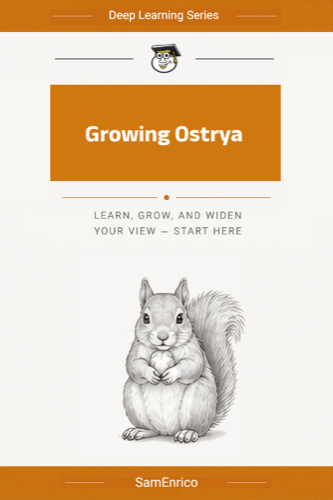
Non-FictionInformativeEducational
Growing Ostrya Audiobook
This publication, published by SamEnrico, covers G
This publication, published by SamEnrico, covers Growing Ostrya
Formats
Free sample
Chapter 1: Beyond the Bark...--The first time I held a piece of Ostrya wood, I understood why the ancients called it iron-wood. The billet was no larger than my forearm, freshly cut from a wind-thrown tree in the Ozarks, yet it weighed as much as a brick. When I tapped it against a granite boulder, the sound was not a thud but a ring—a clean, metallic ping that resonated through my fingers and up to my elbow. A piece of white oak the same size would have dented. The Ostrya was unmarked.That moment changed how I thought about trees.
I had spent years planting maples and oaks like everyone else, assuming that "hardwood" meant something consistent across species. I had never encountered a wood so dense that it felt like a different category of material altogether. And I had never considered that a tree with such remarkable physical properties might also possess remarkable horticultural virtues: drought tolerance, compaction resistance, pest resilience, and a stately beauty that unfolds slowly over decades.This chapter is about that wood, yes—about the Janka scale and the history of plane soles and wagon axles—but it is about much more. It is about the living tree that produces this extraordinary material. It is about the anatomy and taxonomy that make Ostrya one of the most distinctive and underappreciated genera in the temperate world.
And it is about why, after reading these pages, you will never look at a hophornbeam the same way again.By the time you finish this chapter, you will understand where Ostrya sits in the tree of life, how its wood achieves its legendary hardness, why its bark peels in those characteristic shaggy strips, and how to distinguish the different species at a glance. You will have the botanical foundation you need for every subsequent chapter—from propagation to pruning to landscape design. More than that, you will have developed an appreciation for the quiet resilience of a genus that asks for little and gives much.The Birch Family Connection To understand Ostrya, we must first understand its relatives. The genus belongs to the family Betulaceae, the birch family, a lineage that has existed since the late Cretaceous period approximately 70 million years ago. This family includes six extant genera, of which the most familiar to North American and European gardeners are Betula (birches), Alnus (alders), Corylus (hazelnuts), Carpinus (hornbeams), and Ostrya…
This is the end of the free sample. Get the Audiobook to keep going. Buy now
About this book
Details
- Author
- Tran Roderick
- Publisher
- SamEnrico
- Language
- English
- Genre
- Non-Fiction, Informative, Educational
- Released
- 2026-05-07
- Pages (approx.)
- 153
- Available as
- eBook, Audiobook

Listen in the VoxFlicks app
Audiobooks and audio dramas wherever you go. Sign in with your SamEnrico account and press play.
More by Tran Roderick
 Senior Emergency Preparedness GuideTran Roderick$11.99
 RLS And Diabetes Management GuideTran Roderick$11.99
 NVC For Non Native English SpeakersTran Roderick$11.99
 Elizabeth I's Court Management WorkbookTran Roderick$11.99
 Hillary Everest Knife GiftTran Roderick$11.99
 HR and Anger Reporting GuideTran Roderick$11.99
 The Last Stand at the Sydney HiltonTran Roderick$11.99
 Liz Truss LettuceTran Roderick$11.99
 Perspective Taking Anger GuideTran Roderick$11.99
 The Silk Road’s Last Explorer: Rediscovering Marco Polo’s Lost AustraliaTran Roderick$11.99
 Midnight in the Caribbean: The Phantom of Deck 7Tran Roderick$11.99
 No-Code Apps with BubbleTran Roderick$11.99
You may also like
 Hong Kong Handover 1997Dunn Johnnie$11.99
 Zumba For Postnatal Recovery CourseNeal Christian$11.99
 Zumba for BeginnersLadner Nikia$11.99
 YouTube Comment Mining GuideHumes Pandora$12.99
 Worry Box MeditationCarlin Rudy$11.99
 Workplace Stress MeditationNguyen Lynn$11.99
 Workplace Stress and Sleep RepairHawley Ivory$11.99
 Workplace Perfectionism CureDelaney Jeffry$11.99
 Workplace Injustice Anger GuideWallen Isabelle$11.99
 Work Addiction and Burnout LinkGreenwood Ester$11.99
 Women in Yoga and WellnessBeattie Galina$11.99
 Women in Stand Up ComedyChun Evangeline$11.99