
Non-FictionInformativeEducational
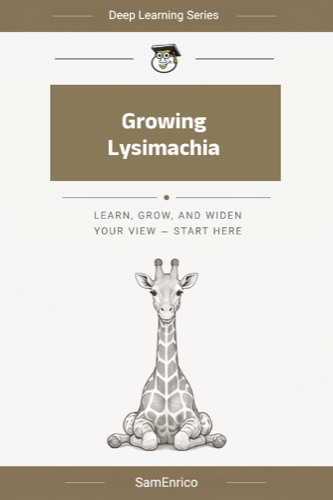
Growing Lysimachia eBook
This publication, published by SamEnrico, covers G
This publication, published by SamEnrico, covers Growing Lysimachia
Formats
Free sample
Chapter 1: The Confession Plot--–- Every gardener has a murder story. Mine involves a pair of rusty pruning shears, a late September evening, and a Gooseneck Loosestrife that had committed the unpardonable sin of surviving everything I threw at it. I had dug it up, hacked its rhizomes into pieces, buried those pieces under two feet of gravel, and then—in a moment of what I can only describe as horticultural rage—poured boiling water over the spot where it had once grown. The next spring, it emerged again, as cheerful and green as if I had sent it a thank-you note instead of an attempted execution.That was twelve years ago. Today, I have seventeen different species of Lysimachia growing in my garden on purpose.This book is not for people who want to dabble.
It is not for the weekend warrior who plants a flat of annuals in May and forgets about them until August. This book is for gardeners who have learned, often through painful experience, that the plants worth growing are the ones that refuse to die. Lysimachia—whether you know it as Creeping Jenny, Gooseneck Loosestrife, Yellow Loosestrife, or any of its other common names—is the most forgiving, most adaptable, and most misunderstood perennial in the temperate garden. And because it is so forgiving, most people grow it wrong.They plant it in the wrong place, then fight it for a decade. They fertilize it into floppy, weak-stemmed monstrosities that cannot hold their own heads up.
They read online forums where someone confuses Lysimachia with Purple Loosestrife and panic, ripping out plants that were perfectly legal and ecologically appropriate. Or they do the opposite: they ignore the plant's fundamental nature, treat it like a delicate primrose, and wonder why it sulks and dies.The truth about Lysimachia sits in an uncomfortable middle ground. It is neither a garden thug to be eradicated on sight nor a fragile treasure to be coddled in special soil. It is a strategic plant—a tool that, when understood and deployed correctly, solves problems that no other perennial can touch. Erosion on a shady slope?
Lysimachia will hold that hillside together better than landscape fabric and staples. A bare patch under a tree where grass refuses to grow? Creeping Jenny will carpet it in gold. A rain garden that floods for three days after every storm? Gooseneck Loosestrife will thrive in those roots-drowning conditions that kill hostas and ferns.But like any powerful tool, Lysimachia demands respect.
You would not hand a chainsaw to a child and say "have fun." You would not store gasoline in an open bucket next to your water heater. And you should not plant Lysimachia without understanding the rhizome network that lies beneath every seemingly innocent clump.This chapter is my confession and my invitation. I have made every mistake possible with this genus, and I have documented those mistakes so you do not have to repeat them. I have also discovered, through those mistakes, the principles that turn Lysimachia from a problem into a solution. By the time you finish this book, you will know exactly which species to choose for your specific conditions, how to plant it so it stays where you put it, how to propagate it into dozens of new plants for free, and how to use it in ways that will make your neighbors ask what your secret is.The secret, I have learned, is not complicated.
It is simply this: Lysimachia wants to grow. It wants to grow more than almost any other perennial you will ever meet. And when you stop fighting that desire and start directing it, the plant becomes not your adversary but your ally.The Love-Hate Continuum: Why Gardeners Can't Agree on This Plant If you ask ten gardeners for their opinion on Lysimachia, you will get eleven answers. The eleventh will come from the gardener's spouse, who has been tripping over creeping runners for the past three summers and has developed strong feelings about the plant's existence.Here is what the divided camps look like.The Lysimachia Haters tend to be gardeners who value order, boundaries, and the ability to plant something and forget about it. They are often former victims of a Lysimachia that was planted by a previous homeowner, who then sold the house before the plant's true nature revealed itself.
These gardeners describe the plant in military terms: invasion, occupation, guerrilla spread. They have tried to dig it out, only to learn that every severed rhizome piece becomes a new plant. They have tried herbicides, only to watch the plant regrow from roots two feet deep. They have tried smothering it with cardboard and mulch, only to see runners emerge at the edges, like a prisoner tunneling out of a cell. Their stories have a certain epic quality—the gardener versus the weed, a battle stretching across multiple seasons, ending (if it ends at all) with the gardener moving to a new house with a clean slate.The Lysimachia Lovers, by contrast, tend to be gardeners who value coverage, resilience, and plants that perform without constant pampering.
They plant Creeping Jenny in hanging baskets and watch it spill over the edges in waterfalls of gold. They use Gooseneck Loosestrife to fill the wet, shady corner where nothing else will bloom. They appreciate that Lysimachia does not get powdery mildew like phlox, does not need staking like delphiniums, does not require winter protection like roses, and does not demand division every two years like daylilies. These gardeners have learned the containment techniques that this book will teach you, and they view the plant's vigor not as a problem but as a feature. They are the ones who, when a friend complains about Lysimachia taking over, say "you're doing it wrong" and then explain why.I have been both of these gardeners.
I have cursed Lysimachia with language that would make a merchant marine blush, and I have praised it to strangers at garden centers. The difference between hatred and love, I have learned, is not the plant itself but the gardener's understanding of it. Every person who hates Lysimachia is just a person who has not yet learned the rules.A Brief History of a Misunderstood Genus Before we get into the practical details of growing Lysimachia, it helps to understand where this plant came from and how it got its confusing name.The genus Lysimachia belongs to the Primulaceae family, which also includes primroses (Primula) and shooting stars (Dodecatheon). This family connection surprises many gardeners, who expect primroses to be delicate and Lysimachia to be, well, not delicate. But the Primulaceae is a diverse family, ranging from alpine treasures to aggressive wetland species.
Lysimachia sits on the robust end of that spectrum.The name "Lysimachia" comes from the Greek words "lysis" (loosening) and "mache" (battle or strife). According to botanical tradition, the plant was named after King Lysimachus of Thrace, a successor to Alexander the Great who supposedly used the plant to calm oxen. Other sources claim the name refers to the plant's supposed medicinal properties for ending quarrels. Given the plant's reputation in modern gardens, the irony is not lost…
This is the end of the free sample. Get the eBook to keep going. Buy now
About this book
Details
- Author
- Morales Susan
- Publisher
- SamEnrico
- Language
- English
- Genre
- Non-Fiction, Informative, Educational
- Released
- 2026-06-02
- Pages (approx.)
- 158
- Available as
- eBook, Audiobook

Read better in the ZLOADR app
Your eBooks on your phone or tablet. Sign in with your SamEnrico account and start reading.
More by Morales Susan
 Immigrant Printing Shop To Marketing FirmMorales Susan$11.99
 Artist's Block RecoveryMorales Susan$11.99
 Empathic Listening Skills HandbookMorales Susan$11.99
 Trace Evidence Database GuideMorales Susan$11.99
 RED S Prevention GuideMorales Susan$11.99
 Legal Profession MentorshipMorales Susan$11.99
 Coppola Dynasty - Sofia CoppolaMorales Susan$11.99
 The Shame SpiralMorales Susan$11.99
 Assertiveness For PastorsMorales Susan$11.99
 The Forgotten Voyages: How Japanese Explorers Redefined the Pacific (1905-1915)Morales Susan$11.99
 The Unlikely Alliance: How a Pop Star and a Dictator Shaped Cold War DiplomacyMorales Susan$11.99
 The Djinn’s Last Vessel: A Marid’s Bargain in the Sands of TimeMorales Susan$11.99
You may also like
 Hong Kong Handover 1997Dunn Johnnie$11.99
 Zumba For Postnatal Recovery CourseNeal Christian$11.99
 Zumba for BeginnersLadner Nikia$11.99
 YouTube Comment Mining GuideHumes Pandora$12.99
 Worry Box MeditationCarlin Rudy$11.99
 Workplace Stress MeditationNguyen Lynn$11.99
 Workplace Stress and Sleep RepairHawley Ivory$11.99
 Workplace Perfectionism CureDelaney Jeffry$11.99
 Workplace Injustice Anger GuideWallen Isabelle$11.99
 Work Addiction and Burnout LinkGreenwood Ester$11.99
 Women in Yoga and WellnessBeattie Galina$11.99
 Women in Stand Up ComedyChun Evangeline$11.99