
Non-FictionInformativeEducational
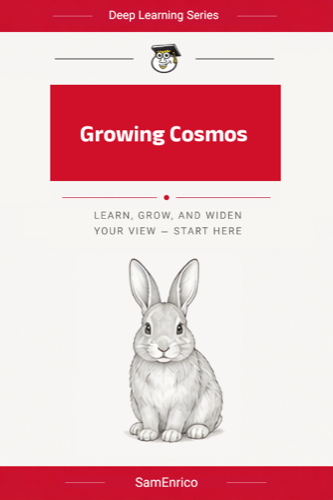
Growing Cosmos eBook
This publication, published by SamEnrico, covers G
by Fogle Weston
This publication, published by SamEnrico, covers Growing Cosmos
Formats
Free sample
Chapter 1: The Seed Remembers...--It begins, as all great things do, with a single seed no larger than a fleck of black pepper. You hold it between your thumb and forefinger, this tiny speck of potential, and you feel nothing remarkable. No vibration. No cosmic hum. Just the dry, papery texture of a dormant life waiting for permission to wake.
And yet, within that unremarkable vessel lies a memory older than human civilization—a memory of soil, sky, and the silent turning of the heavens. The seed remembers what we have forgotten: that the universe is not a distant stage upon which our small lives unfold, but the very ground beneath our feet and the light above our heads.This book is called Growing Cosmos, and the name is not accidental. The flower Cosmos bipinnatus—with its delicate fern-like foliage and brilliant saucer-shaped blooms of white, pink, and crimson—shares its name with the Greek word kosmos, meaning order, harmony, and the universe itself. The ancient Greeks looked up at the scattered stars and saw not chaos but a beautiful, integrated system. They looked down at a flowering meadow and saw the same thing.
The macrocosm of the heavens and the microcosm of the garden were reflections of a single, indivisible truth: everything belongs.But somewhere between the Agrarian Revolution and the invention of the smartphone, we forgot. We began to treat gardening as a mechanical act—sunlight in, water in, fertilizer in, flowers out. We reduced the garden to a set of inputs and outputs, a problem to be solved rather than a relationship to be nurtured. We stopped looking up. And in doing so, we lost something essential: the profound, humbling awareness that we are not the masters of our gardens but the stewards of a much larger conversation between earth and sky.This chapter is an invitation to remember.
Before we discuss moon phases, zodiac signs, or biodynamic preparations, we must first understand why any of this matters. We must confront the skeptic in the room—perhaps the one sitting in your own head—who whispers that gardening by the stars is superstition dressed up in gardening gloves. And we must do so not with blind faith but with open eyes, historical evidence, and a willingness to test these ideas in our own gardens. Because here is the truth that will guide everything that follows: celestial gardening is not about believing in magic. It is about paying attention to a set of observable, repeatable, and scientifically plausible patterns that our ancestors knew and our modern world has dismissed too quickly.The Great Forgetting: How We Lost the Sky Let us travel backward for a moment.
Picture a farmer in ancient Mesopotamia, five thousand years ago. She has no weather app, no soil testing kit, no synthetic fertilizer. What she has is the sky. She watches the moon wax and wane, notes the rising of particular stars, and observes how the behavior of her crops shifts with these celestial rhythms. She notices that seeds planted when the moon is bright and growing (what we now call the waxing phase) push upward faster, while seeds planted when the moon is dark and shrinking (the waning phase) develop stronger roots.
She does not call this "astrology" or "gardening by the signs." She calls it survival.The same pattern repeats across every continent and every ancient civilization. The Egyptians aligned their planting calendars with the heliacal rising of Sirius, the Dog Star, whose appearance heralded the annual flooding of the Nile. The Chinese agricultural almanacs, still in use today, track the twenty-four solar terms and the moon's passage through the twelve zodiacal mansions. The Romans, the Mayans, the Indigenous peoples of the Americas—all of them looked up before they put their hands in the soil. This was not superstition.
It was empirical science, tested over generations, passed down through oral tradition, and encoded into planting rhymes and seasonal festivals.And then something changed. The Enlightenment brought us remarkable gifts: the scientific method, empirical inquiry, the separation of observation from belief. But it also brought us a kind of arrogance—the assumption that anything not measurable by our instruments must be imaginary. We built walls between disciplines. Astronomy became the serious study of celestial mechanics; astrology became the embarrassing cousin who read horoscopes.
Agriculture became a chemistry problem; gardening became a hobby for retired people with too much time on their hands.We forgot that the separation was artificial. A farmer watching the moon was not practicing "folk magic." She was practicing applied observational astronomy. She noticed that groundwater levels rise and fall with lunar tides—a phenomenon any fisherman can confirm and any physicist can explain. She noticed that seed germination rates shifted with the moon's brightness—a fact that modern studies on photoperiodism (the physiological response of plants to light and dark cycles) have begun to validate. She noticed that pests appeared in predictable waves following certain planetary alignments—a correlation that entomologists are only now beginning to map.The seed remembers this knowledge.
It is encoded not in language but in biochemistry, in the way proteins fold in response to light, in the way cell walls expand and contract with moisture availability, in the way genetic switches flip on and off in rhythm with the Earth's rotation. You cannot see this memory when you hold a cosmos seed in your hand. But it is there, waiting. And when you learn to plant in harmony with the celestial rhythms that shaped that memory, the seed will respond as if it has come home.The Flower That Named Itself Before we go further, let us meet the central character of our story: Cosmos bipinnatus, the garden cosmos. Native to the scrublands and open meadows of Mexico and Central America, this remarkable plant has conquered the world not through aggression but through generosity.
It asks for almost nothing: poor soil, full sun, and a little water to get started. In return, it produces hundreds of daisy-like flowers from midsummer until the first hard frost, each bloom balanced on a slender stem that waves in the breeze like a greeting.The Spanish conquistadors who first encountered cosmos in the highlands of Mexico called it cacahuate, the peanut flower, because its seeds vaguely resembled peanuts in their shells. But when the plant made its way to European botanical gardens in the eighteenth century, it was renamed Cosmos by Spanish botanist Antonio José Cavanilles. He chose the name deliberately. The flower's symmetrical petals, arranged in perfect radial order around a golden central disc, embodied the Greek ideal of kosmos: a universe where chaos has been organized into beauty.This is not a trivial observation.
The cosmos flower grows from a seed that is, by any objective measure, tiny, unremarkable, and indistinguishable from thousands of other seeds. It pushes through soil that may be rocky, dry, or nutrient-poor. It faces wind, rain, drought, and pests. And yet, given the slightest opportunity, it transforms into something that humans across cultures and centuries have found irresistibly beautiful. Order from chaos.
Harmony from randomness. The universe in miniature.This is why the cosmos flower is the perfect teacher for celestial gardening. It…
This is the end of the free sample. Get the eBook to keep going. Buy now
About this book
Details
- Author
- Fogle Weston
- Publisher
- SamEnrico
- Language
- English
- Genre
- Non-Fiction, Informative, Educational
- Released
- 2026-05-08
- Pages (approx.)
- 154
- Available as
- eBook, Audiobook

Read better in the ZLOADR app
Your eBooks on your phone or tablet. Sign in with your SamEnrico account and start reading.
More by Fogle Weston
 Self Esteem Recovery Body Image WorkbookFogle Weston$11.99
 Nobel Prize Optogenetics RevolutionFogle Weston$11.99
 Veterans Benefits GuideFogle Weston$11.99
 The Nobel Laureate Science WritersFogle Weston$11.99
 Hot Springs National ParkFogle Weston$11.99
 Fig Leaf Pose as SubmissionFogle Weston$11.99
 Startup Client InsolvencyFogle Weston$11.99
 Beginner Meditation EnvironmentFogle Weston$11.99
 The Sun King's Grand Design: Louis XIV and the Birth of Modern ScienceFogle Weston$11.99
 The Healers of the Nile: The Secret Medical Corps of Ancient NubiaFogle Weston$11.99
 The Mineral Guide to AjoiteFogle Weston$11.99
 JEE Advanced Circle Geometry GuideFogle Weston$12.99
You may also like
 Hong Kong Handover 1997Dunn Johnnie$11.99
 Zumba For Postnatal Recovery CourseNeal Christian$11.99
 Zumba for BeginnersLadner Nikia$11.99
 YouTube Comment Mining GuideHumes Pandora$12.99
 Worry Box MeditationCarlin Rudy$11.99
 Workplace Stress MeditationNguyen Lynn$11.99
 Workplace Stress and Sleep RepairHawley Ivory$11.99
 Workplace Perfectionism CureDelaney Jeffry$11.99
 Workplace Injustice Anger GuideWallen Isabelle$11.99
 Work Addiction and Burnout LinkGreenwood Ester$11.99
 Women in Yoga and WellnessBeattie Galina$11.99
 Women in Stand Up ComedyChun Evangeline$11.99