
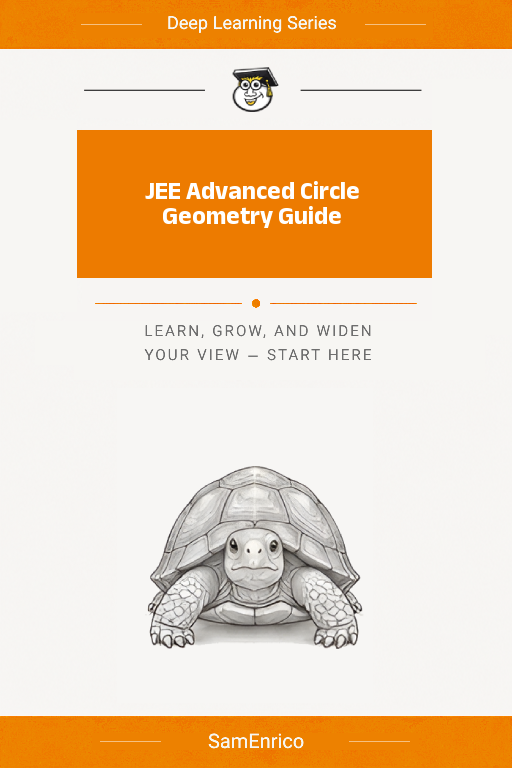
JEE Advanced Circle Geometry Guide
Solve circle chord tangent and family of circles p
by Fogle Weston
Solve circle chord tangent and family of circles problems using parametric and general forms.
Formats
About this book
Free sample
Chapter 1: The Cartesian Mirror--Mathematics, at its core, is the art of seeing the same truth through different lenses. No geometric object embodies this philosophy more elegantly than the circle. To the geometer, a circle is the set of all points equidistant from a fixed center—a definition that conjures images of compasses and traced arcs. To the algebraist, the same circle is a quadratic equation in two variables, a constellation of terms waiting to be decoded. And to the JEE Advanced aspirant, mastery of the circle demands fluency in both languages, the ability to translate effortlessly between the geometric and the algebraic, and the wisdom to choose the right representation at the right moment.This chapter constructs the foundational mirror: the two Cartesian representations of a circle and the precise relationship between them.
We begin not with formulas, but with the question that has haunted JEE aspirants for decades: given a circle in any form, how do we extract its soul—its center and radius? And conversely, given a center and radius, how do we produce its algebraic incarnation? By the time you close this chapter, you will not merely memorize equations. You will see the circle's reflection in the algebraic mirror and recognize it instantly, in any disguise.1.1 The Geometric Definition and Its Algebraic Children A circle is defined as the locus of all points (x,y)(x, y)(x,y) in a plane that are at a fixed distance rrr (the radius) from a fixed point (h,k)(h, k)(h,k) (the center). This definition is geometry in its purest form—visual, intuitive, unforgivingly precise.From this definition, the distance formula gives us the Standard Center-Radius Form:(x−h)2+(y−k)2=r2(x - h)^2 + (y - k)^2 = r^2(x−h)2+(y−k)2=r2This is the circle in its most transparent form.
The center (h,k)(h, k)(h,k) stands revealed. The radius rrr is immediately visible. The equation tells a complete story: for any point (x,y)(x, y)(x,y), the squared distance to the center equals the squared radius.However, when circles intersect, when they share chords, when families of circles…
This is the end of the free sample. Get the eBook to keep going. Buy now
Contents
- Chapter 1
- Chapter 2
- Chapter 3
- Chapter 4
- Chapter 5
- Chapter 6
- Chapter 7
- Chapter 8
- Chapter 9
- Chapter 10
- Chapter 11
- Chapter 12
Details
- Author
- Fogle Weston
- Publisher
- SamEnrico
- Language
- English
- Genre
- Non-Fiction, Student's Shortcut
- Released
- 2026-06-01
- Pages (approx.)
- 140
- Available as
- eBook, Audiobook

Read better in the ZLOADR app
Your eBooks on your phone or tablet. Sign in with your SamEnrico account and start reading.
More by Fogle Weston
 Self Esteem Recovery Body Image WorkbookFogle Weston$11.99
 Nobel Prize Optogenetics RevolutionFogle Weston$11.99
 Veterans Benefits GuideFogle Weston$11.99
 The Nobel Laureate Science WritersFogle Weston$11.99
 Hot Springs National ParkFogle Weston$11.99
 Fig Leaf Pose as SubmissionFogle Weston$11.99
 Startup Client InsolvencyFogle Weston$11.99
 Beginner Meditation EnvironmentFogle Weston$11.99
 The Sun King's Grand Design: Louis XIV and the Birth of Modern ScienceFogle Weston$11.99
 The Healers of the Nile: The Secret Medical Corps of Ancient NubiaFogle Weston$11.99
 The Mineral Guide to AjoiteFogle Weston$11.99
 CTA for International TaxFogle Weston$12.99
You may also like
 Hong Kong Handover 1997Dunn Johnnie$11.99
 Zumba For Postnatal Recovery CourseNeal Christian$11.99
 Zumba for BeginnersLadner Nikia$11.99
 YouTube Comment Mining GuideHumes Pandora$12.99
 Worry Box MeditationCarlin Rudy$11.99
 Workplace Stress MeditationNguyen Lynn$11.99
 Workplace Stress and Sleep RepairHawley Ivory$11.99
 Workplace Perfectionism CureDelaney Jeffry$11.99
 Workplace Injustice Anger GuideWallen Isabelle$11.99
 Work Addiction and Burnout LinkGreenwood Ester$11.99
 Women in Yoga and WellnessBeattie Galina$11.99
 Women in Stand Up ComedyChun Evangeline$11.99