
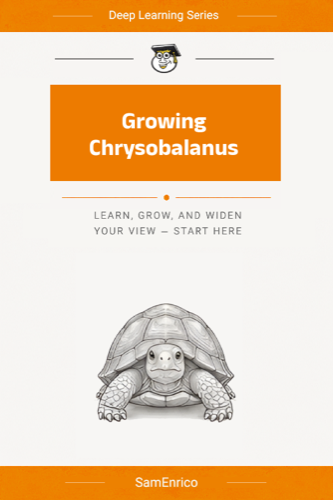
Non-FictionInformativeEducational
Growing Chrysobalanus eBook
This publication, published by SamEnrico, covers G
This publication, published by SamEnrico, covers Growing Chrysobalanus
Formats
Free sample
Chapter 1: Two Plants, One Secret--The first time I killed a Cocoplum, I thought I had followed every instruction perfectly.It was 2014. I had read a glowing paragraph about Chrysobalanus icaco in a obscure Florida native plant guide—something about “edible fruit” and “salt tolerance” and “no fertilizer needed.” I ordered three plants from a mail-order nursery in Homestead. They arrived as twelve-inch seedlings in damp newspaper, their leaves still glossy. I planted them fifteen feet apart in my backyard, in full sun, in sandy loam that had grown tomatoes the previous year. I watered them twice a week.
I mulched around their bases. I did everything right.Six months later, two of them were dead. The third had grown exactly four inches and produced no flowers.I was baffled. Everything I had read suggested Cocoplum was indestructible. "Thrives on neglect," one source claimed.
"Virtually unkillable," said another. Yet here I was, a reasonably competent gardener who had successfully grown avocados from seed and kept a fiddle-leaf fig alive for three years, standing over a shriveled plant that looked like it had been hit with herbicide.The problem, I would learn over the next several years, was not my technique. The problem was that no one had told me the single most important fact about Chrysobalanus icaco: it is not one plant.What appears in botanical databases as a single species is, for the practical purposes of the gardener, two radically different organisms. They share a genus and species name. They can hybridize where their ranges overlap.
But they have different growth habits, different environmental tolerances, different fruit characteristics, and different cultivation requirements. Confusing one for the other is not a minor mistake. It is the difference between a thriving hedge and a dead twig.This chapter exists to ensure you never make the same error I did. By the time you finish reading, you will be able to identify the two main ecotypes of Chrysobalanus icaco at a glance, understand which one belongs in your landscape, and avoid the expensive, time-consuming failures that await the uninformed.The Great Confusion: Why No One Tells You This Before we examine the two forms in detail, it is worth asking why this information is so difficult to find. Walk into any nursery in South Florida or the Caribbean and ask for "Cocoplum." The staff will point you to a section of shrubs.
They will not ask whether you want the coastal form or the inland form. They will not explain that the shrub they are selling will never become a tree. They will simply hand you a three-gallon pot and wish you luck.This is not malice. It is the result of a long and confused botanical history.Chrysobalanus icaco was first described by Carl Linnaeus in 1753. He based his description on specimens collected from coastal areas of the Caribbean.
Those specimens were the low-growing, sprawling form that dominates sandy beaches and rocky shorelines. For the next two centuries, botanists assumed that any inland plant that looked roughly similar was simply a variation within the same species—perhaps influenced by richer soil or protection from wind.It was not until the mid-twentieth century that researchers began to suspect otherwise. When they grew coastal seeds in inland conditions, the plants remained small. When they grew inland seeds in coastal conditions, the plants grew tall but suffered from salt burn. These were not mere environmental variations.
They were ecotypes—genetically distinct populations adapted to specific habitats.Modern taxonomy recognizes two main varieties: C. icaco var. icaco (the coastal form) and C. icaco var. pellocarpus (the inland form).
A handful of other varieties exist in restricted ranges, including C. icaco var. brasiliensis in the Amazon basin and C. orbicularis (a related but distinct species) in Cuba and the Bahamas. But for the home gardener, the two main ecotypes are the ones that matter.The nursery industry, however, has largely ignored this distinction.
Most commercial growers propagate from seed collected from whatever plants are convenient—coastal, inland, or hybrid—and sell the resulting seedlings under the single name "Cocoplum." This is why you can buy two plants labeled identically and watch one become a six-foot hedge while the other reaches twenty-five feet. This is why your neighbor's Cocoplum may produce sweet, apple-flavored fruit while yours produces bland, cottony spheres. You are not growing the same plant.First Face: The Coastal Form (C. icaco var. icaco)Imagine a plant that has evolved to survive conditions that would kill most fruit trees within weeks.
Salt spray that burns the leaves of mangoes and avocados. Sand that holds no water and fewer nutrients. Wind that desiccates unprotected foliage. Tides that occasionally flood the root zone with saltwater. This is the world of the coastal form, and it has adapted to thrive there.Growth Habit and Size The coastal form is a shrub, not a tree.
In the open sun of a beach dune, it grows as a dense, sprawling mound rarely exceeding six feet in height. Its branches spread horizontally, often rooting where they touch the ground, creating thickets that can extend twenty feet or more across. In shadier conditions—under the canopy of sea grapes or Australian pines—it grows taller and more upright, stretching toward the light, but it never loses its fundamental shrubby nature.Growth is slow by tropical standards. A coastal Cocoplum planted from a one-gallon container will add perhaps six to twelve inches of height per year. It will reach its full size in five to seven years.
This slow growth is not a defect. It is the plant's strategy for survival in a low-resource environment. Fast growth requires water, nutrients, and protected conditions—none of which are reliably available on a coastal dune.Leaves and Stems The leaves of the coastal form are its most distinctive feature. They are thick and leathery—almost succulent in their fleshiness—with a rounded or slightly notched tip. The upper surface is dark green and glossy; the lower surface is paler with prominent veins.
Leaves measure one to two inches in length and are arranged alternately along the stems. When you hold a leaf up to the light, you can see a network of tiny translucent dots—glands that secrete salt the plant has absorbed from the environment.The stems are sturdy and woody, often zigzagging between leaf nodes. Young stems are green and slightly fuzzy; mature stems turn gray-brown and develop shallow vertical fissures. The plant branches prolifically from the base, creating a dense, impenetrable thicket if left unpruned.Flowers and Fruit Flowers appear intermittently throughout the year but peak in spring. They are small—less than a quarter-inch across—with five white petals surrounding a central cluster of stamens.
The flowers grow in clusters at the leaf axils and produce a light, sweet fragrance that attracts bees and small flies.The fruit is a drupe, meaning it has a thin skin, a fleshy middle layer, and a hard central seed. Ripe fruits range from white to pink to deep purple, depending on the individual plant. In the coastal form, the flesh is typically soft, mild, and sweet—the consistency of a ripe fig or overripe plum. Some describe…
This is the end of the free sample. Get the eBook to keep going. Buy now
About this book
Details
- Author
- Merritt Brady
- Publisher
- SamEnrico
- Language
- English
- Genre
- Non-Fiction, Informative, Educational
- Released
- 2026-06-03
- Pages (approx.)
- 128
- Available as
- eBook, Audiobook

Read better in the ZLOADR app
Your eBooks on your phone or tablet. Sign in with your SamEnrico account and start reading.
More by Merritt Brady
 Naloxone Narcan Training PrimerMerritt Brady$11.99
 Self Hypnosis For Strength TrainingMerritt Brady$11.99
 Recovery Sabbatical GuideMerritt Brady$11.99
 Hip Pain Meditation GuideMerritt Brady$11.99
 Press Release For LayoffsMerritt Brady$11.99
 Networking for Remote WorkersMerritt Brady$11.99
 Circadian Rhythm Faqs HandbookMerritt Brady$11.99
 Smell Anchor ProtocolMerritt Brady$11.99
 Chinese Mother Visa StruggleMerritt Brady$11.99
 The Shot Heard 'Round the World: Lexington and Concord's Spark of RebellionMerritt Brady$11.99
 The Red and the White: Trotsky’s Last Stand at Perekop (1920)Merritt Brady$11.99
 How to Produce Battery TestersMerritt Brady$11.99
You may also like
 Hong Kong Handover 1997Dunn Johnnie$11.99
 Zumba For Postnatal Recovery CourseNeal Christian$11.99
 Zumba for BeginnersLadner Nikia$11.99
 YouTube Comment Mining GuideHumes Pandora$12.99
 Worry Box MeditationCarlin Rudy$11.99
 Workplace Stress MeditationNguyen Lynn$11.99
 Workplace Stress and Sleep RepairHawley Ivory$11.99
 Workplace Perfectionism CureDelaney Jeffry$11.99
 Workplace Injustice Anger GuideWallen Isabelle$11.99
 Work Addiction and Burnout LinkGreenwood Ester$11.99
 Women in Yoga and WellnessBeattie Galina$11.99
 Women in Stand Up ComedyChun Evangeline$11.99