
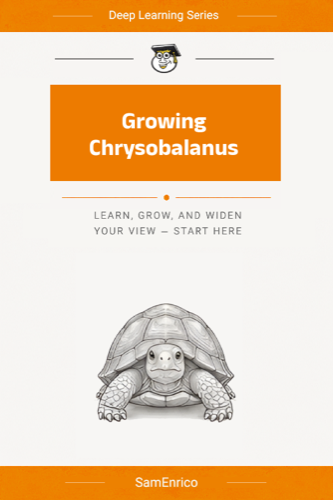
Non-FictionInformativeEducational
Growing Chrysobalanus Audiobook
This publication, published by SamEnrico, covers G
This publication, published by SamEnrico, covers Growing Chrysobalanus
Formats
Free sample
Chapter 1: Two Plants, One Secret--The first time I killed a Cocoplum, I thought I had followed every instruction perfectly.It was 2014. I had read a glowing paragraph about Chrysobalanus icaco in a obscure Florida native plant guide—something about “edible fruit” and “salt tolerance” and “no fertilizer needed.” I ordered three plants from a mail-order nursery in Homestead. They arrived as twelve-inch seedlings in damp newspaper, their leaves still glossy. I planted them fifteen feet apart in my backyard, in full sun, in sandy loam that had grown tomatoes the previous year. I watered them twice a week.
I mulched around their bases. I did everything right.Six months later, two of them were dead. The third had grown exactly four inches and produced no flowers.I was baffled. Everything I had read suggested Cocoplum was indestructible. "Thrives on neglect," one source claimed.
"Virtually unkillable," said another. Yet here I was, a reasonably competent gardener who had successfully grown avocados from seed and kept a fiddle-leaf fig alive for three years, standing over a shriveled plant that looked like it had been hit with herbicide.The problem, I would learn over the next several years, was not my technique. The problem was that no one had told me the single most important fact about Chrysobalanus icaco: it is not one plant.What appears in botanical databases as a single species is, for the practical purposes of the gardener, two radically different organisms. They share a genus and species name. They can hybridize where their ranges overlap.
But they have different growth habits, different environmental tolerances, different fruit characteristics, and different cultivation requirements. Confusing one for the other is not a minor mistake. It is the difference between a thriving hedge and a dead twig.This chapter exists to ensure you never make the same error I did. By the time you finish reading, you will be able to identify the two main ecotypes of Chrysobalanus icaco at a glance, understand which one belongs in your landscape, and avoid the expensive, time-consuming failures that await the uninformed.The Great Confusion: Why No One Tells You This Before we examine the two forms in detail, it is worth asking why this information is so difficult to find. Walk into any nursery in South Florida or the Caribbean and ask for "Cocoplum." The staff will point you to a section of shrubs.
They will not ask whether you want the coastal form or the inland form. They will not explain that the…
This is the end of the free sample. Get the Audiobook to keep going. Buy now
About this book
Details
- Author
- Merritt Brady
- Publisher
- SamEnrico
- Language
- English
- Genre
- Non-Fiction, Informative, Educational
- Released
- 2026-06-03
- Pages (approx.)
- 128
- Available as
- eBook, Audiobook

Listen in the VoxFlicks app
Audiobooks and audio dramas wherever you go. Sign in with your SamEnrico account and press play.
More by Merritt Brady
 Naloxone Narcan Training PrimerMerritt Brady$11.99
 Self Hypnosis For Strength TrainingMerritt Brady$11.99
 Recovery Sabbatical GuideMerritt Brady$11.99
 Hip Pain Meditation GuideMerritt Brady$11.99
 Press Release For LayoffsMerritt Brady$11.99
 Networking for Remote WorkersMerritt Brady$11.99
 Circadian Rhythm Faqs HandbookMerritt Brady$11.99
 Smell Anchor ProtocolMerritt Brady$11.99
 Chinese Mother Visa StruggleMerritt Brady$11.99
 The Shot Heard 'Round the World: Lexington and Concord's Spark of RebellionMerritt Brady$11.99
 The Red and the White: Trotsky’s Last Stand at Perekop (1920)Merritt Brady$11.99
 How to Produce Battery TestersMerritt Brady$11.99
You may also like
 Hong Kong Handover 1997Dunn Johnnie$11.99
 Zumba For Postnatal Recovery CourseNeal Christian$11.99
 Zumba for BeginnersLadner Nikia$11.99
 YouTube Comment Mining GuideHumes Pandora$12.99
 Worry Box MeditationCarlin Rudy$11.99
 Workplace Stress MeditationNguyen Lynn$11.99
 Workplace Stress and Sleep RepairHawley Ivory$11.99
 Workplace Perfectionism CureDelaney Jeffry$11.99
 Workplace Injustice Anger GuideWallen Isabelle$11.99
 Work Addiction and Burnout LinkGreenwood Ester$11.99
 Women in Yoga and WellnessBeattie Galina$11.99
 Women in Stand Up ComedyChun Evangeline$11.99