
Non-FictionInformativeEducational
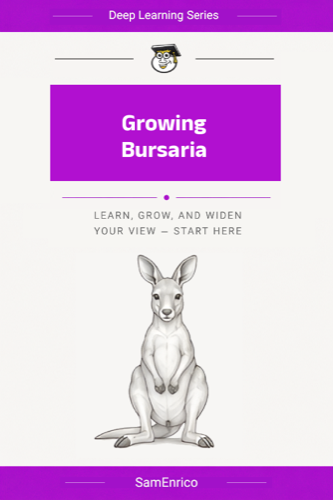
Growing Bursaria eBook
This publication, published by SamEnrico, covers G
by Gordon Vera
This publication, published by SamEnrico, covers Growing Bursaria
Formats
Free sample
Chapter 1: Beyond the Thorns--–- On a hot January afternoon in the outer suburbs of Melbourne, a gardener named Margaret stood at her back fence, secateurs in hand, staring at a plant she had spent five years trying to eliminate. It was a Bursaria spinosa – Sweet Bursaria, Christmas Bush, or, as she called it, “that bloody thorny thing.” The plant had grown from a forgotten seedling into a two-metre impenetrable thicket. It had scratched her arms, tangled her clothesline, and harboured what she assumed were pests. She was one weekend away from hiring a stump grinder.But then something stopped her. A flash of copper.
A small butterfly, no bigger than a two-dollar coin, landed on the Bursaria’s white flower cluster. Then another. Then a native bee she had never seen before. Then a wren disappeared into the dense branches, emerging moments later with a grub in its beak. Margaret lowered her secateurs.
For the first time, she looked at the plant not as an enemy, but as a question mark. What was really going on inside that thorny fortress?That question is the reason you are holding this book.Margaret’s story is not unique. Across Australia – from the windswept grasslands of Tasmania to the dry woodlands of South Australia, from the clay soils of western Victoria to the sandstone ridges of Sydney – thousands of gardeners, landholders, and landcarers have waged war on Bursaria. They have cut it, burned it, poisoned it, and cursed it. And almost every time, they have been wrong.Because Bursaria spinosa – the plant we will call simply “Bursaria” throughout this book – is not a weed.
It is not a nuisance. It is not a mistake of evolution. It is, in fact, one of the most ecologically valuable native plants in temperate Australia. It is a keystone species. A wildlife sanctuary.
A butterfly nursery. A biological pest control system. A timber source. A medicinal plant. And, if you know what you are doing, a stunning addition to any garden or restoration project.This chapter will reframe everything you think you know about Bursaria.
By the time you finish reading, you will never look at a thorny shrub the same way again. You will understand what it is, where it comes from, why it matters, and – most importantly – why your garden desperately needs it.The Plant That Australians Love to Hate Let us begin with an honest confession. Bursaria has an image problem.In the world of Australian native gardening, some plants get all the glory. The waratah, with its dramatic red blooms. The kangaroo paw, with its quirky, velvety flowers.
The wattle, with its explosion of spring gold. Bursaria, by contrast, is the plant that most gardeners discover by accident – usually when it snags their jumper or pokes them in the eye.It is often called “Native Blackthorn,” a name that compares it to the notoriously thorny Northern Hemisphere plum (Prunus spinosa). This comparison is both inaccurate and unfair. Bursaria is not related to blackthorn at all. It is a member of the Pittosporaceae family, which includes the familiar sweet pittosporum (Pittosporum undulatum) and the lesser-known butterfruit.
The “blackthorn” nickname stuck because of superficial similarities: both plants have dark, spiny branches and produce small, white flowers. But that is where the resemblance ends.Other common names are more generous. “Christmas Bush” refers to its summer flowering season, which peaks in December and January across most of its range – just in time for the Australian Christmas. “Prickly Box” acknowledges both its thorns and its timber, which is famously dense and hard. And “Castanet Bush” – perhaps the most charming of its names – describes the sound of its dried seed pods, which rattle like tiny musical instruments when shaken.But regardless of what you call it, one fact remains: Bursaria is the most undervalued native plant in Australian horticulture.
It is the plant that landscape architects overlook, that nursery catalogues bury in the back pages, and that well-meaning friends warn you against planting.This book exists to change that.What Exactly Is Bursaria? A Taxonomic Deep Dive Before we can grow Bursaria, we need to understand what it is. And this is where many gardeners get confused – because “Bursaria” is not a single plant.The genus Bursaria was first described by the French botanist Antoine Laurent de Jussieu in 1789. The name comes from the Latin “bursa,” meaning purse or pouch, referring to the distinctive shape of its seed capsules. To this day, botanists recognise several species, but two dominate the conversation: Bursaria spinosa and Bursaria incana.Bursaria spinosa is the plant you will encounter most often.
It is widespread along the eastern and southern coasts of Australia, from southern Queensland through New South Wales, the Australian Capital Territory, Victoria, Tasmania, and into South Australia. It is incredibly variable. In exposed coastal heathland, it may grow as a low, wind-pruned shrub barely a metre tall. In sheltered forest gullies, it can reach eight metres or more, forming a small tree with a single trunk. Its leaves range from dark green to grey-green, from narrow and elongated to almost round, depending on local genetics.
And, crucially, it has thorns – sharp, stiff, and unforgiving.Bursaria incana is the lesser-known sibling. Its name means “hoary Bursaria,” referring to the fine grey hairs that cover its leaves and young stems. It has fewer thorns – sometimes none at all – and its leaves are broader, softer, and distinctly silvery. Its natural range is more restricted, occurring in drier inland areas and extending into tropical Queensland. For gardeners in warmer, more humid climates, B.
incana may be a better choice than its pricklier, more cold-tolerant cousin.There are also several subspecies and regional variants that botanists are still debating. For practical purposes, most gardeners and landcarers will encounter B. spinosa. Unless otherwise specified, this book focuses on that species, with notes on B. incana where relevant.One final taxonomic point: Bursaria is sometimes confused with another native shrub called “native box” (Bursaria spinosa is occasionally called “prickly box” – yes, the naming is confusing).
The best way to identify Bursaria with certainty is to look for three features together: alternate leaf arrangement (leaves not directly opposite each other on the stem), small white flowers with five petals, and those distinctive purse-shaped seed capsules. If it has thorns, white flowers in summer, and rattling pods in autumn, you have a Bursaria.Where Bursaria Calls Home Understanding a plant’s natural habitat is the first step to growing it successfully. Bursaria is not a fussy plant, but it has preferences – and those preferences tell us everything about how to treat it.Open a map of temperate and subtropical Australia. Draw a line from the Atherton Tablelands in far north Queensland, down the Great Dividing Range, across the Victorian high country, through Tasmania, and across to the Mount Lofty Ranges in South Australia. Bursaria spinosa lives everywhere along that line and many places beyond.
It has been recorded as far inland as the western slopes of the Great Dividing Range, where rainfall drops to 325 millimetres per year, and as high as 1,200 metres in the Australian Alps.This is not a plant that demands rainforest conditions or fertile alluvial…
This is the end of the free sample. Get the eBook to keep going. Buy now
About this book
Details
- Author
- Gordon Vera
- Publisher
- SamEnrico
- Language
- English
- Genre
- Non-Fiction, Informative, Educational
- Released
- 2026-05-18
- Pages (approx.)
- 149
- Available as
- eBook, Audiobook

Read better in the ZLOADR app
Your eBooks on your phone or tablet. Sign in with your SamEnrico account and start reading.
More by Gordon Vera
 Hinge Dating App BurnoutGordon Vera$11.99
 Guilt Of Saying NoGordon Vera$11.99
 Medical Patient NonverbalGordon Vera$11.99
 Police Response FailureGordon Vera$11.99
 Widow Financial Stress GuideGordon Vera$11.99
 Remote Work ResearchGordon Vera$11.99
 Mnemonic Link Method GuideGordon Vera$11.99
 Hormone Therapy SleepGordon Vera$11.99
 Baba Yaga’s Forbidden Grail: A Slavic Knight’s QuestGordon Vera$11.99
 The Great Train Heist: The Untold Story of the 1963 Darjeeling Express RobberyGordon Vera$11.99
 How to Produce Nail BuffersGordon Vera$11.99
 Ghana Dropshipping Product BansGordon Vera$12.99
You may also like
 Hong Kong Handover 1997Dunn Johnnie$11.99
 Zumba For Postnatal Recovery CourseNeal Christian$11.99
 Zumba for BeginnersLadner Nikia$11.99
 YouTube Comment Mining GuideHumes Pandora$12.99
 Worry Box MeditationCarlin Rudy$11.99
 Workplace Stress MeditationNguyen Lynn$11.99
 Workplace Stress and Sleep RepairHawley Ivory$11.99
 Workplace Perfectionism CureDelaney Jeffry$11.99
 Workplace Injustice Anger GuideWallen Isabelle$11.99
 Work Addiction and Burnout LinkGreenwood Ester$11.99
 Women in Yoga and WellnessBeattie Galina$11.99
 Women in Stand Up ComedyChun Evangeline$11.99