
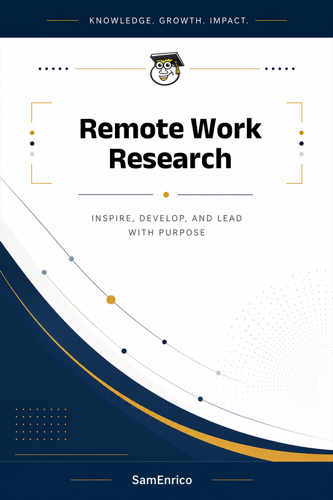
About this book
Free sample
Chapter 1: The Unbundled Corporation–- In March of 2020, approximately 98 percent of the global knowledge workforce discovered something that management theorists had been arguing about for three decades: the office was not, in fact, a law of physics. Within seventy-two hours, tens of millions of workers packed their monitors into shopping bags, grabbed office chairs from empty cubicles, and attempted to recreate their professional lives at kitchen tables, bedroom desks, and, in one memorable case study from a Stanford economist, a closet converted into a soundproof recording booth. The great migration happened so quickly that no one had time to ask the obvious question: if we can do this overnight, why were we doing the other thing at all?The answer, as with most inconvenient truths about modern business, lies buried in the nineteenth century. The office as we know it was not designed for knowledge work, creativity, collaboration, or any of the noble purposes we associate with white-collar labor. It was designed for factories.
More specifically, it was designed for the problem of monitoring manual labor at scale. When Frederick Winslow Taylor began dropping steel ingots across factory floors with his stopwatch in the 1880s, he established a management logic that has proven astonishingly durable: work happens where workers are visible, and workers should be visible because otherwise they might not work. That logic built the skyscrapers, the cubicle farms, the open-plan offices, and the suburban office parks that defined twentieth-century employment. It also locked us into a model of work that became increasingly detached from the actual nature of what knowledge workers do.This book argues that we are living through the Great Unbundling—the systematic separation of work from the workplace. For the first time in industrial history, the physical location of labor has decoupled from the production of value.
Knowledge workers no longer need to commute to a central hub to access the tools, information, and colleagues required to do their jobs. The cloud, high-speed broadband, collaboration software, and a decade of forced experimentation have proven what remote work advocates have claimed since the 1970s: that most…
This is the end of the free sample. Get the eBook to keep going. Buy now
Contents
- Chapter 1
- Chapter 2
- Chapter 3
- Chapter 4
- Chapter 5
- Chapter 6
- Chapter 7
- Chapter 8
- Chapter 9
- Chapter 10
- Chapter 11
- Chapter 12
Details
- Author
- Gordon Vera
- Publisher
- SamEnrico
- Language
- English
- Genre
- research, Self-Help / Science
- Released
- 2026-06-06
- Pages (approx.)
- 159
- Available as
- eBook, Audiobook

Read better in the ZLOADR app
Your eBooks on your phone or tablet. Sign in with your SamEnrico account and start reading.
More by Gordon Vera
 Hinge Dating App BurnoutGordon Vera$11.99
 Guilt Of Saying NoGordon Vera$11.99
 Medical Patient NonverbalGordon Vera$11.99
 Police Response FailureGordon Vera$11.99
 Widow Financial Stress GuideGordon Vera$11.99
 Mnemonic Link Method GuideGordon Vera$11.99
 Hormone Therapy SleepGordon Vera$11.99
 Baba Yaga’s Forbidden Grail: A Slavic Knight’s QuestGordon Vera$11.99
 The Great Train Heist: The Untold Story of the 1963 Darjeeling Express RobberyGordon Vera$11.99
 How to Produce Nail BuffersGordon Vera$11.99
 Ghana Dropshipping Product BansGordon Vera$12.99
 Citation Style Switching GuideGordon Vera$12.99
You may also like
 Pain Meditation ResearchGiron Nelida$11.99
 Interruption ResearchMcintire Raylene$11.99
 Nightmare Research GuideOrellana Tamika$11.99
 Pattern Recognition ResearchMuller Ceola$11.99
 Goal Setting ResearchLopez Todd$11.99
 Chunking Research ReviewCostello Yuri$11.99
 Morning Routine ResearchHammett Corie$11.99
 Scripting ResearchStowe Junior$11.99
 Memory Palace ResearchFox Heidi$11.99
 Habit Research GuideKoenig Margrett$11.99
 Grit Research GuideGardner Tabitha$11.99
 Anticipatory Grief ResearchSelby Ela$11.99