
Non-FictionInformativeEducational
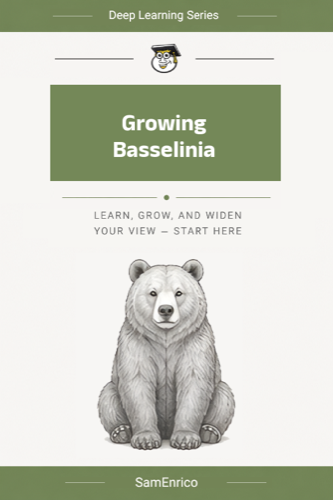
Growing Basselinia eBook
This publication, published by SamEnrico, covers G
This publication, published by SamEnrico, covers Growing Basselinia
Formats
Free sample
Chapter 1: The Impossible Palm--There is a moment in every serious plant collector’s life when they encounter something that should not exist. Not in their climate, not in their budget, not in their wildest horticultural dreams. For me, that moment came on a damp March morning in the greenhouse of a retired botanist outside Santa Barbara, California. Tucked between a towering Dypsis and a flowering Bismarckia stood a palm that stopped me mid-sentence. Its crownshaft was not green, not brown, not even the deep burgundy I had seen on exotic cordylines.
It was black. Not dark green masquerading as black, not charcoal gray, but the true, velvety, almost synthetic black of obsidian. Emerging from this impossible shaft were fronds so perfectly arched and finely textured that they looked like feather embroidery. The label read Basselinia pancheri – New Caledonia. I had never heard of it.
I could not afford it. And I knew, with the irrational certainty that defines every true plant lover, that I would spend the next decade learning to grow it.This book is the result of that decade. It is also the result of hundreds of conversations with growers across four continents, countless failed seeds, several heart-breaking transplant collapses, and exactly three successes that made all the failures worthwhile. Basselinia is not a beginner’s palm. It is not a genus you stumble upon at a big-box garden center or order on a whim from an online catalog.
It is a group of species so specific in their ecological demands, so exacting in their cultural requirements, and so breathtaking in their mature form that they have earned a near-mythical status among palm enthusiasts. But here is the secret that this book will reveal on every page: the difficulty is not arbitrary. It is not randomness or bad luck. The difficulty is simply the distance between where you are growing and where these palms evolved. Bridge that distance, and the impossible becomes inevitable.The Allure of the Unattainable Why do we chase difficult plants?
This question is not rhetorical, and answering it honestly is essential before we discuss soil p H, germination timelines, or the precise angle of morning light that Basselinia favieri demands. The answer has three parts, and each part explains why this genus has inspired such devotion despite—or perhaps because of—its challenges.First, there is the matter of scarcity. New Caledonia, the island nation where every Basselinia species occurs naturally, is one of the most biologically unique places on Earth. It broke away from the ancient supercontinent Gondwana approximately 80 million years ago, taking with it a cargo of plant lineages found nowhere else. More than seventy percent of New Caledonia’s plant species are endemic.
Among its palms—over thirty genera and nearly forty species—the level of endemism approaches one hundred percent. To grow a Basselinia is to participate in a living museum of evolutionary history that has no equivalent anywhere else on the planet. But that same isolation makes these palms rare in cultivation. Seeds are difficult to obtain, require permits for international transport, and lose viability within months. A mature Basselinia in a private collection is not merely a plant.
It is a statement of commitment, a trophy earned through patience and skill.Second, there is the visual spectacle. Palm collectors speak of crownshafts the way gemologists speak of precious stones. The crownshaft—that smooth, cylindrical extension of fused leaf bases above the trunk—varies dramatically across palm genera. Most offer variations on green. Some offer waxy white or powdery blue.
Basselinia offers a palette that includes lime green so bright it seems illuminated from within, deep purple that shifts to magenta under certain lights, and the famous black form of B. pancheri that first captivated me. No photograph captures this accurately. No description quite does it justice. The black is not the absence of color but the presence of a specific anthocyanin pigment that accumulates in the crownshaft tissue, creating a surface that absorbs nearly all visible light.
Combine this with fronds that can reach six feet in length, divided into hundreds of narrow leaflets arranged in a single plane like a feather, and you have a palm that commands attention from across a garden while rewarding close inspection with endless detail.Third, and most importantly for the purpose of this book, there is the conservation imperative. New Caledonia sits atop one of the world’s largest deposits of nickel ore. Mining operations have already destroyed significant portions of the island’s ultramafic forests—the very habitats where most Basselinia species evolved. The International Union for Conservation of Nature has assessed several species as Vulnerable, some as Endangered, and at least one as Critically Endangered. In the wild, these populations are fragmenting.
In cultivation, they are spreading. The global community of rare palm growers has become, whether intentionally or not, an ark for genetic diversity that is disappearing from its native soil. When you successfully grow a Basselinia from seed and distribute its offspring to other collectors, you are not just gardening. You are preserving a lineage that may no longer exist in the wild within our lifetimes. This is not hyperbole.
It is the documented trajectory of island endemics worldwide, and it is the moral undercurrent of every chapter that follows.The Geography of Obsession Before we can grow a plant, we must understand where it comes from. This seems obvious, yet it is the single most common source of failure among rare palm enthusiasts. A grower reads that a species comes from New Caledonia, assumes that means tropical, and proceeds to treat it like a coconut palm. The plant declines. The grower blames the species.
The cycle repeats.New Caledonia is tropical in latitude but not in climate. The main island, Grande Terre, stretches approximately 250 miles from northwest to southeast, with a central mountain range that rises to over 5,000 feet. Rainfall varies dramatically between the windward east coast, which receives up to 120 inches annually, and the leeward west coast, which receives as little as 30 inches. Temperatures at sea level rarely drop below 60°F or exceed 90°F, but at higher elevations, frost is not unknown. The soils are predominantly ultramafic—weathered from peridotite and serpentinite rocks rich in iron, magnesium, and heavy metals, and poor in calcium, nitrogen, and phosphorus.
Most Basselinia species occupy a narrow band of elevations between 1,000 and 3,000 feet, where clouds frequently blanket the mountains, keeping humidity high and temperatures moderate.Consider Basselinia favieri, named for the French botanist who first described it. This species grows only on a single mountain, Mount Panié, in the northeast of Grande Terre. It occupies the transition zone between montane rainforest and ultramafic shrubland, at elevations between 1,600 and 2,600 feet. Rainfall exceeds 150 inches annually. Fog and mist are present on most days.
The soil is shallow, acidic, and drains instantly despite the high rainfall. The temperature range is compressed: summer highs rarely exceed 75°F, winter lows rarely drop below 50°F. Now compare this to Basselinia pancheri, which grows across a broader range of elevations from sea level to 2,000 feet, tolerates slightly lower rainfall, and appears on both ultramafic and volcanic substrates. The former requires the precise simulation of a…
This is the end of the free sample. Get the eBook to keep going. Buy now
About this book
Details
- Author
- Mackey Tillie
- Publisher
- SamEnrico
- Language
- English
- Genre
- Non-Fiction, Informative, Educational
- Released
- 2026-05-11
- Pages (approx.)
- 141
- Available as
- eBook, Audiobook

Read better in the ZLOADR app
Your eBooks on your phone or tablet. Sign in with your SamEnrico account and start reading.
More by Mackey Tillie
 Child Loss Photography MemoryMackey Tillie$11.99
 Nipping Negotiation AnchorsMackey Tillie$11.99
 Daily Sobriety Maintenance ManualMackey Tillie$11.99
 HIIT Periodization GuideMackey Tillie$11.99
 Funeral Planning With PurposeMackey Tillie$11.99
 The Processing Speed BoosterMackey Tillie$11.99
 The Quiet Professional Confidence CourseMackey Tillie$11.99
 No Kids Divorce RecoveryMackey Tillie$11.99
 The Windward Crown: How the Dutch Ruled the WavesMackey Tillie$11.99
 The Storming of the Yuan: Kublai Khan's Last Stand at XiangyangMackey Tillie$11.99
 How to Produce Motor Vehicle TowingMackey Tillie$11.99
 How to Produce Laser EquipmentMackey Tillie$11.99
You may also like
 Hong Kong Handover 1997Dunn Johnnie$11.99
 Zumba For Postnatal Recovery CourseNeal Christian$11.99
 Zumba for BeginnersLadner Nikia$11.99
 YouTube Comment Mining GuideHumes Pandora$12.99
 Worry Box MeditationCarlin Rudy$11.99
 Workplace Stress MeditationNguyen Lynn$11.99
 Workplace Stress and Sleep RepairHawley Ivory$11.99
 Workplace Perfectionism CureDelaney Jeffry$11.99
 Workplace Injustice Anger GuideWallen Isabelle$11.99
 Work Addiction and Burnout LinkGreenwood Ester$11.99
 Women in Yoga and WellnessBeattie Galina$11.99
 Women in Stand Up ComedyChun Evangeline$11.99