
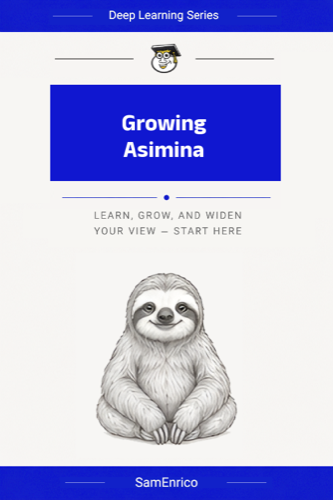
Non-FictionInformativeEducational
Growing Asimina eBook
This publication, published by SamEnrico, covers G
by Jacobs Mabel
This publication, published by SamEnrico, covers Growing Asimina
Formats
Free sample
Chapter 1: The Ice Age Relic...--–- On a cool October morning in the Allegheny foothills of western Pennsylvania, a forager presses her thumb against the yellow-green skin of a wild fruit hanging from a slender tree. The flesh gives way like a ripe avocado. She twists gently, and the fruit releases into her palm. She brings it to her nose and inhales a fragrance that defies logic: the sweet, perfumed aroma of a tropical mango, a hint of banana, and something else entirely—a faint, almost vanilla-like creaminess. She is standing in a deciduous forest where oaks and maples have already begun to turn gold and crimson.
The temperature is fifty-two degrees Fahrenheit. Winter is six weeks away. And yet, she is holding a fruit that tastes like the equator.This is the paradox of the pawpaw. And this chapter is the story of how that impossible fruit came to be.The Strangest Tree in the Temperate Forest The pawpaw (Asimina triloba) is North America’s largest native edible fruit. A single fruit can weigh up to a pound and measure six inches in length.
Its custard-like texture and complex flavor profile—often described as a cross between banana, mango, pineapple, and berries—are unlike anything else produced by a temperate climate tree. Yet most Americans have never tasted one. Many have never heard of it. And those who have often dismiss it as a curiosity, a “poor man’s banana,” or a fruit too fleeting to bother with.But the pawpaw is none of those things. It is, in fact, one of the most extraordinary botanical survivors on the continent.To understand why, we must travel back in time.
Not decades, not centuries, but millions of years. The story of Asimina triloba is written in ice, soil, and the slow drift of continents. It is a story of extinction, adaptation, and a singular evolutionary gamble that paid off against all odds.The Annonaceae Family: A Tropical Lineage in a Cold Climate The pawpaw belongs to the Annonaceae family, commonly known as the custard apple family. This is a lineage of flowering plants that originated in the ancient supercontinent of Gondwana, roughly 100 million years ago, during the mid-Cretaceous period. Today, the Annonaceae family includes more than 2,000 species distributed across the tropics and subtropics of the world.
Its most famous members include the cherimoya (Annona cherimola), the soursop (Annona muricata), the sugar apple (Annona squamosa), and the atemoya (a hybrid). These are plants of the equator and the Tropic of Cancer—warm, humid, frost-free environments where growing seasons stretch uninterrupted by winter.And then there is Asimina. The only member of the Annonaceae family that has successfully colonized temperate latitudes.This is not a minor distinction. It is a botanical outlier of the highest order. Imagine a wild orchid surviving in the Siberian tundra, or a mangrove forest thriving on the shores of Lake Superior.
That is the level of ecological improbability we are dealing with. Somehow, somewhere in the deep evolutionary past, a lineage of Annonaceae adapted not just to survive but to thrive in climates that experience freezing temperatures, snow cover, and a dormant season lasting months.How did this happen?The Ice Age Explanation: Relict Range and Glacial Refugia The answer lies in the Pleistocene epoch, which began approximately 2.6 million years ago and ended around 11,700 years ago. During this period, vast ice sheets advanced and retreated across North America multiple times. The Laurentide Ice Sheet, at its maximum extent, covered most of Canada and reached as far south as modern-day Illinois, Indiana, Ohio, and Pennsylvania. Glaciers scraped the continent clean, obliterating ecosystems and pushing plant and animal communities southward into refugia—isolated pockets of habitable land where life could persist.The pawpaw survived in these refugia.
Specifically, genetic evidence suggests that Asimina triloba retreated to the southeastern United States, in regions that are now Georgia, Alabama, Mississippi, and Florida. When the glaciers retreated for the final time, the pawpaw expanded northward again, recolonizing the eastern deciduous forest. But it never lost its tropical genetic heritage. The fruit still produces the same aromatic compounds as its equatorial cousins. The leaves still have the same ovate shape and leathery texture.
The flowers still carry the faint, fetid odor of carrion—a trait inherited from tropical ancestors that evolved to attract beetles and flies for pollination.What changed was the tree’s phenology: its timing of flowering, fruiting, and dormancy. The pawpaw learned to wait. It learned to go dormant when temperatures dropped and to wake precisely when the risk of hard frost had passed. It learned to produce fruit that ripens in late summer and early autumn—a narrow window that maximizes sunlight exposure while avoiding the killing freezes of winter.This is why the pawpaw is sometimes called the “Ice Age Fruit.” Its very existence is a relic of a world that no longer exists. Its native range—from northern Florida to the Great Lakes, from the Atlantic coast to eastern Nebraska and Texas—is a ghost map of the last glacial retreat.
Every pawpaw tree growing wild in a Pennsylvania hollow or an Ohio river bottom is a living fossil, a testament to the resilience of a tropical lineage that refused to die.The Indigenous-Human Relationship: Before Colonialism Long before European settlers arrived, the pawpaw was well known to the Indigenous peoples of North America. Archaeological evidence suggests that Native Americans cultivated, traded, and selectively propagated pawpaws for centuries prior to contact. The fruit was dried and pressed into cakes for winter storage—a method that concentrated sugars and preserved nutrition. The inner bark was used to make cordage and fishing nets. The leaves and twigs were used in medicinal preparations, including treatments for head lice and fevers.
The seeds, when crushed, were used as a parasiticide.The pawpaw’s name itself likely derives from the Spanish papaya, which early explorers misapplied to the fruit due to its superficial resemblance to tropical papayas. Indigenous names varied widely by language group: the Miami-Illinois people called it cīhkimini, the Meskwaki called it akohkwîmini, and the Cherokee referred to it as tu′kĭ-lĭ (which some sources translate as “no-heart,” possibly referencing the fruit’s distinctive shape). This linguistic diversity reflects the pawpaw’s wide distribution and cultural significance.Trading networks moved pawpaw seeds and dried fruit across the continent. There is evidence that pawpaw seeds reached the Great Plains and the Mississippi River valley through Indigenous trade routes long before European contact. This suggests deliberate cultivation and selection—not merely wild foraging.
Indigenous horticulturalists likely identified superior individuals and planted them near villages, camps, and travel corridors.The Colonial Erasure: Tropical Imports and Agricultural Neglect When European colonists arrived in North America, they encountered a fruit that confused them. It was not an apple, pear, or plum—the familiar fruits of their homelands. It had no established presence in European culinary tradition. And, most critically, it spoiled within days of ripening. A pawpaw picked at peak ripeness would be a mushy, fermented mess by the time it reached any market more than a day’s ride away.Compare this to the tropical imports that began flooding colonial ports in the seventeenth…
This is the end of the free sample. Get the eBook to keep going. Buy now
About this book
Details
- Author
- Jacobs Mabel
- Publisher
- SamEnrico
- Language
- English
- Genre
- Non-Fiction, Informative, Educational
- Released
- 2026-05-11
- Pages (approx.)
- 150
- Available as
- eBook, Audiobook

Read better in the ZLOADR app
Your eBooks on your phone or tablet. Sign in with your SamEnrico account and start reading.
More by Jacobs Mabel
 Zoom Call DistractionsJacobs Mabel$11.99
 Voice Actor Roommate Audition TalesJacobs Mabel$11.99
 Teen Voice Finding GuideJacobs Mabel$11.99
 Stimulant Post Acute WithdrawalJacobs Mabel$11.99
 Gambling Addiction MedicationJacobs Mabel$11.99
 Required Minimum Distribution GuideJacobs Mabel$11.99
 Holiday Grief After Pregnancy LossJacobs Mabel$11.99
 Sleep and Long Term RegulationJacobs Mabel$11.99
 The Night the Sky Burned: The 2017 Grenfell Tower InfernoJacobs Mabel$11.99
 How to Produce Mortars and PestlesJacobs Mabel$11.99
 A Collector's Handbook to the Renault 5Jacobs Mabel$11.99
 Pop Up Retail for Streetwear Brands GuideJacobs Mabel$12.99
You may also like
 Hong Kong Handover 1997Dunn Johnnie$11.99
 Zumba For Postnatal Recovery CourseNeal Christian$11.99
 Zumba for BeginnersLadner Nikia$11.99
 YouTube Comment Mining GuideHumes Pandora$12.99
 Worry Box MeditationCarlin Rudy$11.99
 Workplace Stress MeditationNguyen Lynn$11.99
 Workplace Stress and Sleep RepairHawley Ivory$11.99
 Workplace Perfectionism CureDelaney Jeffry$11.99
 Workplace Injustice Anger GuideWallen Isabelle$11.99
 Work Addiction and Burnout LinkGreenwood Ester$11.99
 Women in Yoga and WellnessBeattie Galina$11.99
 Women in Stand Up ComedyChun Evangeline$11.99