
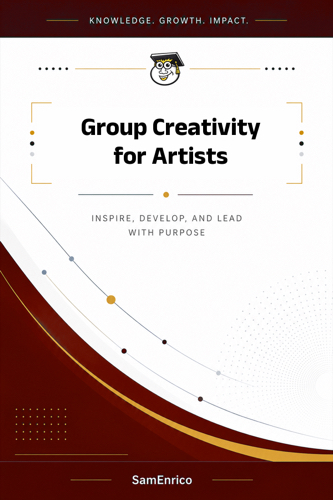
Group Creativity for Artists eBook
Art collective collaborative projects.
by Marsh Edith
Art collective collaborative projects.
Formats
Free sample
Chapter 1: The Lone Genius Lie--–- The artist’s studio has a door. It closes. Inside, one person faces a blank canvas, a block of marble, or an empty page. This image—the solitary creator wrestling with demons and muses alike—has become so ingrained in Western culture that we rarely question it. We build museums around it, structure art schools to protect it, and write biographies that treat collaboration as a curious footnote.
There is only one problem with this picture: it is almost entirely fiction.The myth of the lone genius is not ancient wisdom. It does not stretch back to the cave painters of Lascaux, who almost certainly worked in teams, nor to the cathedral builders of medieval Europe, who organized themselves into elaborate guilds. The lone genius is a relatively recent invention, born from the Romantic movement of the eighteenth and nineteenth centuries, supercharged by the art market’s need for recognizable brands, and canonized by twentieth-century art criticism that preferred the drama of individual struggle to the messier reality of shared creation. This chapter dismantles that myth not for the sake of academic correctness but for a practical reason: if you believe that real art emerges only from solitary struggle, you will never fully commit to collective work. You will hold back, hedge your bets, and sabotage your own collaborations before they have a chance to succeed.The purpose of this book is to treat the group not as a necessary evil or a temporary convenience but as a distinct artistic medium in itself.
A paintbrush is a medium. A camera is a medium. A collective of three, seven, or twelve people is also a medium—one with its own properties, affordances, and limitations. Learning to work with this medium requires unlearning the stories you have been told about where creativity comes from and who gets credit for it. This chapter provides the historical and conceptual foundation for that unlearning.
We will trace the lineage of collaborative art from the Dadaist cabarets of 1920s Zurich to the anonymous collectives of the 1980s, the participatory happenings of the 1960s, and the relational aesthetics of the 1990s. Along the way, we will build a vocabulary for distinguishing different kinds of group work, because not all collaboration looks the same, and not all groups want the same things. Finally, we will introduce a diagnostic framework that will guide you through the rest of this book: the decision between operating as a named collective (where individual members are publicly known and credit matters) or an anonymous collective (where the group speaks as a single, faceless entity). This choice will determine which tools you need and which chapters matter most to you.By the end of this chapter, you will understand that you have never really worked alone—and that admitting this is the first step toward working better together.The Romantic Invention of the Solitary Genius Before the late eighteenth century, the idea of the artist as a tortured loner would have struck most Europeans as strange, even pathological. Medieval painters worked in workshops where masters, apprentices, and assistants collaborated under a single studio name.
Renaissance sculptors like Michelangelo did produce individual masterpieces, but they also oversaw teams of assistants who carved significant portions of what we now attribute to the master alone. The signature on a painting was less an assertion of solitary authorship than a guarantee of quality control, like a brand logo today.The shift began with the Romantics. Poets like William Wordsworth and Samuel Taylor Coleridge celebrated the imagination as a private, almost supernatural faculty. Painters like Caspar David Friedrich depicted lone figures gazing into misty abysses—perfect visual metaphors for the new artistic ideal. The critic John Ruskin elevated the “genius” to a near-sacred status, arguing that true art could only emerge from one person’s singular vision.
This was not an objective description of how art was made; it was a value judgment about how art should be made. And it served a convenient economic function. A single named artist is far easier to market than a collective. You can put a single name on a gallery wall, build a biography around a single life, and create scarcity around a single hand. Collectives complicate all of that.
They dilute the brand. They make it harder to tell a simple story. The art market did not invent the lone genius myth, but it certainly perfected it.The consequences of this myth are not merely historical. They shape the daily experience of artists today. Art schools train students to develop a “unique voice” and protect their “individual vision.” Critique sessions focus on the work of one student at a time, as if the work emerged from a vacuum.
Grant applications ask for a single lead artist. Residencies offer private studios. Every structure of the professional art world reinforces the idea that you are alone. No wonder so many artists feel isolated, competitive, and anxious about sharing credit. The myth of the lone genius is not just a bad description of reality; it is an active source of suffering.The first step toward effective collective work is recognizing that this myth is a choice, not a law of nature.
You can choose to opt out. You can choose to build something else.A New Vocabulary: Collective vs. Collaborative Before we go any further, we need to get precise about our terms. Not all group work is the same, and using vague language leads to confused expectations. This book relies on a key distinction that will appear in every chapter.A collaborative project is temporary.
Specific individuals retain their separate identities. Credit is shared but still attributed. Think of Christo and Jeanne-Claude: they worked as a pair for decades, but each was known as an individual. Their names appeared together. Their biographies were separate.
A collaborative project might last a weekend or a lifetime, but it never erases the fact that distinct people made it.A collective, by contrast, is a long-term identity that supersedes its individual members. Collectives are often (though not always) anonymous or pseudonymous. The group has a name, and that name is the author. The Guerrilla Girls are the paradigmatic example: no one knows their individual identities. They speak as a single voice.
They have persisted for decades even as members have come and gone. In a collective, the group is the artist.This distinction matters because it predicts different challenges and requires different solutions. Collaborative projects need clear agreements about credit, because individuals will eventually leave and want recognition. Collectives need clear agreements about anonymity, because the whole point is that individual identity disappears. A collaborative project can survive the departure of a member with a simple credit adjustment.
A collective must have a mechanism for replacing members without breaking the illusion of a single, continuous entity.Most groups fall somewhere on a spectrum between these two poles. A band might have named members but also a group name that functions as a brand. A theater ensemble might rotate directors but keep the same company name for decades. The diagnostic tool at the end of this chapter will help you figure out where…
This is the end of the free sample. Get the eBook to keep going. Buy now
About this book
Details
- Author
- Marsh Edith
- Publisher
- SamEnrico
- Language
- English
- Genre
- Non-Fiction, Self-Help, Art
- Released
- 2026-06-05
- Pages (approx.)
- 158
- Available as
- eBook, Audiobook

Read better in the ZLOADR app
Your eBooks on your phone or tablet. Sign in with your SamEnrico account and start reading.
More by Marsh Edith
 Telling Family About LayoffMarsh Edith$11.99
 Medication Induced ED GuideMarsh Edith$11.99
 The Growth Mindset for KidsMarsh Edith$11.99
 Stress and Skin Disorders GuideMarsh Edith$11.99
 Postpartum Core RecoveryMarsh Edith$11.99
 Brown Noise Deep SleepMarsh Edith$11.99
 Influence Techniques for VeterinariansMarsh Edith$11.99
 The Hollow Crown: Merlin’s Lost Prophecy and the Fall of CamelotMarsh Edith$11.99
 The Celestial Architects of Meroë: The Astronomy and Engineering of the Kushite KingdomMarsh Edith$11.99
 Echidnas: Egg-laying MammalMarsh Edith$11.99
 A Beginners Guide to Systema (Volume 1)Marsh Edith$11.99
 Payment Assurance for Perishable ExportsMarsh Edith$12.99
You may also like
 Hong Kong Handover 1997Dunn Johnnie$11.99
 Zumba For Postnatal Recovery CourseNeal Christian$11.99
 Zumba for BeginnersLadner Nikia$11.99
 YouTube Comment Mining GuideHumes Pandora$12.99
 Worry Box MeditationCarlin Rudy$11.99
 Workplace Stress MeditationNguyen Lynn$11.99
 Workplace Stress and Sleep RepairHawley Ivory$11.99
 Workplace Perfectionism CureDelaney Jeffry$11.99
 Workplace Injustice Anger GuideWallen Isabelle$11.99
 Work Addiction and Burnout LinkGreenwood Ester$11.99
 Women in Yoga and WellnessBeattie Galina$11.99
 Women in Stand Up ComedyChun Evangeline$11.99