
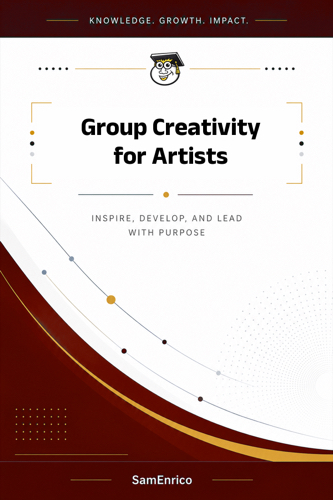
Group Creativity for Artists Audiobook
Art collective collaborative projects.
by Marsh Edith
Art collective collaborative projects.
Formats
Free sample
Chapter 1: The Lone Genius Lie--–- The artist’s studio has a door. It closes. Inside, one person faces a blank canvas, a block of marble, or an empty page. This image—the solitary creator wrestling with demons and muses alike—has become so ingrained in Western culture that we rarely question it. We build museums around it, structure art schools to protect it, and write biographies that treat collaboration as a curious footnote.
There is only one problem with this picture: it is almost entirely fiction.The myth of the lone genius is not ancient wisdom. It does not stretch back to the cave painters of Lascaux, who almost certainly worked in teams, nor to the cathedral builders of medieval Europe, who organized themselves into elaborate guilds. The lone genius is a relatively recent invention, born from the Romantic movement of the eighteenth and nineteenth centuries, supercharged by the art market’s need for recognizable brands, and canonized by twentieth-century art criticism that preferred the drama of individual struggle to the messier reality of shared creation. This chapter dismantles that myth not for the sake of academic correctness but for a practical reason: if you believe that real art emerges only from solitary struggle, you will never fully commit to collective work. You will hold back, hedge your bets, and sabotage your own collaborations before they have a chance to succeed.The purpose of this book is to treat the group not as a necessary evil or a temporary convenience but as a distinct artistic medium in itself.
A paintbrush is a medium. A camera is a medium. A collective of three, seven, or twelve people is also a medium—one with its own properties, affordances, and limitations. Learning to work with this medium requires unlearning the stories you have been told about where creativity comes from and who gets credit for it. This chapter provides the historical and conceptual foundation for that unlearning.
We will trace the lineage of collaborative art from the Dadaist cabarets of 1920s Zurich to the anonymous collectives of the 1980s, the participatory happenings of the 1960s, and the relational aesthetics of the 1990s. Along the way, we will build a vocabulary for distinguishing different kinds of group work, because not all collaboration looks the same, and not all groups want the same things. Finally, we will introduce a diagnostic framework that will guide…
This is the end of the free sample. Get the Audiobook to keep going. Buy now
About this book
Details
- Author
- Marsh Edith
- Publisher
- SamEnrico
- Language
- English
- Genre
- Non-Fiction, Self-Help, Art
- Released
- 2026-06-05
- Pages (approx.)
- 158
- Available as
- eBook, Audiobook

Listen in the VoxFlicks app
Audiobooks and audio dramas wherever you go. Sign in with your SamEnrico account and press play.
More by Marsh Edith
 Telling Family About LayoffMarsh Edith$11.99
 Medication Induced ED GuideMarsh Edith$11.99
 The Growth Mindset for KidsMarsh Edith$11.99
 Stress and Skin Disorders GuideMarsh Edith$11.99
 Postpartum Core RecoveryMarsh Edith$11.99
 Brown Noise Deep SleepMarsh Edith$11.99
 Influence Techniques for VeterinariansMarsh Edith$11.99
 The Hollow Crown: Merlin’s Lost Prophecy and the Fall of CamelotMarsh Edith$11.99
 The Celestial Architects of Meroë: The Astronomy and Engineering of the Kushite KingdomMarsh Edith$11.99
 Echidnas: Egg-laying MammalMarsh Edith$11.99
 A Beginners Guide to Systema (Volume 1)Marsh Edith$11.99
 Payment Assurance for Perishable ExportsMarsh Edith$12.99
You may also like
 Hong Kong Handover 1997Dunn Johnnie$11.99
 Zumba For Postnatal Recovery CourseNeal Christian$11.99
 Zumba for BeginnersLadner Nikia$11.99
 YouTube Comment Mining GuideHumes Pandora$12.99
 Worry Box MeditationCarlin Rudy$11.99
 Workplace Stress MeditationNguyen Lynn$11.99
 Workplace Stress and Sleep RepairHawley Ivory$11.99
 Workplace Perfectionism CureDelaney Jeffry$11.99
 Workplace Injustice Anger GuideWallen Isabelle$11.99
 Work Addiction and Burnout LinkGreenwood Ester$11.99
 Women in Yoga and WellnessBeattie Galina$11.99
 Women in Stand Up ComedyChun Evangeline$11.99