
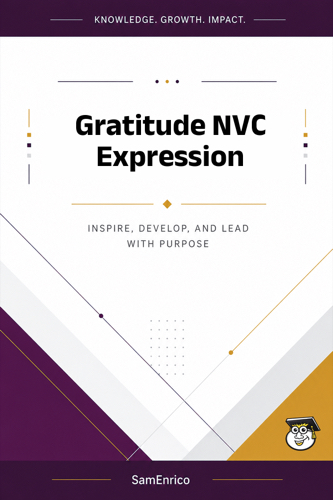
Gratitude NVC Expression eBook
Thank others by specifying what they did and what
by Lea Darnell
Thank others by specifying what they did and what need it met.
Formats
Free sample
Chapter 1: The Praise Paradox--–- Every time you say “good job,” you might be doing the opposite of what you intend. This is not a criticism of your good intentions. It is an invitation to see something most self-help books overlook: the difference between praise that connects and praise that controls.Let’s begin with a simple experiment. Think of the last time someone gave you a compliment that made you feel uncomfortable. Maybe a manager said, “You’re such a reliable employee,” and instead of feeling warm, you felt a subtle pressure to never make a mistake.
Maybe a parent said, “You’re the best daughter anyone could ask for,” and instead of feeling loved, you felt the weight of an unspoken contract. Maybe a partner said, “You’re so patient with me,” and you thought, I’m not patient. I’m exhausted.If you have ever felt uneasy receiving praise, you are not broken. You are not “bad at accepting compliments.” You are responding to something real: the difference between appreciation that enriches life and evaluation that entangles it.This chapter introduces the central problem that the rest of this book will solve. Traditional gratitude—the kind we are taught in parenting books, leadership seminars, and relationship advice columns—often fails.
It fails not because gratitude is bad, but because most of what we call “gratitude” is actually evaluation dressed in nice clothes. And evaluation, even positive evaluation, creates distance, dependency, and anxiety.The good news is that another way exists. The Nonviolent Communication (NVC) model, developed by Marshall Rosenberg, offers a precise, learnable skill for expressing gratitude that actually meets the human need for connection, recognition, and mutual joy. But before we can learn that skill, we must first unlearn the habits that masquerade as thanks.The Hidden Cost of a Compliment Let’s be specific. Imagine three common scenarios.Scenario A: The Workplace Your manager says, “Great work on that report, Sarah.
You’re a rockstar.”On the surface, this seems positive. But let’s look underneath. The word “rockstar” is not a description of what you did. It is a label. It carries unspoken expectations: rockstars work late.
Rockstars never complain. Rockstars solve problems without asking for help. The manager has just given you a role to perform, not acknowledged a specific action.What happens inside Sarah? If she is like most people, she feels a brief flash of pleasure followed by a quieter feeling of pressure. Her need for autonomy—the freedom to work at her own pace—has just been subtly compromised.
Her need for trust—the confidence that she will be appreciated even when she is not exceptional—has been nudged aside. The compliment created a debt, not a celebration.Scenario B: Parenting A father says to his four-year-old, “Good girl! You shared your toy!”The child’s face lights up—for a moment. But researchers have known for decades that person-oriented praise (“good girl,” “you’re so smart”) creates what psychologist Carol Dweck calls a “fixed mindset.” The child learns that her worth depends on performing approved behaviors. She does not learn why sharing matters.
She learns to seek approval.Over time, this child may become less likely to share when no one is watching. She may become anxious about making mistakes. She may grow into an adult who asks, “Do you like me?” rather than “Did my action contribute to life?” The father’s intention was love. The outcome was dependency.Scenario C: Romantic Partnership A partner says, “You’re so thoughtful.”Thoughtful compared to whom? By what standard?
The word “thoughtful” is a judgment, not an observation. The receiving partner may feel seen, or they may feel confused. What exactly did I do? The dishes? The coffee?
The way I listened last night? Without specificity, the gratitude floats in the air, untethered to any actual action. It feels nice, but it does not build the kind of concrete, reliable connection that relationships need to survive conflict.In each of these scenarios, the speaker intended to express gratitude. The speaker likely felt genuine appreciation. But the form of expression—a label, a judgment, a role assignment—undermined the intention.
The result is what Rosenberg called “life-alienating communication”: language that separates us from our own experience and from each other.The Domination Culture Problem To understand why traditional praise fails, we have to look at the larger system in which we learned it. Most of us were raised in what NVC calls domination culture. Domination culture is not about evil people. It is a set of unconscious rules for organizing relationships, and its core logic is simple: reward good behavior, punish bad behavior, and use guilt, shame, obligation, and fear to control people who do not comply on their own.Think about the institutions that shaped you. School: gold stars for correct answers, detention for wrong ones.
Church: blessings for virtue, warnings of hell for sin. Sports: trophies for winners, benches for losers. Family: “I’m so proud of you” when you meet expectations, cold silence when you disappoint.In domination culture, praise is a tool of social control. It is the carrot to punishment’s stick. When you say “good job” to a child, a partner, or an employee, you are not merely expressing joy.
You are also, implicitly, saying “keep doing what I like.” You are positioning yourself as the judge. You are placing the other person in the role of performer.This is not a moral failing. It is a linguistic habit so deep that most of us cannot see it. But once you see it, you cannot unsee it.Now consider the alternative. What if gratitude could be an expression of mutual joy rather than a tool of control?
What if you could thank someone in a way that freed them from the need for your approval rather than chaining them to it? What if the very structure of your words could communicate: “I am not judging you. I am celebrating with you. Your action enriched my life, and I want you to know exactly how, with no strings attached?”That is the promise of NVC gratitude. But to get there, we must first understand why most praise fails at the level of human needs.The Three Hidden Failures of Traditional Praise Let’s break down what actually happens inside a person who receives traditional praise.
Drawing on decades of research in social psychology, developmental psychology, and neuroscience, we can identify three consistent failures.Failure 1: Praise Creates Performance Anxiety When you tell a child “You’re so smart,” they do not feel more confident. They feel more afraid of looking stupid. Dweck’s research is clear: after receiving person-oriented praise, children choose easier tasks, give up faster when frustrated, and lie about their scores. They become risk-averse because they have learned that their worth is on the line.The same pattern appears in adults. In workplace studies, employees who receive generic praise (“great job,” “you’re a star”) report higher anxiety before their next task.
They worry about falling short of the label. They spend energy maintaining an image rather than doing the work.In romantic relationships, partners…
This is the end of the free sample. Get the eBook to keep going. Buy now
About this book
Details
- Author
- Lea Darnell
- Publisher
- SamEnrico
- Language
- English
- Genre
- Non-Fiction, Self-Help
- Released
- 2026-06-11
- Pages (approx.)
- 150
- Available as
- eBook, Audiobook

Read better in the ZLOADR app
Your eBooks on your phone or tablet. Sign in with your SamEnrico account and start reading.
More by Lea Darnell
 Francis and the Wolf of Gubbio StoryLea Darnell$11.99
 Boundary Setting for RoommatesLea Darnell$11.99
 Tax Debt Stress Solutions GuideLea Darnell$11.99
 Virtual Water Cooler MomentsLea Darnell$11.99
 The Frozen Calculus: Newton, Leibniz, and the Arctic Race for Mathematical DiscoveryLea Darnell$11.99
 Chronoquest: The Lost City of ZarahemlaLea Darnell$11.99
 Harvard Extension AdmissionsLea Darnell$12.99
 MindMyHouse Digital NomadLea Darnell$12.99
 Idocrase (Synonym of Vesuvianite) MiningLea Darnell$11.99
 How to Start a Parts of Skirts for Women and Girls Business (Beginners Guide)Lea Darnell$11.99
 Understanding Epidermolysis Bullosa Herpetiformis, Dowling–mearaLea Darnell$17.99
You may also like
 Hong Kong Handover 1997Dunn Johnnie$11.99
 Zumba For Postnatal Recovery CourseNeal Christian$11.99
 Zumba for BeginnersLadner Nikia$11.99
 YouTube Comment Mining GuideHumes Pandora$12.99
 Worry Box MeditationCarlin Rudy$11.99
 Workplace Stress MeditationNguyen Lynn$11.99
 Workplace Stress and Sleep RepairHawley Ivory$11.99
 Workplace Perfectionism CureDelaney Jeffry$11.99
 Workplace Injustice Anger GuideWallen Isabelle$11.99
 Work Addiction and Burnout LinkGreenwood Ester$11.99
 Women in Yoga and WellnessBeattie Galina$11.99
 Women in Stand Up ComedyChun Evangeline$11.99