
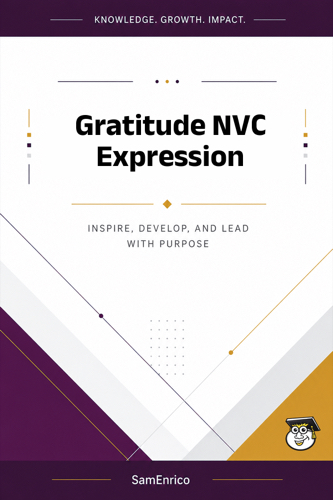
Gratitude NVC Expression
Thank others by specifying what they did and what
by Lea Darnell
Thank others by specifying what they did and what need it met.
Formats
About this book
Free sample
Chapter 1: The Praise Paradox--–- Every time you say “good job,” you might be doing the opposite of what you intend. This is not a criticism of your good intentions. It is an invitation to see something most self-help books overlook: the difference between praise that connects and praise that controls.Let’s begin with a simple experiment. Think of the last time someone gave you a compliment that made you feel uncomfortable. Maybe a manager said, “You’re such a reliable employee,” and instead of feeling warm, you felt a subtle pressure to never make a mistake.
Maybe a parent said, “You’re the best daughter anyone could ask for,” and instead of feeling loved, you felt the weight of an unspoken contract. Maybe a partner said, “You’re so patient with me,” and you thought, I’m not patient. I’m exhausted.If you have ever felt uneasy receiving praise, you are not broken. You are not “bad at accepting compliments.” You are responding to something real: the difference between appreciation that enriches life and evaluation that entangles it.This chapter introduces the central problem that the rest of this book will solve. Traditional gratitude—the kind we are taught in parenting books, leadership seminars, and relationship advice columns—often fails.
It fails not because gratitude is bad, but because most of what we call “gratitude” is actually evaluation dressed in nice clothes. And evaluation, even positive evaluation, creates distance, dependency, and anxiety.The good news is that another way exists. The Nonviolent Communication (NVC) model, developed by Marshall Rosenberg, offers a precise, learnable skill for expressing gratitude that actually meets the human need for connection, recognition, and mutual joy. But before we can learn that skill, we must first unlearn the habits that masquerade as thanks.The Hidden Cost of a Compliment Let’s be specific. Imagine three common scenarios.Scenario A: The Workplace Your manager says, “Great work on that report, Sarah.
You’re a rockstar.”On the surface, this seems positive. But let’s look underneath. The word “rockstar” is not a description of what you did. It…
This is the end of the free sample. Get the eBook to keep going. Buy now
Contents
- Chapter 1
- Chapter 2
- Chapter 3
- Chapter 4
- Chapter 5
- Chapter 6
- Chapter 7
- Chapter 8
- Chapter 9
- Chapter 10
- Chapter 11
- Chapter 12
Details
- Author
- Lea Darnell
- Publisher
- SamEnrico
- Language
- English
- Genre
- Non-Fiction, Self-Help
- Released
- 2026-06-11
- Pages (approx.)
- 150
- Available as
- eBook, Audiobook

Read better in the ZLOADR app
Your eBooks on your phone or tablet. Sign in with your SamEnrico account and start reading.
More by Lea Darnell
 Francis and the Wolf of Gubbio StoryLea Darnell$11.99
 Boundary Setting for RoommatesLea Darnell$11.99
 Tax Debt Stress Solutions GuideLea Darnell$11.99
 Virtual Water Cooler MomentsLea Darnell$11.99
 The Frozen Calculus: Newton, Leibniz, and the Arctic Race for Mathematical DiscoveryLea Darnell$11.99
 Chronoquest: The Lost City of ZarahemlaLea Darnell$11.99
 Harvard Extension AdmissionsLea Darnell$12.99
 MindMyHouse Digital NomadLea Darnell$12.99
 Idocrase (Synonym of Vesuvianite) MiningLea Darnell$11.99
 How to Start a Parts of Skirts for Women and Girls Business (Beginners Guide)Lea Darnell$11.99
 Understanding Epidermolysis Bullosa Herpetiformis, Dowling–mearaLea Darnell$17.99
You may also like
 Workplace Stress MeditationNguyen Lynn$11.99
 Volcano Monitoring ScientistCox Alexis$11.99
 The Tech Professional NetAguiar Nevada$11.99
 The Morning Metta RitualCanales Anya$11.99
 The Chunking Memory TechniqueClanton Hyacinth$11.99
 The Beginner Mistake FixAmmons Cassondra$11.99
 Surrendering to What IsGrimm Reatha$11.99
 Self Hypnosis for Fear of FireBillups Eli$11.99
 Road Rage for Professional DriversBrackett Janise$11.99
 Psychiatric Ward Nurse StressDunning Wyatt$11.99
 Observation vs Evaluation NVCTimmons Alda$11.99
 Networking for Nonprofit ProfessionalsPoole Jesse$11.99