
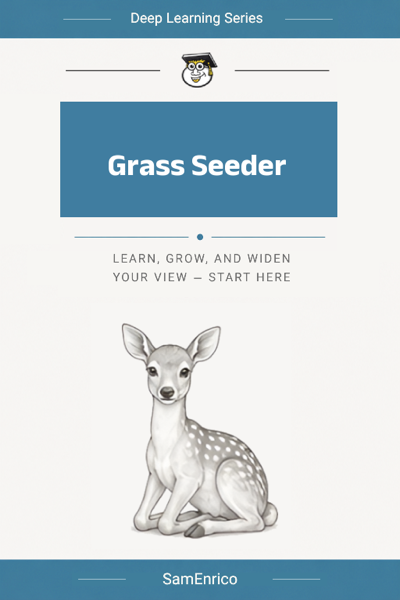
Grass Seeder eBook
A Coursebook on Grass Seeder
by Jay Ninfa
A Coursebook on Grass Seeder
Formats
Free sample
Chapter 1: The Green Frontier--–- On a chilly October morning in eastern Nebraska, Robert Hargrove stood at the edge of a forty-acre field that had been in his family for three generations. The previous year’s soybean harvest had been respectable, but the real challenge lay ahead. He wasn’t planting corn or wheat this time. He was planting grass. Not for a lawn, not for a golf course, but for something far more fundamental: the future of his cattle operation.
The old method of broadcasting seed by hand from a bucket, which his father had sworn by, had left him with thin stands, weed invasions, and soil erosion that carved gullies across his best ground every spring. Last year alone, he estimated he’d lost nearly twenty percent of his seeded area to patchy emergence and bird foraging. Standing there with a new no-till drill hitched to his tractor, Robert realized something that this book will argue from the first page to the last: knowing how to operate a grass seeder is not about machinery alone. It is about understanding the living system beneath your feet, the biology of the seed in your hopper, and the economics of every pound you plant. This chapter establishes why humans across the globe invest billions of dollars and millions of labor hours into planting grass, and why doing it right matters more now than ever before.The Unseen Continent: Why Grass Dominates Human Civilization Grass is the most successful plant family on earth, covering roughly forty percent of the planet’s land surface outside of Antarctica.
From the steppes of Mongolia to the prairies of North America, from the pampas of South America to the savannas of Africa, grasses have shaped human migration, agriculture, and economies for ten thousand years. But the grasses we plant today are not the wild varieties our ancestors encountered. Modern grass seeding is a deliberate, science-driven act that serves three global crop types, each with its own economic and ecological logic.The first category is forage. This is grass grown to feed livestock—cattle, sheep, goats, horses—either as grazed pasture or as harvested hay and silage. In the United States alone, forage crops cover over 130 million acres and generate more than $40 billion in annual value.
Dairy farmers in Wisconsin, beef ranchers in Texas, and sheepherders in New Zealand all share the same fundamental need: a dense, productive, and persistent stand of grass that can withstand grazing pressure and seasonal stress. The difference between a well-seeded pasture and a failed one can mean tens of thousands of dollars per year in supplemental feed costs, veterinary bills, and lost animal weight gain.The second category is turf. This is grass grown for aesthetic, recreational, or functional purposes around human habitation. Lawns, sports fields, golf courses, parks, and roadside verges all fall under this umbrella. The turf industry in North America is estimated at over $40 billion annually when including maintenance, equipment, and inputs.
A single professional sports stadium may contain two to three acres of turf valued at more than $100,000 per acre when replacement costs and downtime are factored in. Golf courses, which represent some of the most intensively managed grass systems on earth, spend between $500,000 and $1.5 million annually on turf establishment and maintenance per eighteen-hole facility. The margin for error in turf seeding is razor thin—a failed fairway renovation can delay play for an entire season and cost a club hundreds of thousands in lost revenue.The third category is conservation. This is grass planted not for harvest or recreation but for ecosystem services: erosion control, water quality improvement, carbon sequestration, wildlife habitat, and flood mitigation. Government programs in the United States, such as the Conservation Reserve Program (CRP), pay landowners more than $1.5 billion annually to take environmentally sensitive land out of production and plant permanent grass covers.
These plantings stabilize soil, filter agricultural runoff, and provide habitat for pollinators and grassland birds. A single acre of well-established conservation grass can trap over four tons of sediment per year, prevent fifty pounds of nitrogen from reaching waterways, and store half a ton of carbon in root biomass annually. The seeding methods used for conservation must work on marginal soils, steep slopes, and without intensive follow-up management—conditions that challenge even experienced operators.These three categories—forage, turf, conservation—do not exist in isolation. A farmer may plant a grass mix for forage that inadvertently provides conservation benefits. A golf course superintendent may adopt turf management practices that reduce runoff.
A conservation planting may be grazed under carefully managed conditions. But the seeding principles that apply to all three share a common foundation: the need to place the right seed, at the right depth, in the right soil conditions, with the right equipment, at the right time of year. Get any one of these wrong, and the entire investment is at risk.The Three Pathways to a Grass Stand: Seeding, Sodding, and Vegetative Propagation Before a single seed leaves the hopper, the grass manager must choose among three fundamentally different establishment methods. Each has its place, its costs, and its risks. Understanding these pathways is the first real decision in any grass project, and it shapes everything that follows.Seeding is the most common method and the central focus of this book.
It involves distributing grass seeds—either dry or as a hydroseeding slurry—onto or into a prepared seedbed. Seeding offers several advantages over the alternatives. First, it is cost-effective. A pound of quality grass seed may cost between $3 and $20 depending on species and cultivar, and typical seeding rates range from ten to two hundred pounds per acre. This compares favorably to sod, which can cost $0.30 to $0.80 per square foot installed—or $13,000 to $35,000 per acre.
Second, seeding provides genetic diversity. A seed mixture can contain multiple species and cultivars, each adapted to different microclimates, soil types, or stress conditions within the same field. Third, seeding allows for rapid establishment of large areas. A single tractor-drawn drill can seed fifty to one hundred acres per day under good conditions, something impossible with hand-planted sod or vegetative material.However, seeding has significant vulnerabilities. Seeds are small, light, and vulnerable to wind, water, and bird predation.
They require precise soil contact and moisture conditions to germinate. They compete poorly with weeds in the early stages. And they take time—anywhere from five to thirty days to emerge, and another four to eight weeks to become robust enough to withstand light traffic or grazing. These vulnerabilities mean that seeding success depends heavily on preparation, timing, and follow-up care, all of which will be explored in detail throughout this book.Sodding is the second method. It involves harvesting mature grass from a specialized farm as a cohesive mat of vegetation, roots, and soil, then rolling it out onto a prepared surface like carpet.
Sod provides instant cover—a mature, functional lawn or sports field within hours rather than weeks. It is virtually immune to erosion immediately upon installation. It can be walked on and used almost immediately. For high-value applications like professional sports stadiums, corporate campuses, or luxury residential projects, sod is often the only acceptable choice.The disadvantages of sod are equally stark.…
This is the end of the free sample. Get the eBook to keep going. Buy now
About this book
Details
- Author
- Jay Ninfa
- Publisher
- SamEnrico
- Language
- English
- Genre
- Non-Fiction, Informative, Educational
- Released
- 2026-06-02
- Pages (approx.)
- 139
- Available as
- eBook, Audiobook

Read better in the ZLOADR app
Your eBooks on your phone or tablet. Sign in with your SamEnrico account and start reading.
More by Jay Ninfa
 HIIT During Pregnancy GuideJay Ninfa$11.99
 Sleep Meditation GroupJay Ninfa$11.99
 Concertmaster Leadership LessonsJay Ninfa$11.99
 Assertiveness with Friends GuideJay Ninfa$11.99
 The OCD Symmetry and Ordering GuideJay Ninfa$11.99
 The Hollow PactJay Ninfa$11.99
 Win Back Campaigns GuideJay Ninfa$12.99
 Dating App Free to PaidJay Ninfa$12.99
 How to Become a Germination WorkerJay Ninfa$11.99
 The Breeder's Guide to Harlequin RabbitsJay Ninfa$11.99