
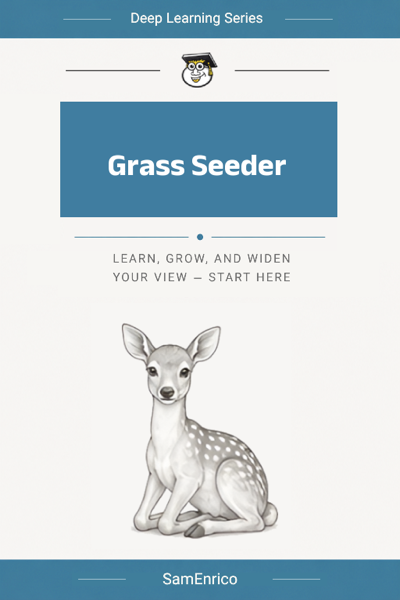
Grass Seeder Audiobook
A Coursebook on Grass Seeder
by Jay Ninfa
A Coursebook on Grass Seeder
Formats
Free sample
Chapter 1: The Green Frontier--–- On a chilly October morning in eastern Nebraska, Robert Hargrove stood at the edge of a forty-acre field that had been in his family for three generations. The previous year’s soybean harvest had been respectable, but the real challenge lay ahead. He wasn’t planting corn or wheat this time. He was planting grass. Not for a lawn, not for a golf course, but for something far more fundamental: the future of his cattle operation.
The old method of broadcasting seed by hand from a bucket, which his father had sworn by, had left him with thin stands, weed invasions, and soil erosion that carved gullies across his best ground every spring. Last year alone, he estimated he’d lost nearly twenty percent of his seeded area to patchy emergence and bird foraging. Standing there with a new no-till drill hitched to his tractor, Robert realized something that this book will argue from the first page to the last: knowing how to operate a grass seeder is not about machinery alone. It is about understanding the living system beneath your feet, the biology of the seed in your hopper, and the economics of every pound you plant. This chapter establishes why humans across the globe invest billions of dollars and millions of labor hours into planting grass, and why doing it right matters more now than ever before.The Unseen Continent: Why Grass Dominates Human Civilization Grass is the most successful plant family on earth, covering roughly forty percent of the planet’s land surface outside of Antarctica.
From the steppes of Mongolia to the prairies of North America, from the pampas of South America to the savannas of Africa, grasses have shaped human migration, agriculture, and economies for ten thousand years. But the grasses we plant today are not the wild varieties our ancestors encountered. Modern grass seeding is a deliberate, science-driven act that serves three global crop types, each with its own economic and ecological logic.The first category is forage. This is grass grown to feed livestock—cattle, sheep, goats, horses—either as grazed pasture or as harvested hay and silage. In the United States alone, forage crops cover over 130 million acres and generate more than $40 billion in annual value.
Dairy farmers in Wisconsin, beef ranchers in Texas, and sheepherders in New Zealand all share the same fundamental need: a dense…
This is the end of the free sample. Get the Audiobook to keep going. Buy now
About this book
Details
- Author
- Jay Ninfa
- Publisher
- SamEnrico
- Language
- English
- Genre
- Non-Fiction, Informative, Educational
- Released
- 2026-06-02
- Pages (approx.)
- 139
- Available as
- eBook, Audiobook

Listen in the VoxFlicks app
Audiobooks and audio dramas wherever you go. Sign in with your SamEnrico account and press play.
More by Jay Ninfa
 HIIT During Pregnancy GuideJay Ninfa$11.99
 Sleep Meditation GroupJay Ninfa$11.99
 Concertmaster Leadership LessonsJay Ninfa$11.99
 Assertiveness with Friends GuideJay Ninfa$11.99
 The OCD Symmetry and Ordering GuideJay Ninfa$11.99
 The Hollow PactJay Ninfa$11.99
 Win Back Campaigns GuideJay Ninfa$12.99
 Dating App Free to PaidJay Ninfa$12.99
 How to Become a Germination WorkerJay Ninfa$11.99
 The Breeder's Guide to Harlequin RabbitsJay Ninfa$11.99