
Non-FictionSelf-HelpPerfectionism
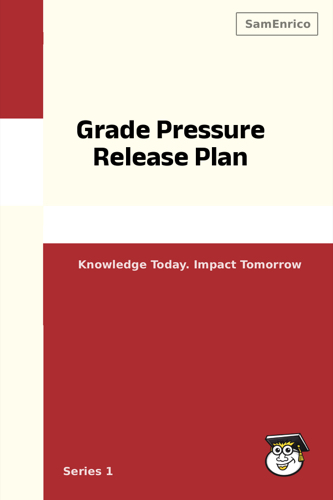
Grade Pressure Release Plan eBook
Reduces perfectionism and fear of failure around g
by Neil Lucius
Reduces perfectionism and fear of failure around grades.
Formats
Free sample
Chapter 1: The Quiet Crisis--–- The text message arrived at 3:17 PM on a Tuesday. "Mom, I can't do this anymore." Attached was a screenshot of a grade portal showing an 82 on a Spanish quiz. The mother, a successful attorney who had graduated summa cum laude, called her daughter immediately. No answer. She drove home to find her straight-A sophomore sobbing on the kitchen floor, convulsing with the kind of grief usually reserved for funerals.
"I'm stupid," the girl gasped. "I'm a failure. Everyone is going to know." The grade in question? A B-minus. On a quiz.
Worth two percent of her final grade. This is not an isolated incident. This is the quiet crisis unfolding in millions of homes across the country, hiding behind closed doors, masked by report cards full of As and extracurricular resumes that glitter like trophies. The students who look most successful on paper are often the ones drowning silently beneath the surface.The rising tide of academic perfectionism has reached epidemic proportions. According to a 2023 meta-analysis published in the Psychological Bulletin, rates of perfectionism among college students have increased by over thirty percent since 1989, with socially prescribed perfectionism—the belief that others demand perfection—showing the steepest rise.
Emergency room visits for anxiety-related symptoms among adolescents have quadrupled in the past decade. Pediatricians report treating "homework tears" as routinely as ear infections. And yet, the cultural narrative remains stubbornly fixated on achievement. We celebrate the valedictorian, the National Merit Scholar, the student who "never settles for less than an A." We do not see the panic attacks, the sleepless nights, the self-harm, the eating disorders, the quiet resignations of students who have decided that if they cannot be perfect, they would rather not exist at all.This book exists because the current approach is not working. More tutoring does not fix perfectionism.
More parental pressure does not fix perfectionism. Even more therapy—while helpful—cannot address the systemic, daily, moment-by-moment patterns that rewire a child's brain to equate a B with worthlessness. What is required is a fundamental release plan: a structured, twelve-week intervention that targets the cognitive, behavioral, and environmental drivers of grade pressure. This is not a book about lowering standards or accepting mediocrity. It is a book about reclaiming your child's mental health without sacrificing their ambition.
It is a book about teaching excellence without terror. And it begins with a single, difficult truth: your child is not lazy. They are terrified.The Great Distinction: Grade Pressure Versus Work Ethic Before we go any further, we must disentangle two concepts that most parents mistakenly conflate. Grade pressure is fear-driven, externally motivated, and anxiety-producing. It says: I must get an A or I am worthless.
Work ethic is internally motivated, effort-focused, and sustainable. It says: I will work hard because I value learning and growth. On the surface, both produce high grades. But beneath the surface, they are as different as a marathon runner and a hostage.Consider two students. Student A wakes up at 5:00 AM to study because she loves biology and wants to understand cellular respiration deeply.
She takes breaks. She asks questions when confused. She gets an A and feels proud. Then she celebrates with friends. Student B wakes up at 5:00 AM to study because she is convinced that if she gets a B, her parents will be disappointed, her teacher will think less of her, and her college applications will be ruined.
She crams until her eyes burn. She does not ask questions because that would reveal ignorance. She gets an A and feels a brief moment of relief, followed immediately by dread about the next test. She cannot celebrate because she is already behind.Student A has work ethic. Student B has grade pressure.
Both have the same transcript. Only one has a future that includes joy.The tragedy is that most parents cannot tell the difference. They see the A and assume everything is fine. They praise the result, not realizing they are pouring gasoline on a fire. The child learns: The A is what matters.
My suffering is invisible. Therefore, I must continue suffering to produce the A. This is the quiet crisis.Why "Lazy" Is Almost Always the Wrong Diagnosis If you have ever looked at your child procrastinating on homework—scrolling Tik Tok, organizing their desk, suddenly passionate about reorganizing their bookshelf—and thought, "They are just being lazy," you are not alone. But you are almost certainly wrong.Clinical research on procrastination reveals a counterintuitive truth: procrastination is rarely about laziness. It is about fear.
The fear of failure loop operates like this: A student anticipates a task that might result in imperfection. That anticipation triggers anxiety. The brain, seeking relief, looks for a distraction. The distraction works—temporarily. The student feels relief.
But now the task is even closer to the deadline, making failure even more likely. The anxiety spikes again. The cycle repeats until the student is cramming at 11:00 PM, producing work far below their ability, and confirming their deepest fear: I am not good enough.This is not laziness. This is a sophisticated, unconscious protection strategy. The student's brain is saying: If I only have one hour to study, I cannot be blamed for the bad grade.
But if I study for ten hours and still fail, that means I am fundamentally flawed. Procrastination preserves the possibility of brilliance. It is a shield for the ego, not a character defect.Understanding this distinction is liberating. When you stop seeing procrastination as a moral failing, you can start addressing the actual problem: fear. And fear, unlike laziness, responds to specific, evidence-based interventions.
Those interventions—beginning with the 5-Minute Start introduced in Chapter 2—are the backbone of this book.The 12-Week Roadmap: A Structured Intervention This book is not designed to be read in a weekend and then forgotten. It is a twelve-week intervention, with each chapter corresponding to one week of active work. Attempting to rush through will undermine the entire process. Perfectionism took years to wire into your child's nervous system. It will take weeks to rewire.Here is the weekly roadmap:Weeks 1-3: Diagnosis – You will identify your child's perfectionism profile (Chapter 1), understand the fear-procrastination loop (Chapter 2), and begin rewiring their mindset from fixed to growth using the unified Failure Practice protocol (Chapter 3).Weeks 4-6: Release – Parents will learn the Three C's framework and implement the 24-Hour Rule (Chapter 4).
Families will address gendered perfectionism (Chapter 5). Students will master strategic imperfection using the 80/20 Rule and timeboxing (Chapter 6).Week 7: Systemic Support – You will learn how to partner with teachers, request accommodations, and advocate for your child without over-functioning (Chapter 7).Weeks 8-11: Safety Net – Students will diversify their identities beyond grades (Chapter 8). Families will learn the Autopsy Without Blame protocol for processing real failures (Chapter 9). Parents will navigate the social pressure cooker of peers and college admissions (Chapter 10). Students will master mindfulness techniques for test anxiety (Chapter 11).Week 12: Permanent Release – The final chapter guides students in defining success on their own terms, converting all future product goals into process goals, and writing a Letter to Their Future Self that has nothing to…
This is the end of the free sample. Get the eBook to keep going. Buy now
About this book
Details
- Author
- Neil Lucius
- Publisher
- SamEnrico
- Language
- English
- Genre
- Non-Fiction, Self-Help, Perfectionism
- Released
- 2026-06-09
- Pages (approx.)
- 123
- Available as
- eBook, Audiobook

Read better in the ZLOADR app
Your eBooks on your phone or tablet. Sign in with your SamEnrico account and start reading.
More by Neil Lucius
 Caregiver Stress Partner GuideNeil Lucius$11.99
 Breathwork for Deep SleepNeil Lucius$11.99
 Meditation for Nighttime RuminationNeil Lucius$11.99
 Peg System for Mental MathNeil Lucius$11.99
 Roma Room MethodNeil Lucius$11.99
 Rocky Mountain Elk MeadowNeil Lucius$11.99
 Loving Kindness For Direct ReportsNeil Lucius$11.99
 The Last Lap: The Untold Story of Cathy Freeman's 2000 Sydney GoldNeil Lucius$11.99
 The Vanishing of the D.B. Cooper Heist: A Sky High MysteryNeil Lucius$11.99
 The Last Dance: Jordan’s Mind PalaceNeil Lucius$11.99
 The Mineral Guide to CobaltiteNeil Lucius$11.99
 Growing DuvaliaNeil Lucius$11.99
You may also like
 Hong Kong Handover 1997Dunn Johnnie$11.99
 Zumba For Postnatal Recovery CourseNeal Christian$11.99
 Zumba for BeginnersLadner Nikia$11.99
 YouTube Comment Mining GuideHumes Pandora$12.99
 Worry Box MeditationCarlin Rudy$11.99
 Workplace Stress MeditationNguyen Lynn$11.99
 Workplace Stress and Sleep RepairHawley Ivory$11.99
 Workplace Perfectionism CureDelaney Jeffry$11.99
 Workplace Injustice Anger GuideWallen Isabelle$11.99
 Work Addiction and Burnout LinkGreenwood Ester$11.99
 Women in Yoga and WellnessBeattie Galina$11.99
 Women in Stand Up ComedyChun Evangeline$11.99