
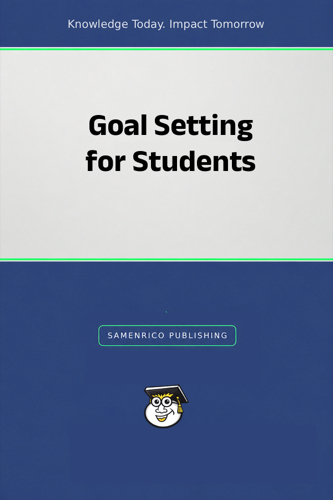
Goal Setting for Students eBook
Academic and college application targets.
Academic and college application targets.
Formats
Free sample
Chapter 1: Your Brain Lies to You--Your phone is buzzing. Again. You tell yourself you’ll check it “real quick,” just to see who texted. Forty-five minutes later, you’re watching a video of a dog riding a Roomba, your homework is untouched, and you have no idea how you got here. You sigh, feel a familiar twist of guilt in your stomach, and mutter the words that have become your personal mantra: “I’m so lazy.”What if I told you that you’re not lazy?What if I told you that the feeling of staring at a blank document, the urge to reorganize your pencil case instead of starting your essay, the sudden and overwhelming need to clean your entire room the night before a deadline — none of that is a character flaw?
What if it’s actually your brain trying to protect you from something it mistakenly thinks will hurt you?This is not a trick. This is not toxic positivity. This is neuroscience.Before you can set a single goal, before you can open a planner or write a to-do list, you need to understand the single most important truth in this entire book: your brain has been programmed to make studying feel dangerous. And until you learn to trick that ancient, well-meaning, but deeply unhelpful alarm system, no goal-setting system in the world will work. You will continue to procrastinate, not because you are weak, but because you are human.Let me prove it to you.The Amygdala Doesn't Know About Finals Deep in the center of your skull, about the size and shape of an almond, sits a small cluster of neurons called the amygdala.
Its job is simple and ancient: keep you alive. Thousands of years ago, when your ancestors were walking across savannas, the amygdala was the smoke detector. It scanned for threats. A rustle in the grass? Amygdala fires.
A shadow moving too fast? Amygdala screams. A stranger with a spear? Amygdala says RUN.Here’s the problem. Your amygdala cannot tell the difference between a saber-toothed tiger and a calculus final.When you open your textbook and see a page of equations that look like a foreign language, your amygdala does not think, “Ah yes, this is a moderately challenging academic task that will require focused effort and perhaps a review of Chapter 4.” No.
Your amygdala thinks, “THREAT. UNKNOWN. POTENTIALLY DANGEROUS. ENGAGE EMERGENCY PROTOCOLS.”And what are those emergency protocols? You know them intimately.
Your heart rate increases slightly. Your palms get clammy. A vague sense of dread settles into your chest. And then — this is the sneaky part — your brain looks for the nearest exit. Not a physical exit (you’re not actually running out of the classroom, because even your amygdala knows that would be weird).
A mental exit. Your phone. Your laundry. Your suddenly urgent need to reorganize your bookshelf. The Wikipedia page for the Franco-Prussian War, which you have absolutely no reason to read.That feeling you call “laziness” is actually avoidance.
And avoidance is not a moral failure. It is a neurological reflex.The Pain of Starting Is Worse Than the Pain of Doing Here’s the part that will blow your mind. Researchers have actually measured this. In a now-famous study, participants were given a math problem to solve and told they could choose to do it immediately or delay it. While they thought about their choice, the researchers scanned their brains using f MRI machines.
Here’s what they found: the brain’s pain centers lit up more intensely while participants anticipated doing the math problem than while they actually did the math problem.Let me say that again. The anticipation of work was more painful than the work itself.Think about what this means for your daily life. The fifteen minutes you spend scrolling before you start your homework? That’s your amygdala trying to avoid anticipated pain. The twenty minutes you spend finding the “perfect” study playlist?
Avoidance. The three times you get up to get water, then a snack, then a different snack? Avoidance, avoidance, avoidance.You are not avoiding the work. You are avoiding the feeling of starting the work. And once you actually start — once you write that first sentence, solve that first problem, read that first paragraph — the pain disappears.
The amygdala calms down. Your brain realizes, “Oh, this isn’t a tiger. This is just algebra. We can handle algebra.”But here’s the cruel trick. Your brain doesn’t learn this lesson.
Every single time you face a new assignment, the amygdala fires again. Because the amygdala doesn’t have a memory for “last time this was fine.” It only has a memory for “unknown thing might be dangerous.” So you are fighting the same battle every day. And every day, you call yourself lazy for losing a battle that your own biology is rigging against you.The Myth of the "Lazy Student"Let’s pause here and talk about the word “lazy” itself. Where did you learn it? Probably from a parent, a teacher, or that voice in your head that sounds suspiciously like both of them combined.
“You’re so lazy.” “Stop being lazy.” “If you weren’t so lazy, you’d have better grades.”Here’s what no one tells you. There is almost no scientific evidence that “laziness” exists as a stable personality trait. What we call laziness is almost always one of three things: fear, fatigue, or friction.Fear is what we just talked about — your amygdala running its ancient protection program. Fatigue is your body and brain genuinely needing rest, which we’ll cover in Chapter 11. And friction?
Friction is the gap between you and the thing you need to do. If your textbook is in your backpack, in your locker, on the other side of the school, that’s friction. If you have to log into three different portals to find your assignment, that’s friction. If your desk is covered in clutter, that’s friction.None of these are character flaws. Fear is biology.
Fatigue is physiology. Friction is design. And design can be fixed.So here is your first and most important reframe. From this moment forward, you are forbidden from calling yourself lazy. Not because I’m being nice.
Because it is scientifically inaccurate. When you catch yourself thinking, “I’m so lazy,” you will instead ask one of three questions:“What am I afraid of right now?” (Fear)“When did I last sleep or eat?” (Fatigue)“What is making this task harder to start than it needs to be?” (Friction)That’s it. That’s the whole trick. You are not broken. You are just asking the wrong question.The Yet Protocol: Your New Best Friend Now let’s move from the biology of avoidance to the psychology of belief.
Because even if you understand why your brain is trying to protect you, you still have to actually do the work. And doing the work requires believing that the work is possible.Meet Carol Dweck. She’s a psychologist at Stanford, and she spent decades studying something she calls “mindset.” Her discovery was simple and world-changing: people…
This is the end of the free sample. Get the eBook to keep going. Buy now
About this book
Details
- Author
- Orozco Deidra
- Publisher
- SamEnrico
- Language
- English
- Genre
- Non-Fiction, Self-Help, Student
- Released
- 2026-06-05
- Pages (approx.)
- 125
- Available as
- eBook, Audiobook

Read better in the ZLOADR app
Your eBooks on your phone or tablet. Sign in with your SamEnrico account and start reading.
More by Orozco Deidra
 CEO Stress and Decision FatigueOrozco Deidra$11.99
 Taganrog Criminal SyndicateOrozco Deidra$11.99
 Benzodiazepine DetoxOrozco Deidra$11.99
 Restaurant Kitchen Anger GuideOrozco Deidra$11.99
 Cross Industry AnalogiesOrozco Deidra$11.99
 TM History and OriginsOrozco Deidra$11.99
 Senior Sexuality EsteemOrozco Deidra$11.99
 Sigrid Undset: The Nobel Laureate Who Defied the NazisOrozco Deidra$11.99
 Whispers of the Forgotten: The Lost Library of AlexandriaOrozco Deidra$11.99
 The Photographer's Guide to Street PhotographyOrozco Deidra$11.99
 How to Produce Prepared Appetizers and Side DishesOrozco Deidra$11.99
 Bankruptcy Cross Border IssuesOrozco Deidra$12.99
You may also like
 Hong Kong Handover 1997Dunn Johnnie$11.99
 Zumba For Postnatal Recovery CourseNeal Christian$11.99
 Zumba for BeginnersLadner Nikia$11.99
 YouTube Comment Mining GuideHumes Pandora$12.99
 Worry Box MeditationCarlin Rudy$11.99
 Workplace Stress MeditationNguyen Lynn$11.99
 Workplace Stress and Sleep RepairHawley Ivory$11.99
 Workplace Perfectionism CureDelaney Jeffry$11.99
 Workplace Injustice Anger GuideWallen Isabelle$11.99
 Work Addiction and Burnout LinkGreenwood Ester$11.99
 Women in Yoga and WellnessBeattie Galina$11.99
 Women in Stand Up ComedyChun Evangeline$11.99