

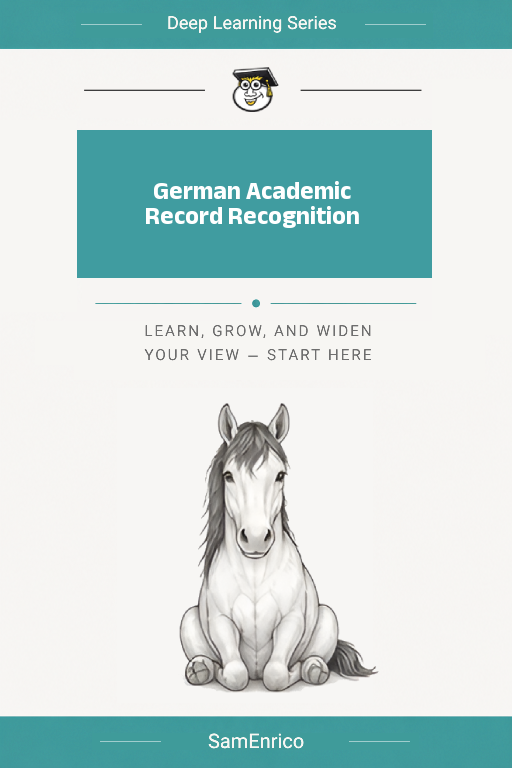
Non-FictionCredential GuideDocumentation
German Academic Record Recognition eBook
Get your foreign credentials recognized. Anabin da
Get your foreign credentials recognized. Anabin database and statement of comparability explained.
Formats
Free sample
Chapter 1: The Invisible Filter--Marina had done everything right. She had spent four years earning her Master's degree in Project Management from a respected university in Kyiv. She had saved for two years to afford the language classes, pushing her German to a solid B2 level. She had ten years of professional experience, including managing cross-border teams and multimillion-euro budgets. She had packed her entire life into two suitcases, said goodbye to her family, and boarded a one-way flight to Berlin with exactly €8,000 in her savings account — enough, she had calculated, to survive six months of job searching.Three hundred and forty-seven applications later, Marina had received exactly zero interview invitations.Not rejections, mind you.
Rejections would have at least acknowledged her existence. Rejections would have meant a human being had looked at her resume and made a decision. What Marina received was silence. A black hole. Application after application, uploaded into corporate portals, never to be seen again.She sat in her temporary apartment in Neukölln, staring at her laptop screen, and asked herself the question that haunts thousands of foreign professionals in Germany every single day: "What am I doing wrong?"The answer, when she finally discovered it, was not what she expected.
The problem was not her qualifications. The problem was not her German level. The problem was not her interview skills — she had never even reached the interview stage. The problem was something she had never heard of before moving to Germany. A database called Anabin.Marina's university was not in it.
And in the German system, a degree that cannot be verified is a degree that does not exist.The Silent Rejection Machine Marina's story is not unusual. It is not even remarkable. Every week, thousands of qualified professionals from outside Germany submit applications to German employers and receive nothing but silence. They blame themselves. They assume their degrees are worthless.
They assume their experience does not count. They assume Germany has rejected them personally.None of these assumptions are true.What Marina encountered — what you may be encountering right now — is what I call the Invisible Filter. It is not personal. It is not malicious. It is simply the way German bureaucracy has evolved to handle an impossible volume of international applications.
And once you understand how it works, you can not only bypass it — you can make it work in your favor.The Invisible Filter operates through three overlapping systems that most foreign applicants never see. Understanding each one is the first step toward defeating it.The First Filter: Applicant Tracking Systems Large German companies receive hundreds — sometimes thousands — of applications for a single job posting. A human resources department cannot manually review every CV. Instead, they use Applicant Tracking Systems (ATS): software that scans incoming applications and automatically rejects those that do not meet predetermined criteria.These criteria are set by HR managers who, more often than not, have no expertise in evaluating foreign degrees. They do not know which universities in India, Brazil, or Vietnam are reputable.
They do not know how a three-year Bachelor's from one country compares to a four-year Bachelor's from another. So they take the path of least resistance: they configure their ATS to accept only applicants whose degrees can be instantly verified through a single source.That source is Anabin.If your university is listed in Anabin as H+ (fully recognized), and your specific degree appears in the database as equivalent to a German degree, the ATS lets your application pass to a human reviewer. If either of those conditions is not met, the ATS silently rejects your application. You never receive a notification. You never receive an explanation.
Your application simply disappears.The Second Filter: Immigration Law Even if you bypass the ATS and receive a job offer, you are not done. To work legally in Germany as a non-EU citizen, you need a residence permit. The most common permit for qualified professionals is the EU Blue Card, governed by Section 18b of the German Residence Act (Aufenth G).The law is explicit: to qualify for a Blue Card, you must have either a German university degree or a foreign university degree that is "recognized" or "comparable" to a German degree.What does "recognized" mean in legal terms? It does not mean your employer thinks your degree is fine. It does not mean you have years of successful work experience.
It means a formal determination by the Central Office for Foreign Education (ZAB) that your degree is equivalent to a German degree. That determination comes in the form of a document called the Statement of Comparability (Zeugnisbewertung).Without that document, your foreign degree is legally invisible. You cannot get a Blue Card. You cannot get most other work visas. You cannot even apply for many university programs.
Your degree might as well not exist.The Third Filter: Employer Uncertainty The third filter is the most subtle but perhaps the most powerful. Even when a German employer wants to hire you, even when their ATS has not rejected you automatically, they face a problem: they do not know how to evaluate your degree.German HR professionals are trained to assess German degrees. They know what a Bachelor from the Technical University of Munich means. They know what a Master from the University of Heidelberg represents. But ask them to evaluate a degree from the University of Mumbai, the American University of Beirut, or the National University of Kyiv, and you will see uncertainty creep into their eyes.This uncertainty kills job offers.
Employers do not like uncertainty. They like clear, verifiable facts. If you cannot provide a document that translates your foreign degree into German terms, they will often choose a candidate who can — even if that candidate is less qualified.The Statement of Comparability solves this problem. It takes your foreign degree and gives it a German equivalent: "equivalent to a German Bachelor of Science in Mechanical Engineering." Now the HR professional knows exactly what they are looking at. The uncertainty disappears.
The job offer becomes possible.The Triad of Recognition: What You Actually Need Before we go further, we need to clear up a fundamental confusion that derails most applicants. There are three different things people mean when they say "degree recognition." They are not the same. Mixing them up will waste months of your time.Academic Recognition (The ZAB Statement)Academic recognition is what this book is primarily about. It is a formal determination by the ZAB that your foreign degree is equivalent to a German degree. The output is a document called the Statement of Comparability (Zeugnisbewertung).This document is used for:EU Blue Card applications Other work visa applications under Section 18b Aufenth GAdmission to German universities for further study Employer verification (showing HR that your degree is legit)Permanent residency applications (the statement cuts waiting time from 5 years to 21 months with B1 German)The ZAB Statement does not give you permission to practice regulated professions like medicine or law.
It only verifies your academic qualification.Professional Recognition (State Licensure)Professional recognition is separate from academic recognition. It is required only for regulated professions — occupations where German law requires a license to…
This is the end of the free sample. Get the eBook to keep going. Buy now
About this book
Details
- Author
- Delvalle Angele
- Publisher
- SamEnrico
- Language
- English
- Genre
- Non-Fiction, Credential Guide, Documentation
- Released
- 2026-05-28
- Pages (approx.)
- 152
- Available as
- eBook, Audiobook

Read better in the ZLOADR app
Your eBooks on your phone or tablet. Sign in with your SamEnrico account and start reading.
More by Delvalle Angele
 Walking Meditation For Teens GuideDelvalle Angele$11.99
 Learning Language Memory BoostDelvalle Angele$11.99
 Construction Trade Alcohol RecoveryDelvalle Angele$11.99
 The Forgiveness Chair TechniqueDelvalle Angele$11.99
 Body Scan for Nurses GuideDelvalle Angele$11.99
 The Ballot Box Bombing: New Zealand's Forgotten Political AssassinationDelvalle Angele$11.99
 Understanding Occupational Asthma Animals, Insects and FungiDelvalle Angele$17.99
 Structural Design EngineerDelvalle Angele$11.99
 Heijunka Production Leveling HandbookDelvalle Angele$12.99
 How to Start a Chimney Cleaning Business (Beginners Guide)Delvalle Angele$11.99
You may also like
 Hong Kong Handover 1997Dunn Johnnie$11.99
 Zumba For Postnatal Recovery CourseNeal Christian$11.99
 Zumba for BeginnersLadner Nikia$11.99
 YouTube Comment Mining GuideHumes Pandora$12.99
 Worry Box MeditationCarlin Rudy$11.99
 Workplace Stress MeditationNguyen Lynn$11.99
 Workplace Stress and Sleep RepairHawley Ivory$11.99
 Workplace Perfectionism CureDelaney Jeffry$11.99
 Workplace Injustice Anger GuideWallen Isabelle$11.99
 Work Addiction and Burnout LinkGreenwood Ester$11.99
 Women in Yoga and WellnessBeattie Galina$11.99
 Women in Stand Up ComedyChun Evangeline$11.99