
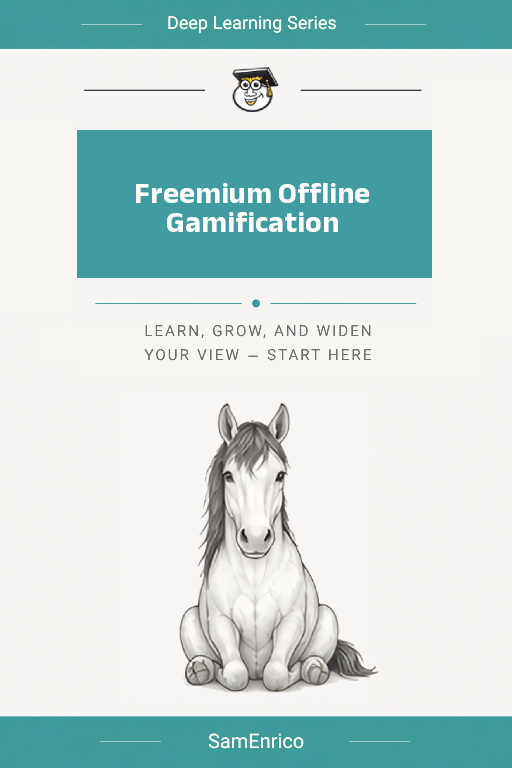
Non-FictionBusiness BriefGamification
Freemium Offline Gamification eBook
Add gamification elements that work without intern
by Wiles Sindy
Add gamification elements that work without internet for freemium users. Award badges locally and sync achievements when connection returns.
Formats
Free sample
Chapter 1: The Connectivity Bias--–- The meeting was supposed to be routine. Sarah, a product manager for a fitness app with three million monthly active users, was presenting retention data to her executive team. The numbers were good—industry standard, even—but not great. Day 7 retention hovered around 28 percent. Day 30 was a tragic 12 percent.
The team had tried everything: more push notifications, brighter badge animations, more aggressive leaderboards, double-reward weekends. Nothing moved the needle beyond statistical noise.Then someone asked a question that changed everything: "What do our subway riders see?"Sarah pulled up the analytics segmented by connectivity. What she found stopped the meeting cold. Users who opened the app during their morning commute—specifically in the 15-minute window when they were underground with no signal—had a 73 percent higher churn rate on those days. The app's gamification system (daily streaks, achievement pop-ups, and a live leaderboard) simply broke when the "Spinner of Death" appeared.
Users would complete a workout, wait for the badge to appear, see an infinite loading indicator, and close the app. Many never came back that day. Some never came back at all.The Connectivity Tax, as Sarah later termed it, was costing her company an estimated 1.2 million lost user sessions per month. And she had never even thought to look for it.This chapter dismantles the foundational assumption that has corrupted gamification design for a decade: the belief that users always have reliable, low-latency internet access. We will explore the hidden geography of disconnection, the psychological damage inflicted by broken feedback loops, and the massive market opportunity hiding in plain sight.
By the end, you will understand why offline-first gamification is not a fallback feature but the primary engine of retention, engagement, and freemium conversion.The Geography of Disconnection Let us begin with a simple exercise. Open your phone's settings and navigate to your screen time or battery usage report. Scroll down to the hours between 7:00 AM and 9:00 AM, and again between 5:00 PM and 7:00 PM. What do you see? For the majority of mobile users in urban environments, these windows show the highest app usage of the day.
They are also the windows during which users are most likely to be in transit—subways, buses, trains, elevators, parking garages, and tunnels.Now consider the connectivity reality of these environments. A 2023 study by Open Signal analyzing 50 million mobile devices across 87 countries found that the average urban commuter experiences 12 to 18 minutes of total signal loss per day, distributed across 6 to 9 discrete dead zones. That is not a fringe case. That is a structural feature of modern mobility.The numbers become even more dramatic when we expand the definition of "liminal connectivity zones"—environments where signal exists but is unreliable, high-latency, or expensive. Consider:Subway systems: Over 200 cities worldwide have underground metro networks.
In New York City alone, 5.5 million daily riders lose signal for an average of 22 minutes per trip.Elevators and stairwells: The average office worker spends 7 minutes per day in elevator banks and stairwells where cellular signals are attenuated by concrete and steel.Airplanes: Over 4 billion passengers annually experience 2 to 14 hours of complete disconnection during flights. In-flight Wi-Fi remains expensive, slow, and frequently broken.Rural and suburban fringe: Approximately 15 percent of the US population and over 30 percent of the global population live in areas where cellular data speeds drop below 2 Mbps—too slow for real-time gamification validation.Hospitals, schools, and government buildings: Many institutional buildings are designed with signal-blocking materials (lead-lined walls, metal framing, faraday cage-adjacent construction) that create unpredictable dead zones.Parking garages and basements: Almost universally, these spaces have no signal. Millions of users pass through them daily, often while checking apps before entering a building or after leaving a car.The aggregate picture is staggering. The average smartphone user experiences between 45 and 90 minutes of total disconnection per week—not by choice, but by environmental constraint. That is roughly the same amount of time they spend exercising, or commuting, or waiting in line.
It is free time. It is prime app usage time. And it is almost entirely wasted by gamification systems that assume constant connectivity.The Spinner of Death To understand why disconnection destroys engagement, we must first understand flow state. Psychologist Mihaly Csikszentmihalyi, in his seminal work on optimal experience, described flow as the mental state in which a person is fully immersed in an activity, with energized focus, full involvement, and enjoyment of the process. Flow requires three conditions:Clear goals with immediate feedback A balance between perceived challenges and perceived skills A sense of personal control over the activity Gamification is, at its core, a flow-engineering discipline.
Badges, points, leaderboards, progress bars, and streaks are all designed to provide immediate feedback. They answer the question "Did I do it right?" within milliseconds. When that feedback loop breaks, flow collapses.The "Spinner of Death"—that dreaded animated loading indicator—is not a neutral visual element. It is a psychological event. Every millisecond the spinner spins, the user experiences a cascade of negative cognitive responses:Confusion: "Did I press the wrong button?
Did the action register?"Frustration: "Why is this taking so long? This should be instant."Suspicion: "Is the app broken? Is my data being saved?"Abandonment: "I don't have time for this. I'll check later."And here is the cruel irony: the user never actually sees the spinner because they have already looked away. The moment a gamification system fails to provide immediate feedback, the user's brain disengages and seeks a more reliable source of dopamine—usually another app, a notification, or simply locking the phone and looking up at the real world.The Spinner of Death is not merely an annoyance.
It is a conversion killer. In A/B tests conducted across multiple freemium applications (dating back to 2018 research from conversion optimization firm Wider Funnel), the presence of a loading spinner of more than 400 milliseconds reduced completion rates by 11 percent. At one second, the reduction was 26 percent. At three seconds—a typical server round-trip in poor connectivity—completion rates dropped by 57 percent.Let that number sink in. If your gamification system requires server validation for every badge, point, or streak, and your user is in a dead zone, you are losing more than half of your engagement opportunities.
Not due to product-market fit. Not due to bad design. Due to physics.The Connectivity Tax Formula We can now define the Connectivity Tax with mathematical precision. Let:E = Total engagement events (badge earns, streak completions, level ups, etc.) in a given period S = Signal availability (percentage of time with reliable, low-latency connectivity)F = Feedback loop latency in seconds (time from user action to system response)R(F) = Retention rate as a function of latency, where R(F) decays exponentially after 500ms The Connectivity Tax is the lost engagement due to signal failure, expressed as:Tax = E * (1 - S) * (1 - R(F))For a typical freemium app with 1 million daily engagement events, 85 percent signal availability (generous for urban commuters), and an average latency of 2 seconds (optimistic for cellular networks), the daily tax is approximately:1,000,000 * 0.15 * 0.74 = 111,000 lost engagement events per day Over a month, that is over 3 million lost badges, streaks, and level completions. Over a year, it approaches 40 million.
This is not a rounding error. This is the difference between a healthy freemium business and a struggling one.The Case…
This is the end of the free sample. Get the eBook to keep going. Buy now
About this book
Details
- Author
- Wiles Sindy
- Publisher
- SamEnrico
- Language
- English
- Genre
- Non-Fiction, Business Brief, Gamification
- Released
- 2026-06-01
- Pages (approx.)
- 135
- Available as
- eBook, Audiobook

Read better in the ZLOADR app
Your eBooks on your phone or tablet. Sign in with your SamEnrico account and start reading.
More by Wiles Sindy
 The Virtual Meeting FixWiles Sindy$11.99
 NVC For Indigenous ReconciliationWiles Sindy$11.99
 Dividend Index Fund StrategyWiles Sindy$11.99
 Chest Compressions Deep DiveWiles Sindy$11.99
 The Poisoned Tea: Japan's Forgotten Female Serial Killer of the Prohibition EraWiles Sindy$11.99
 How to Produce Bisque PrimerWiles Sindy$11.99
 Artistic DirectorWiles Sindy$11.99
 How to Become a Glass-cut-off SupervisorWiles Sindy$11.99
You may also like
 Hong Kong Handover 1997Dunn Johnnie$11.99
 Zumba For Postnatal Recovery CourseNeal Christian$11.99
 Zumba for BeginnersLadner Nikia$11.99
 YouTube Comment Mining GuideHumes Pandora$12.99
 Worry Box MeditationCarlin Rudy$11.99
 Workplace Stress MeditationNguyen Lynn$11.99
 Workplace Stress and Sleep RepairHawley Ivory$11.99
 Workplace Perfectionism CureDelaney Jeffry$11.99
 Workplace Injustice Anger GuideWallen Isabelle$11.99
 Work Addiction and Burnout LinkGreenwood Ester$11.99
 Women in Yoga and WellnessBeattie Galina$11.99
 Women in Stand Up ComedyChun Evangeline$11.99