
Non-FictionHealth & WellnessEmergency Medicine
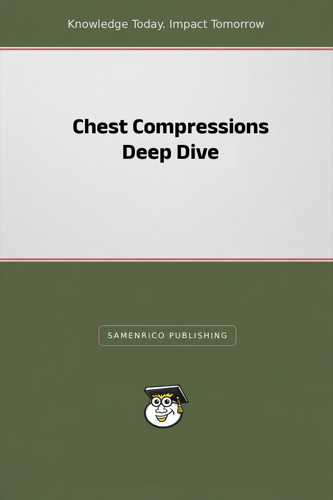
Chest Compressions Deep Dive
Teaches correct hand placement, depth, and rate fo
by Wiles Sindy
Teaches correct hand placement, depth, and rate for adult and pediatric CPR scenarios.
Formats
About this book
Free sample
Chapter 1: The Squeeze Deception...–- Most people believe that cardiopulmonary resuscitation works because the rescuer physically squeezes the heart between the sternum and the spine. This is wrong. Not partially incorrect or oversimplified, but fundamentally, physiologically, and clinically wrong. Yet this misconception persists in the minds of medical students, paramedics, and even some emergency physicians because it feels intuitive. You push on the chest.
The heart sits between the breastbone and backbone. Squeezing it must eject blood. The logic is seductive. It is also dangerously misleading, and believing it leads rescuers to make precisely the wrong mechanical choices during the critical first minutes of a cardiac arrest.The mistake matters because the mechanics of a high-quality chest compression are not intuitive. They are counterintuitive.
If you try to squeeze the heart directly, you will compress too slowly, focus too much force on the left ventricle, and fail to generate the intrathoracic pressure gradients that actually drive blood flow. You will also fatigue faster, because squeezing is a sustained muscle action, while effective compressions require explosive, brief, and fully relaxing movements. Understanding the true physics of perfusion transforms how a rescuer approaches the chest. It turns a mechanical act into a physiological intervention. This chapter demolishes the squeeze myth and replaces it with the two competing models that have shaped resuscitation science over the past five decades: the Cardiac Pump Theory and the Cardiothoracic Pump Theory.
By the end, you will understand why the latter is now favored for most adult arrests, what Coronary Perfusion Pressure really means for survival, and why the first two minutes of a code are the most precious window you will ever manage.The Seduction of Simple Mechanics The idea that the heart works as a compression pump dates back to the earliest days of closed-chest CPR. In 1960, Kouwenhoven, Jude, and Knickerbocker published their landmark paper in the Journal of the American Medical Association demonstrating that rhythmic pressure on the sternum could generate palpable pulses in patients who had arrested. They called the technique "closed-chest cardiac massage," a term that implicitly endorsed the squeezing model. The…
This is the end of the free sample. Get the eBook to keep going. Buy now
Contents
- Chapter 1
- Chapter 2
- Chapter 3
- Chapter 4
- Chapter 5
- Chapter 6
- Chapter 7
- Chapter 8
- Chapter 9
- Chapter 10
- Chapter 11
- Chapter 12
Details
- Author
- Wiles Sindy
- Publisher
- SamEnrico
- Language
- English
- Genre
- Non-Fiction, Health & Wellness, Emergency Medicine
- Released
- 2026-06-06
- Pages (approx.)
- 149
- Available as
- eBook, Audiobook

Read better in the ZLOADR app
Your eBooks on your phone or tablet. Sign in with your SamEnrico account and start reading.
More by Wiles Sindy
 The Virtual Meeting FixWiles Sindy$11.99
 NVC For Indigenous ReconciliationWiles Sindy$11.99
 Dividend Index Fund StrategyWiles Sindy$11.99
 The Poisoned Tea: Japan's Forgotten Female Serial Killer of the Prohibition EraWiles Sindy$11.99
 Freemium Offline GamificationWiles Sindy$12.99
 How to Produce Bisque PrimerWiles Sindy$11.99
 Artistic DirectorWiles Sindy$11.99
 How to Become a Glass-cut-off SupervisorWiles Sindy$11.99
You may also like
 Hong Kong Handover 1997Dunn Johnnie$11.99
 Zumba For Postnatal Recovery CourseNeal Christian$11.99
 Zumba for BeginnersLadner Nikia$11.99
 YouTube Comment Mining GuideHumes Pandora$12.99
 Worry Box MeditationCarlin Rudy$11.99
 Workplace Stress MeditationNguyen Lynn$11.99
 Workplace Stress and Sleep RepairHawley Ivory$11.99
 Workplace Perfectionism CureDelaney Jeffry$11.99
 Workplace Injustice Anger GuideWallen Isabelle$11.99
 Work Addiction and Burnout LinkGreenwood Ester$11.99
 Women in Yoga and WellnessBeattie Galina$11.99
 Women in Stand Up ComedyChun Evangeline$11.99