
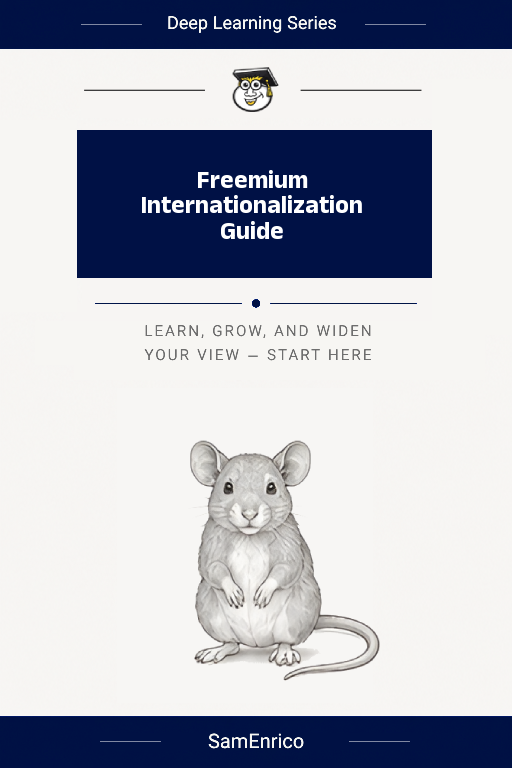
Freemium Internationalization Guide eBook
Translate and adapt freemium products for low-band
by Doan Sarina
Translate and adapt freemium products for low-bandwidth regions language needs.
Formats
Free sample
Chapter 1: The $10 Lie--For five years, I watched it happen again and again. A brilliant startup founder would raise millions, build a beautiful freemium product, and launch in Indonesia or Nigeria or India with confidence. The metrics would look amazing for the first ninety days: hundreds of thousands of downloads, engagement rates that would make a Silicon Valley investor weep with joy, session times that stretched into hours. Then the revenue reports would arrive. Two hundred paying customers.
Maybe three hundred. On a user base of two million.The founder would sit across from me, frustrated and confused. "They love the product," they would say, pulling up dashboards covered in green arrows. "Look at these retention numbers. Look at how often they use the premium features.
They're clearly getting value. Why won't they pay?"I would ask one question: "What do you charge?""Ten dollars a month. Same as everywhere else. It's fair."And there it was. The $10 lie.The Arithmetic of Affordability Let me be blunt: ten dollars is not a universal price.
It is not even close. In Jakarta, the minimum daily wage is roughly ten dollars. That means your $10/month subscription asks a worker to spend an entire day's labor—every single month—on your product. Not on food, not on transport for their children to school, not on medical care. On your Saa S tool.This is not a failure of your product.
This is a failure of your pricing model.The numbers tell a stark story across emerging markets. In India, the median daily wage hovers around five dollars. Your $10 subscription costs two full days of work per month. In Lagos, Nigeria, daily minimum wage is approximately six dollars. Your subscription takes nearly two days.
In Manila, roughly ten dollars—same as Jakarta. In Cairo, closer to four dollars. Your subscription would consume two and a half days.Now consider what that means for usage behavior. When a product is genuinely valuable but priced at a multiple of daily wages, users don't simply walk away. They get creative.
They become what I call "freemium gamers"—experts at extracting maximum value while paying nothing. They cycle through burner email addresses. They use temporary phone numbers for SMS verification. They share accounts across families and friends. They exploit trial resets.
They build scripts to automate account creation.And here is the critical insight that most founders miss: these users are not malicious. They are not thieves. They are economically rational actors responding rationally to misaligned incentives. You have created a product they genuinely want. You have also created a payment barrier that exceeds their disposable income by an order of magnitude.
Their response is not fraud. It is survival.I once interviewed a user in Jakarta who had used a popular project management tool for three years without paying a single cent. He had cycled through forty-seven different email addresses. He had built a spreadsheet to track which email was active on which week. He described his system with pride, not guilt.
When I asked if he would pay five dollars a month, he said yes immediately. When I asked about ten dollars, he laughed. "That's my daughter's school fees for two days," he said. "You want me to choose between your app and my daughter?"The Purchasing Power Parity Framework The solution is not to lower your prices arbitrarily. The solution is to tie pricing to local economic reality using a Purchasing Power Parity (PPP) framework.PPP is an economic concept that adjusts for differences in cost of living and income levels between countries.
In simple terms: a dollar buys vastly different things in different places. Your 10subscriptionin San Franciscobuysafancysandwichandacoffee.In Jakarta,thatsame10 subscription in San Francisco buys a fancy sandwich and a coffee. In Jakarta, that same 10subscriptionin San Franciscobuysafancysandwichandacoffee.In Jakarta,thatsame10 buys a day of labor. When you ignore PPP, you aren't pricing globally. You are pricing for the wealthiest five percent of humanity and calling it universal.Here is the framework I have used successfully across dozens of products:Step One: Determine the local median daily wage.
This data is available from the World Bank, International Labour Organization, and national statistics bureaus. For Indonesia (2024 data), median daily wage is approximately 10USDequivalent.For India,10 USD equivalent. For India, 10USDequivalent.For India,5. For Nigeria, 6.For Egypt,6. For Egypt, 6.For Egypt,4.Step Two: Calculate your price as a percentage of that daily wage.
The sweet spot I have observed across successful freemium products in emerging markets is between 0.5% and 2% of median daily wage. At 0.5%, your product becomes an impulse purchase. At 2%, it becomes a considered but manageable expense. Above 5%, you enter the territory of significant financial decisions—and you will see correspondingly low conversion.Step Three: Apply your product's relative value. A productivity tool that saves users time might command a higher percentage than a entertainment app.
A business-critical service might go higher than a consumer utility. But never exceed 5% of daily wage for any freemium product targeting mainstream users.Let me show you how this works in practice. For Indonesia, median daily wage of $10:0.5% = $0.05 per month1% = $0.10 per month2% = $0.20 per month5% = $0.50 per month These numbers look absurd to a Western Saa S founder. Fifty cents per month? That's less than the transaction fee on most payment processors.
But that is precisely the point. Your pricing must match local economic reality, not your cost structure. If your cost structure cannot support local pricing, your business model is fundamentally incompatible with that market.For India, with median daily wage of $5:0.5% = $0.025 per month1% = $0.05 per month2% = $0.10 per month For Nigeria, $6 daily wage:0.5% = $0.03 per month1% = $0.06 per month2% = $0.12 per month Now you understand why your $10 subscription fails. You are asking users to spend 100% of a day's wages when the market rate for comparable products is closer to 1-2%. You are not too expensive.
You are fifty times too expensive.The Case Study That Changed My Thinking In 2018, I was consulting for a music streaming company that had launched in India six months earlier. They had done everything "right" by Western standards. They had localized the interface into Hindi, Tamil, Telugu, and Bengali. They had integrated local payment methods including UPI and mobile wallets. They had priced their premium tier at the equivalent of $1.40 per month after PPP adjustment.
They thought this was aggressive.Their competitor, a different streaming service, had launched at the same time with a premium tier at $0.70 per month plus a robust ad-supported free tier.The results were not close. The 0.70productcapturedseventypercentofthemarketwithinayear.The0.70 product captured seventy percent of the market within a year. The 0.70productcapturedseventypercentofthemarketwithinayear.The1.40 product struggled to convert even ten percent of its free users. Both had similar feature sets. Both had similar music libraries.
Both had similar localization quality. The only meaningful difference was price.But here is what made the difference sustainable. The $0.70 product paired its low price with an ad-supported tier that gave free users a genuine experience—not a crippled demo, but a real product with limitations that felt fair rather than punitive. Free users could listen to any song, but they had to listen to an ad every three songs. Premium users had no ads and could download for offline listening.The 1.40product,bycontrast,hadnoad−supportedtier.Theirfreetierwasathirty−daytrialfollowedbyahardpaywall.Userswhocouldn′tafford1.40 product…
This is the end of the free sample. Get the eBook to keep going. Buy now
About this book
Details
- Author
- Doan Sarina
- Publisher
- SamEnrico
- Language
- English
- Genre
- Non-Fiction, Business Brief
- Released
- 2026-05-29
- Pages (approx.)
- 130
- Available as
- eBook, Audiobook

Read better in the ZLOADR app
Your eBooks on your phone or tablet. Sign in with your SamEnrico account and start reading.
More by Doan Sarina
 Empowerment Success StoriesDoan Sarina$11.99
 Cocaine Induced DepressionDoan Sarina$11.99
 Cognitive Reframing Road RageDoan Sarina$11.99
 Meal Timing Memory SleepDoan Sarina$11.99
 Conquering Imposter Syndrome WorkbookDoan Sarina$11.99
 Chunking MistakesDoan Sarina$11.99
 Workplace Rejection SensitivityDoan Sarina$11.99
 The Sobriety Affirmations GuideDoan Sarina$11.99
 TM For TinnitusDoan Sarina$11.99
 The Enigma of the Sydney Cipher: How a Mathematician Cracked the Code of the PacificDoan Sarina$11.99
 Shadows of the Yurei SpyDoan Sarina$11.99
 Ghosts of the Greenbrier: The Lost Children of the Underground RailroadDoan Sarina$11.99
You may also like
 Hong Kong Handover 1997Dunn Johnnie$11.99
 Zumba For Postnatal Recovery CourseNeal Christian$11.99
 Zumba for BeginnersLadner Nikia$11.99
 YouTube Comment Mining GuideHumes Pandora$12.99
 Worry Box MeditationCarlin Rudy$11.99
 Workplace Stress MeditationNguyen Lynn$11.99
 Workplace Stress and Sleep RepairHawley Ivory$11.99
 Workplace Perfectionism CureDelaney Jeffry$11.99
 Workplace Injustice Anger GuideWallen Isabelle$11.99
 Work Addiction and Burnout LinkGreenwood Ester$11.99
 Women in Yoga and WellnessBeattie Galina$11.99
 Women in Stand Up ComedyChun Evangeline$11.99