
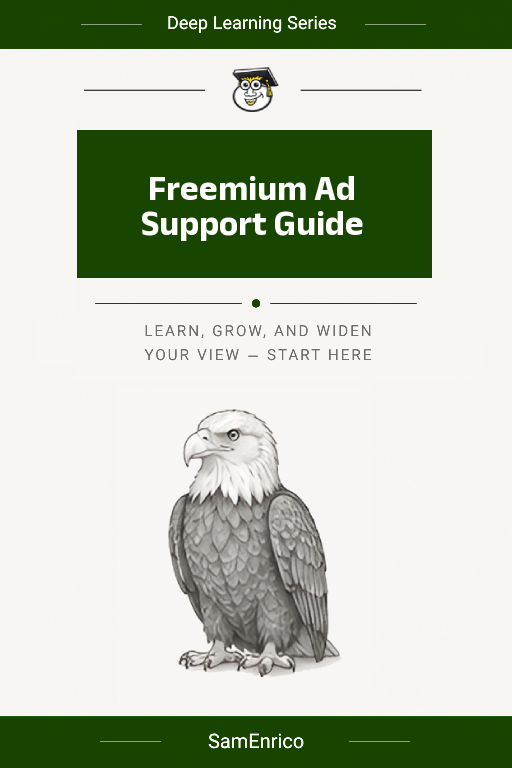
Non-FictionBusiness BriefAd Supported
Freemium Ad Support Guide eBook
Monetize freemium users with lightweight ads that
Monetize freemium users with lightweight ads that work in low-bandwidth conditions.
Formats
Free sample
Chapter 1: The Generosity Paradox--–- Most app founders believe that limiting their free tier is the path to profitability. They think that if they give away too much value, no one will pay. They build "crippleware"—apps that tease functionality, show greyed-out buttons, and interrupt users with paywalls before the user has even experienced the core value. And then they wonder why their retention curves look like a cliff.This chapter dismantles that assumption. It proves, through data and case studies, that generous free tiers funded by lightweight ads generate more revenue than restrictive "paywall-first" approaches.
More importantly, it establishes the ethical and strategic foundation for everything that follows in this book: user retention is the ultimate metric. Monetization tactics that degrade retention are self-defeating. And the most successful freemium apps are not the ones that trap users into paying, but the ones that users actually want to recommend to their friends.This is the Generosity Paradox: the more you give away for free, the more money you make.The Crippleware Epidemic Walk through the app store today and you will find thousands of apps that have sabotaged themselves. Their free tiers are exercises in frustration: "Upgrade to Pro to unlock this feature." "Subscribe now to remove the watermark." "Your free trial ends in 3 days." These apps treat free users not as potential customers, but as pests to be converted or discarded.This approach has a name in the industry: crippleware. The term originates from early shareware software, where developers would release versions with intentionally broken features.
The theory was simple: if users wanted the full experience, they would pay. The practice was widespread in the 1990s and early 2000s.But here is what the crippleware advocates got wrong. In today's mobile-first world, user acquisition is expensive. The average cost to install a mobile app via paid advertising ranges from 1.50to1.50 to 1.50to5.00 depending on the category and geography. If you acquire a user for $3.00 and they uninstall your app within 48 hours because your free tier feels like a hostage negotiation, you have simply burned money.
You have not built a business.The math is brutal. A typical crippleware app might convert 15-20% of free users to paid subscriptions. That sounds healthy until you calculate the retention of the 80% who never convert. Most of those users churn within a week. They leave one-star reviews: "Too expensive." "Everything is locked." "Waste of time." These reviews kill organic growth.
They increase your cost per install because fewer users download from search rankings. They create a death spiral.There is an alternative. It requires courage because it feels counterintuitive. Instead of restricting the free tier, make it genuinely valuable. Give away enough functionality that users form a daily habit.
Then monetize that habit not through aggressive paywalls, but through lightweight, well-placed ads that do not destroy the user experience. This is the Generosity Paradox in action.The Opal Case Study: A 20% Conversion Rate That Was Actually a Failure Let me tell you about Opal. You may not know the name, but you know the problem it solves. Opal is a screen-time management app that helps users block distracting apps and websites. Think of it as a digital fence around your attention.
When it launched in 2019, it followed the conventional wisdom. The free tier was severely limited: users could block only three apps, could not schedule blocking sessions, and saw a paywall after every session. Paid conversion was strong at 20%. The team was thrilled.But something was wrong. User reviews were filled with frustration.
People appreciated the concept but hated the execution. "I can't block Instagram without paying $4/month? Uninstalled." "Why do I have to subscribe to block more than three apps?" The average rating hovered around 3.2 stars. Organic growth was stagnant. The team was spending more and more on paid acquisition just to maintain user numbers.Then they made a decision that seemed insane to their investors.
They redesigned the free tier entirely. They moved valuable features out from behind the paywall: unlimited app blocking, scheduled sessions, and basic analytics all became free. They removed the post-session paywall popup. They added lightweight, non-intrusive banner ads at the bottom of the settings screen (static images only, never video). They kept the paid subscription for advanced features like cross-device sync, family sharing, and detailed usage reports.The results shocked everyone.
Paid conversion dropped from 20% to 9%—a 55% decline. But daily active users skyrocketed from 200,000 to over 1 million in 90 days—a 400% increase. Total revenue doubled because ad revenue from millions of free users, combined with fewer angry churns and massive organic growth, far outweighed the lost subscription revenue. Their app store rating climbed to 4.7 stars. Organic downloads tripled without any increase in marketing spend.Let me repeat the key numbers because they are that important: a 55% decline in paid conversion led to a 100% increase in total revenue.
This is not a typo. This is the Generosity Paradox in its purest form.Why did this work? Three reasons. First, the massive increase in free users provided a huge inventory for ad impressions. At 1 million daily active users, even low e CPM ads generated substantial revenue.
Second, user retention improved dramatically because the free tier was actually usable. Users who previously churned after three days now stuck around for months, generating repeated ad impressions. Third, the high app store rating and positive word-of-mouth reduced customer acquisition costs to nearly zero. The team stopped spending on paid ads altogether because organic growth was sufficient.Opal teaches us that conversion rate is a vanity metric. It tells you how many people upgrade, but it does not tell you how many people you lost.
A high conversion rate on a small, angry user base is worth less than a low conversion rate on a large, happy user base. This is not opinion. This is arithmetic.The "Would a Free User Recommend This?" Litmus Test Before you launch any free tier, before you write a single line of monetization code, run this simple test. Recruit ten non-paying beta users who accurately represent your target audience. Give them access to your complete free tier—every feature, every screen, every interaction they would have as a non-paying user.
Do not warn them about ads. Do not explain the monetization strategy. Just let them use the app for seven days.At the end of the seven days, ask them one question: "Would you tell a friend to download this app for free?"If fewer than eight of the ten say yes, your free tier is broken. Stop everything. Do not launch.
Do not optimize ads. Do not build more features. Fix the free tier first.Why eight out of ten? Because the Net Promoter Score methodology has shown that a 80% promoter rate is the threshold where organic growth becomes self-sustaining. Below that, your users are indifferent or hostile.
Above that, they become your marketing department.This test is humbling. I have watched dozens of founders run it with their apps, confident that their free tier was "good enough." Almost none of them passed on the first try. The most common failure patterns are:The Tease Pattern: The app shows premium features as greyed-out buttons. Users feel taunted rather…
This is the end of the free sample. Get the eBook to keep going. Buy now
About this book
Details
- Author
- Langston Marcell
- Publisher
- SamEnrico
- Language
- English
- Genre
- Non-Fiction, Business Brief, Ad Supported
- Released
- 2026-06-01
- Pages (approx.)
- 148
- Available as
- eBook, Audiobook

Read better in the ZLOADR app
Your eBooks on your phone or tablet. Sign in with your SamEnrico account and start reading.
More by Langston Marcell
 The Sea Around Us LegacyLangston Marcell$11.99
 The Nobel And RelativityLangston Marcell$11.99
 New Parent Small Talk CourseLangston Marcell$11.99
 Mountain Walking MindfulnessLangston Marcell$11.99
 Cognitive Restructuring All Or NoneLangston Marcell$11.99
 The Silent Cartographers: Unraveling the Psychology of Modern African ExplorationLangston Marcell$11.99
 Silk & Steel: The Opium Wars That Built an EmpireLangston Marcell$11.99
 Power System EngineerLangston Marcell$11.99
 One Page Podcast Marketing GuideLangston Marcell$12.99
 Understanding Gonadal Dysgenesis Turner TypeLangston Marcell$17.99
 A Beginners Guide to Chilean rodeo (Volume 1)Langston Marcell$11.99
You may also like
 Hong Kong Handover 1997Dunn Johnnie$11.99
 Zumba For Postnatal Recovery CourseNeal Christian$11.99
 Zumba for BeginnersLadner Nikia$11.99
 YouTube Comment Mining GuideHumes Pandora$12.99
 Worry Box MeditationCarlin Rudy$11.99
 Workplace Stress MeditationNguyen Lynn$11.99
 Workplace Stress and Sleep RepairHawley Ivory$11.99
 Workplace Perfectionism CureDelaney Jeffry$11.99
 Workplace Injustice Anger GuideWallen Isabelle$11.99
 Work Addiction and Burnout LinkGreenwood Ester$11.99
 Women in Yoga and WellnessBeattie Galina$11.99
 Women in Stand Up ComedyChun Evangeline$11.99