
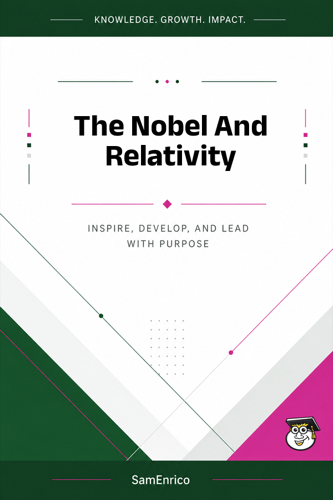
Non-FictionBiographyRelativity
The Nobel And Relativity
Explores why Einstein never won for relativity and
Explores why Einstein never won for relativity and how other laureates advanced space-time concepts.
Formats
About this book
Free sample
Chapter 1: The Orphan of Bern...--–- In the summer of 1905, a 26-year-old patent clerk named Albert Einstein published four papers in the journal Annalen der Physik. Any one of them would have guaranteed his place in the history of science. Together, they rewrote the laws of physics. Yet one of these papers—the one that would eventually redefine time, space, and reality itself—was treated by the scientific establishment as an unwanted orphan. It was too strange, too radical, and too impractical for the world’s most prestigious prize.
This is the story of why the Nobel Committee rejected relativity, and why that rejection tells us more about the limits of institutions than it does about the genius of Einstein.The Miracle Year The year 1905 is often called Einstein’s Annus Mirabilis—his miracle year. He was working six days a week at the Swiss Patent Office in Bern, examining applications for electromagnetic devices and mechanical clocks. In his spare time, he produced a body of work that would have occupied a dozen ordinary physicists for a decade.The first paper, submitted in March, proposed that light consists of discrete particles—quanta—rather than a continuous wave. This explained the photoelectric effect, in which light striking metal knocks electrons loose. The second paper, submitted in April, proved the existence of atoms by explaining Brownian motion, the random jitter of pollen grains in water.
The third paper, submitted in June, introduced Special Relativity, which demolished the Newtonian idea of absolute time. The fourth paper, submitted in September, gave the world the most famous equation in history: E=mc2E = mc^2E=mc2.Each paper was a masterpiece. But they were not equal in the eyes of the scientific establishment.The photoelectric effect paper was immediately useful. It explained why light sensors worked. The Brownian motion paper was experimentally verifiable.
Within a decade, French physicist Jean Perrin would confirm Einstein’s predictions and win a Nobel Prize for it. The E=mc2E = mc^2E=mc2 paper, though startling, was a mathematical consequence of Special Relativity—a footnote, albeit a spectacular one.But Special Relativity itself was…
This is the end of the free sample. Get the eBook to keep going. Buy now
Contents
- Chapter 1
- Chapter 2
- Chapter 3
- Chapter 4
- Chapter 5
- Chapter 6
- Chapter 7
- Chapter 8
- Chapter 9
- Chapter 10
- Chapter 11
- Chapter 12
Details
- Author
- Langston Marcell
- Publisher
- SamEnrico
- Language
- English
- Genre
- Non-Fiction, Biography, Relativity
- Released
- 2026-06-08
- Pages (approx.)
- 116
- Available as
- eBook, Audiobook

Read better in the ZLOADR app
Your eBooks on your phone or tablet. Sign in with your SamEnrico account and start reading.
More by Langston Marcell
 The Sea Around Us LegacyLangston Marcell$11.99
 New Parent Small Talk CourseLangston Marcell$11.99
 Mountain Walking MindfulnessLangston Marcell$11.99
 Cognitive Restructuring All Or NoneLangston Marcell$11.99
 The Silent Cartographers: Unraveling the Psychology of Modern African ExplorationLangston Marcell$11.99
 Silk & Steel: The Opium Wars That Built an EmpireLangston Marcell$11.99
 Power System EngineerLangston Marcell$11.99
 Freemium Ad Support GuideLangston Marcell$12.99
 One Page Podcast Marketing GuideLangston Marcell$12.99
 Understanding Gonadal Dysgenesis Turner TypeLangston Marcell$17.99
 A Beginners Guide to Chilean rodeo (Volume 1)Langston Marcell$11.99
You may also like
 Hong Kong Handover 1997Dunn Johnnie$11.99
 Zumba For Postnatal Recovery CourseNeal Christian$11.99
 Zumba for BeginnersLadner Nikia$11.99
 YouTube Comment Mining GuideHumes Pandora$12.99
 Worry Box MeditationCarlin Rudy$11.99
 Workplace Stress MeditationNguyen Lynn$11.99
 Workplace Stress and Sleep RepairHawley Ivory$11.99
 Workplace Perfectionism CureDelaney Jeffry$11.99
 Workplace Injustice Anger GuideWallen Isabelle$11.99
 Work Addiction and Burnout LinkGreenwood Ester$11.99
 Women in Yoga and WellnessBeattie Galina$11.99
 Women in Stand Up ComedyChun Evangeline$11.99