
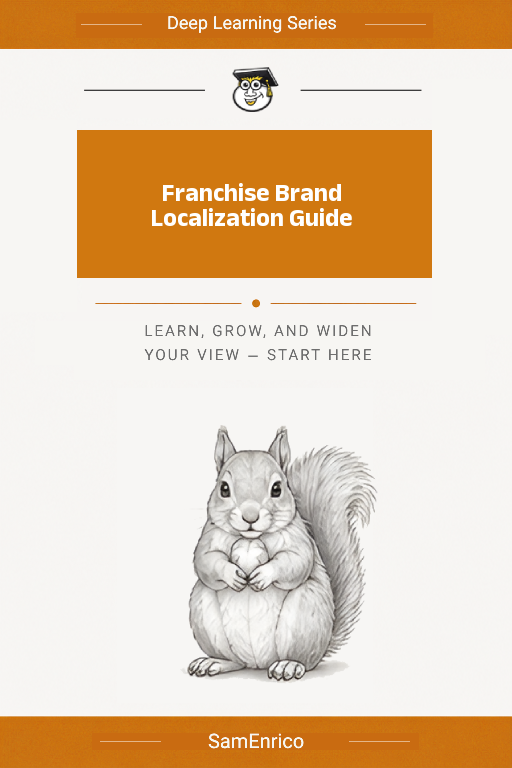
Non-FictionBusiness BriefBrand Adaptation
Franchise Brand Localization Guide eBook
Adapt your brand name, menu, and marketing to loca
by Cho Emmanuel
Adapt your brand name, menu, and marketing to local cultures while protecting global identity standards.
Formats
Free sample
Chapter 1: The Export-Ready Trap--–- In 2016, a celebrated American burger chain with over 500 domestic locations flew its executive team to Shanghai for the grand opening of its first international franchise. The local partner had spent $4 million on build-out. The mayor attended the ribbon-cutting. Food bloggers lined up at 6 a.m. Three months later, the location was serving 40 percent of projected volume.
Six months after that, it closed permanently. The post-mortem revealed no single catastrophe—no food safety scandal, no cultural offense, no legal battle. Instead, the autopsy listed seventeen small failures: inconsistent portion sizes because local cooks had never been trained on gram-based measurements; a signature sauce that took forty-five minutes to prepare because an imported ingredient was held in customs; customer complaints about wait times that corporate couldn't verify because no one had installed CCTV cameras linked to headquarters; and a general manager who had never seen the original operations manual because it hadn't been translated beyond a Google-translated PDF. The brand had spent two years negotiating the franchise agreement and zero days auditing whether their own systems were ready to travel. This book exists because that story has played out, in different forms, across thousands of franchise expansions.
The hard truth is that most global franchise failures are not caused by bad localization. They are caused by exporting broken systems.The Premature Expansion Epidemic The franchise industry is addicted to announcements. A press release declares entry into a new country. A photo op features the CEO shaking hands with a master franchisee. Investors applaud.
Then reality arrives. According to data from FRANdata and the International Franchise Association, nearly 60 percent of international franchise expansions underperform their first-year projections, and over 30 percent terminate their master franchise agreements within five years. The most common root cause is not market rejection of the brand concept—it is operational collapse on the ground.Franchisors consistently underestimate the gap between domestic success and international readiness. A brand that thrives in Ohio because the founder personally trained every original manager cannot assume that same model will work in Vietnam. A supply chain that works beautifully across Texas because ingredients are never more than a four-hour drive away fails completely in Indonesia, where roads, refrigeration, and customs create unpredictable delays.
A training program that relies on regional supervisors dropping in for quarterly visits becomes invisible when those supervisors are now fourteen time zones away.The problem is compounded by the structure of franchise expansion itself. When a brand signs a master franchise agreement, the master franchisee pays an upfront fee—often hundreds of thousands or millions of dollars. That payment creates a dangerous psychological dynamic. The franchisor, having received a large check, feels pressure to declare success. The master franchisee, having written that check, feels pressure to open locations quickly to recoup the investment.
Both parties are incentivized to move fast. Neither is incentivized to pause and ask the uncomfortable question: Are our systems actually ready to be replicated in a completely different country?This chapter provides the framework for answering that question before you spend a dollar on market entry. The answer will determine whether your international expansion becomes a growth engine or a very expensive lesson.The Four Pillars of Export Readiness After studying over one hundred franchise expansions across twenty countries, researchers have identified four non-negotiable systems that must be fully operational before any international location opens. These are not aspirational best practices. They are minimum requirements.
If any pillar is weak, the entire international structure collapses.Pillar One: Proven Systems Proven systems mean that your operational model has been tested outside your founder's direct oversight. This sounds obvious, but it is the most common blind spot. Many franchise brands grow domestically through the sheer force of a charismatic founder or a small, highly dedicated corporate team. They open locations where the founder personally trains the first manager, where the founder's cousin runs the supply chain, where the founder's former assistant handles customer complaints. This works—until the founder is no longer on the ground.A proven system is one that has been successfully operated by someone who is not you, not your family, and not your original team.
It has been documented, transferred, and executed by a franchisee who had no prior relationship with the brand. It has survived a manager turnover. It has weathered a supply chain disruption. It has been tested in a market where your personal reputation does not precede you.The diagnostic question for this pillar is simple: If you were hit by a bus tomorrow, could your least experienced franchisee continue operating at 90 percent of your current quality standards? If the answer requires any explanation beyond "yes," your systems are not yet proven enough to export.Pillar Two: Documented Standard Operating Procedures Documented SOPs are the difference between a brand that can scale and a cult of personality.
Many franchisors believe they have SOPs because they have a three-ring binder somewhere with instructions. That binder is almost always incomplete. True documentation means that every repetitive task—every single one—has been reduced to written, visual, or video instructions that a reasonably competent new hire can follow without asking for clarification.The scope of required documentation is larger than most franchisors imagine. It includes opening procedures (who arrives when, what they do first, second, third), food preparation (ingredient measurements in both volume and weight, cooking temperatures and times, plating standards), customer service (greeting scripts, complaint handling, upselling protocols), cleaning (what gets cleaned when, with what chemicals, to what standard), closing procedures (cash handling, security checks, equipment shutdown), and emergency responses (fire, injury, theft, power outage).But documentation is not just about having the instructions—it is about having them in a format that can be translated, localized, and accessed remotely. A paper binder that lives in the back office of your domestic locations is useless in a country where your franchisee has never seen your headquarters.
True export-ready documentation is digital, searchable, modular (so sections can be replaced without reprinting the whole manual), and designed from the start with translation in mind. That means avoiding idioms, cultural references, and measurements that do not translate.The diagnostic question: Can you hand your operations manual to a stranger in a foreign country today, and can that stranger open a location that meets your brand standards within ninety days? If the manual requires any verbal explanation from you, it is not sufficiently documented.Pillar Three: Scalable Training Programs Scalable training is the most underestimated pillar. Domestic franchise brands often train new franchisees through a combination of classroom time at headquarters, on-site training at an existing location, and ongoing support from a dedicated franchise business coach. This model works when the brand has fifty locations within a two-hour drive of headquarters.
It fails when the new location is a twenty-hour flight away.Scalable training for international expansion requires three specific capabilities. First, a train-the-trainer program that enables local master franchisees to certify their own trainers, who then certify store managers, who then certify hourly staff. Without this cascade, you will be flying corporate trainers to every new location forever—a cost model that does not scale.Second, a remote certification system that allows you to…
This is the end of the free sample. Get the eBook to keep going. Buy now
About this book
Details
- Author
- Cho Emmanuel
- Publisher
- SamEnrico
- Language
- English
- Genre
- Non-Fiction, Business Brief, Brand Adaptation
- Released
- 2026-06-01
- Pages (approx.)
- 130
- Available as
- eBook, Audiobook

Read better in the ZLOADR app
Your eBooks on your phone or tablet. Sign in with your SamEnrico account and start reading.
More by Cho Emmanuel
 Body Scan Meditation Track PackCho Emmanuel$11.99
 Time Blocking for Google WorkspaceCho Emmanuel$11.99
 Parental Anger RethinkingCho Emmanuel$11.99
 Antarctica Traverse GuideCho Emmanuel$11.99
 Unidentified Remains Hair MicroscopyCho Emmanuel$11.99
 Bangladeshi Garment Worker To OwnerCho Emmanuel$11.99
 Atomic Habits For Habit ResetCho Emmanuel$11.99
 Small Habit ChangesCho Emmanuel$11.99
 The Silk Road Heist: How a 19th-Century Scam Fooled the WorldCho Emmanuel$11.99
 The Humber Bridge: Breaking the Limits of Steel and DreamsCho Emmanuel$11.99
 How to Start a Sixth Form Colleges Business (Beginners Guide)Cho Emmanuel$11.99
 How to Produce Aldehyde, Ketone and QuinoneCho Emmanuel$11.99
You may also like
 Hong Kong Handover 1997Dunn Johnnie$11.99
 Zumba For Postnatal Recovery CourseNeal Christian$11.99
 Zumba for BeginnersLadner Nikia$11.99
 YouTube Comment Mining GuideHumes Pandora$12.99
 Worry Box MeditationCarlin Rudy$11.99
 Workplace Stress MeditationNguyen Lynn$11.99
 Workplace Stress and Sleep RepairHawley Ivory$11.99
 Workplace Perfectionism CureDelaney Jeffry$11.99
 Workplace Injustice Anger GuideWallen Isabelle$11.99
 Work Addiction and Burnout LinkGreenwood Ester$11.99
 Women in Yoga and WellnessBeattie Galina$11.99
 Women in Stand Up ComedyChun Evangeline$11.99