
Non-FictionInformativeEducational
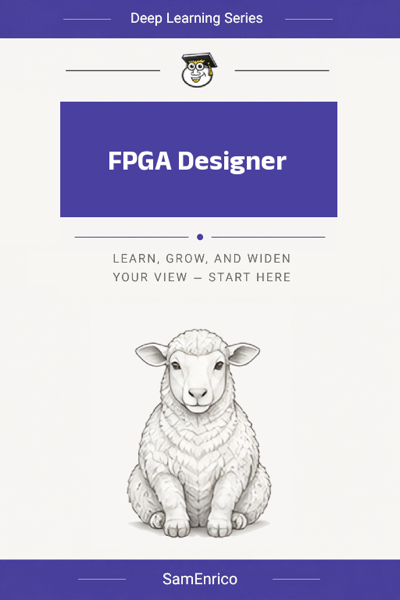
FPGA Designer eBook
A Coursebook on FPGA Designer
A Coursebook on FPGA Designer
Formats
Free sample
Chapter 1: The Sandwich That Reprograms Itself--–- In the summer of 1985, a small company in San Jose, California, shipped a chip that almost everyone said would fail. It had no fixed function. It contained 64 identical blocks of logic connected by a network of programmable switches that looked, to the skeptical engineers at competing firms, like a solution desperately searching for a problem. Why would anyone buy a chip that you had to configure yourself? Why not just use a standard microprocessor and write software?
Why not design a custom ASIC and get perfect efficiency? The chip was called the XC2064, and its inventors—Ross Freeman, Bernie Vonderschmitt, and Jim Barnett—called it a Field-Programmable Gate Array. Thirty-seven years later, the same basic architecture powers everything from the Mars Perseverance rover’s image processing pipelines to the world’s fastest financial trading systems to the AI accelerators that run large language models in the cloud. The FPGA, dismissed as a niche curiosity, became one of the most important computing platforms of the twenty-first century. This chapter is the story of why that happened—and why understanding the FPGA’s unique place in the computing universe is the first step toward thinking like a hardware designer.The Great Computing Spectrum Every engineer who designs digital systems eventually faces a fundamental question: what kind of computing engine should I use for this task?
The answer is almost never obvious, and the wrong choice can sink a project in cost, power, or time-to-market. To understand where the FPGA fits, you must first understand the full spectrum of computing devices. At one end sits the humble microcontroller unit (MCU)—the little engine that powers your microwave, your car’s window controls, and the keyboard you are using right now. At the other end sits the application-specific integrated circuit (ASIC)—the custom-designed chip that handles billions of transactions per second in your router or performs the cryptographic hashes in a Bitcoin miner. Somewhere in the middle, you will find the digital signal processor (DSP) for math-heavy streaming workloads and, finally, the FPGA.The MCU, often based on the ARM or RISC-V architectures, is a sequential machine.
It fetches an instruction from memory, decodes it, executes it, writes the result, and moves to the next instruction. This fetch-decode-execute cycle repeats millions or billions of times per second. The beauty of the MCU is flexibility: you can change what it does by simply writing new software. The cost is that it can only do one thing at a time. Even with multiple cores and hardware threads, the underlying model is temporal—you are sharing a single execution engine across many tasks.
For control-oriented applications like reading a temperature sensor once per second or debouncing a button press, this is perfectly adequate. For processing streaming video at 4K resolution or synthesizing a radio signal in real time, it is hopeless.At the opposite extreme, the ASIC is a spatial machine. When you design an ASIC, you are physically carving logic gates into silicon. Every operation has its own dedicated hardware. A video scaling ASIC contains a dedicated multiplier for every pixel channel, connected by fixed wires, with no instruction fetch overhead, no operating system, no context switching.
The result is breathtaking efficiency: an ASIC can be thousands of times more power-efficient than an MCU for the same task. But that efficiency comes at a brutal cost. Designing an ASIC takes months, requires millions of dollars in non-recoverable engineering (NRE) costs for mask sets, and once it is fabricated, the function is permanently frozen. A bug in the logic means a respin—another six months and another million dollars. As a result, ASICs only make economic sense for products that will ship in volumes of millions of units.The DSP sits between these extremes.
It is a specialized microprocessor with hardware accelerators for multiply-accumulate (MAC) operations, the bread and butter of filtering, Fourier transforms, and audio processing. A DSP can execute a MAC in a single cycle, something a general-purpose MCU might need ten cycles to complete. But like any sequential processor, the DSP still fetches instructions, still has a pipeline, and still faces the Von Neumann bottleneck. For a single channel of audio, a DSP is wonderful. For 128 channels of 5G beamforming, it falls over.Enter the FPGA.
The FPGA is a spatial computing device like an ASIC, but one you can reprogram in the field—hence the name. Instead of carving logic gates into fixed silicon, the FPGA provides a sea of pre-fabricated building blocks (look-up tables, flip-flops, multiplexers, routing switches) that you can wire together arbitrarily. After manufacturing, you load a configuration bitstream that tells every block what to do and how to connect to its neighbors. The result is a custom hardware datapath that runs in parallel, with no instruction overhead, but that you can redesign in minutes or hours rather than months. The FPGA occupies the sweet spot in the computing spectrum: it offers the spatial parallelism and low latency of an ASIC with the re-programmability of a software platform.When to Choose an FPGA: The Four-Question Test In my years of teaching FPGA design, I have seen engineers reach for an FPGA for the wrong reasons—because it sounds cool, because their manager heard a talk about it at a conference, because they want to add a bullet point to their resume.
An FPGA is a powerful tool, but it is not the right tool for every job. Before you commit to an FPGA-based design, ask yourself four questions.First, do you need true parallelism? If your algorithm processes data in a loop where each iteration depends on the previous result (for example, a recursive filter or a serial parser), an FPGA may not help much. FPGAs excel at dataflow architectures where many operations happen simultaneously on different pieces of data. Video processing, where each pixel can be transformed independently, is a perfect fit.
Fast Fourier transforms, where multiple butterfly stages run in parallel, are another. If your algorithm is inherently sequential, you might be better off with a fast MCU or DSP.Second, do you need deterministic low latency? A microcontroller running a real-time operating system might respond to an interrupt in tens of microseconds. A carefully optimized FPGA can respond in a handful of clock cycles—nanoseconds. For applications like motor control, where a delay of one microsecond means the difference between smooth rotation and destructive oscillation, the FPGA’s deterministic timing is a life-saver.
For packet processing in a network switch, where you must forward a frame before the next one arrives, the FPGA’s wire-speed processing is unmatched.Third, can you tolerate the development complexity? FPGA design is not software. The tools are temperamental, the compile times can stretch to hours, and debugging a design that fails only once every million clock cycles due to a timing violation requires patience and discipline. If your project timeline is measured in weeks and you have a team of experienced embedded software engineers but no hardware background, an FPGA is a risk. If you have months and a team that includes at least one person who has shipped an FPGA product before, the rewards can…
This is the end of the free sample. Get the eBook to keep going. Buy now
About this book
Details
- Author
- Alonzo Arletta
- Publisher
- SamEnrico
- Language
- English
- Genre
- Non-Fiction, Informative, Educational
- Released
- 2026-06-02
- Pages (approx.)
- 134
- Available as
- eBook, Audiobook

Read better in the ZLOADR app
Your eBooks on your phone or tablet. Sign in with your SamEnrico account and start reading.
More by Alonzo Arletta
 Interview Explanation for Job LossAlonzo Arletta$11.99
 Time Blocking for Burnout PreventionAlonzo Arletta$11.99
 Former Nickelodeon Star MemoirAlonzo Arletta$11.99
 The Freelance Accounting SystemAlonzo Arletta$11.99
 GST Registration Documents Checklist HandbookAlonzo Arletta$11.99
 Managing Interruption Debt HandbookAlonzo Arletta$11.99
 The Persuasion ScriptbookAlonzo Arletta$11.99
 Teen Affirmations for ConfidenceAlonzo Arletta$11.99
 Sam's Club StoryAlonzo Arletta$11.99
 The Forgotten Codex: Deciphering the Voynich ManuscriptAlonzo Arletta$11.99
 Whispers of the Sand Djinn: The Unseen Maestro of the DesertAlonzo Arletta$11.99
 Echoes of Liberty: The Forgotten Voices of Black Patriots in the Revolutionary WarAlonzo Arletta$11.99
You may also like
 Hong Kong Handover 1997Dunn Johnnie$11.99
 Zumba For Postnatal Recovery CourseNeal Christian$11.99
 Zumba for BeginnersLadner Nikia$11.99
 YouTube Comment Mining GuideHumes Pandora$12.99
 Worry Box MeditationCarlin Rudy$11.99
 Workplace Stress MeditationNguyen Lynn$11.99
 Workplace Stress and Sleep RepairHawley Ivory$11.99
 Workplace Perfectionism CureDelaney Jeffry$11.99
 Workplace Injustice Anger GuideWallen Isabelle$11.99
 Work Addiction and Burnout LinkGreenwood Ester$11.99
 Women in Yoga and WellnessBeattie Galina$11.99
 Women in Stand Up ComedyChun Evangeline$11.99