
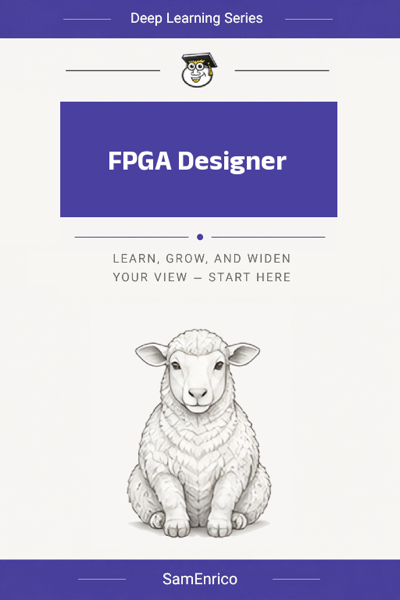
FPGA Designer
A Coursebook on FPGA Designer
A Coursebook on FPGA Designer
Formats
About this book
Free sample
Chapter 1: The Sandwich That Reprograms Itself--–- In the summer of 1985, a small company in San Jose, California, shipped a chip that almost everyone said would fail. It had no fixed function. It contained 64 identical blocks of logic connected by a network of programmable switches that looked, to the skeptical engineers at competing firms, like a solution desperately searching for a problem. Why would anyone buy a chip that you had to configure yourself? Why not just use a standard microprocessor and write software?
Why not design a custom ASIC and get perfect efficiency? The chip was called the XC2064, and its inventors—Ross Freeman, Bernie Vonderschmitt, and Jim Barnett—called it a Field-Programmable Gate Array. Thirty-seven years later, the same basic architecture powers everything from the Mars Perseverance rover’s image processing pipelines to the world’s fastest financial trading systems to the AI accelerators that run large language models in the cloud. The FPGA, dismissed as a niche curiosity, became one of the most important computing platforms of the twenty-first century. This chapter is the story of why that happened—and why understanding the FPGA’s unique place in the computing universe is the first step toward thinking like a hardware designer.The Great Computing Spectrum Every engineer who designs digital systems eventually faces a fundamental question: what kind of computing engine should I use for this task?
The answer is almost never obvious, and the wrong choice can sink a project in cost, power, or time-to-market. To understand where the FPGA fits, you must first understand the full spectrum of computing devices. At one end sits the humble microcontroller unit (MCU)—the little engine that powers your microwave, your car’s window controls, and the keyboard you are using right now. At the other end sits the application-specific integrated circuit (ASIC)—the custom-designed chip that handles billions of transactions per second in your router or performs the cryptographic hashes in a Bitcoin miner. Somewhere in the middle, you will find the digital signal processor (DSP) for math-heavy streaming workloads and, finally, the FPGA.The MCU, often based on the ARM or…
This is the end of the free sample. Get the eBook to keep going. Buy now
Contents
- Chapter 1
- Chapter 2
- Chapter 3
- Chapter 4
- Chapter 5
- Chapter 6
- Chapter 7
- Chapter 8
- Chapter 9
- Chapter 10
- Chapter 11
- Chapter 12
Details
- Author
- Alonzo Arletta
- Publisher
- SamEnrico
- Language
- English
- Genre
- Non-Fiction, Informative, Educational
- Released
- 2026-06-02
- Pages (approx.)
- 134
- Available as
- eBook, Audiobook

Read better in the ZLOADR app
Your eBooks on your phone or tablet. Sign in with your SamEnrico account and start reading.
More by Alonzo Arletta
 Interview Explanation for Job LossAlonzo Arletta$11.99
 Time Blocking for Burnout PreventionAlonzo Arletta$11.99
 Former Nickelodeon Star MemoirAlonzo Arletta$11.99
 The Freelance Accounting SystemAlonzo Arletta$11.99
 GST Registration Documents Checklist HandbookAlonzo Arletta$11.99
 Managing Interruption Debt HandbookAlonzo Arletta$11.99
 The Persuasion ScriptbookAlonzo Arletta$11.99
 Teen Affirmations for ConfidenceAlonzo Arletta$11.99
 Sam's Club StoryAlonzo Arletta$11.99
 The Forgotten Codex: Deciphering the Voynich ManuscriptAlonzo Arletta$11.99
 Whispers of the Sand Djinn: The Unseen Maestro of the DesertAlonzo Arletta$11.99
 Echoes of Liberty: The Forgotten Voices of Black Patriots in the Revolutionary WarAlonzo Arletta$11.99