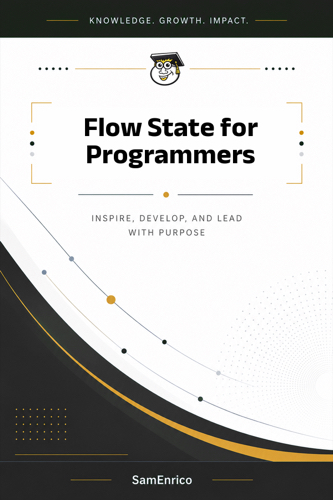
Flow State for Programmers eBook
Code for hours without fatigue using environment a
Code for hours without fatigue using environment and mindset optimizations.
Formats
Free sample
Chapter 1: The 23-Minute Tax--The screen glows. Your fingers hover over the keyboard. Inside your head, a recursive function unwinds perfectly—nine variables balanced like spinning plates, each dependent on the last, the solution just three keystrokes away. Then Slack chirps. Your eyes flick to the corner of the screen.
Someone has posted a GIF in #watercooler. You look away for one second. When you look back, the plates have shattered. The variables scatter. The recursive chain dissolves into fog.
You stare at the cursor blinking on line 47 and think: What was I doing?This is not a failure of willpower. It is not a sign that you lack discipline or that you are not a "real" programmer. It is cognitive physics. Every interruption, no matter how small, burns a measurable amount of your brain's limited fuel. And the recovery time is far longer than anyone admits.The Myth of the Uninterrupted Hour Most developers believe they can multitask.
They believe that a quick glance at a notification, a two-minute reply to a message, or a thirty-second context switch to check Jira costs them nothing more than those thirty seconds. This belief is demonstrably, provably false.The human brain does not switch contexts like a computer. A computer can pause one process, save its state to memory, load another process, and later reload the first process exactly where it left off, all in milliseconds. Your brain cannot do this. When you switch from coding to Slack and back, you are not pausing and resuming.
You are destroying one cognitive state and rebuilding another from scratch.Consider what happens inside your head when you are deep in code. You are holding a mental model of the system: which functions call which, which variables carry what state, which edge cases remain unhandled. This mental model is not stored as a neat file on a hard drive. It is a fragile web of activated neurons, held together by a continuous stream of attention. Interrupt that attention for even a few seconds, and the web begins to collapse.
The neurons that were firing in synchrony drift apart. The associations that felt obvious become opaque.This is why you can spend twenty minutes wrestling with a bug, finally see the solution, glance at your phone for one minute, and then return to your editor with no idea what you were about to type. The solution was never stored as a discrete memory. It was a process, a chain of reasoning that required active maintenance. When you stopped maintaining it, it evaporated.Executive Function Depletion: The Finite Fuel Tank The prefrontal cortex—the part of your brain just behind your forehead—is the seat of executive function.
Executive function is the set of cognitive processes that allow you to plan, focus attention, remember instructions, and juggle multiple concepts simultaneously. Every line of code you write, every bug you track down, every decision about whether to use a map or a filter runs through this region.Executive function runs on fuel. Specifically, it runs on glucose and a cocktail of neurotransmitters including dopamine and norepinephrine. This fuel is finite. Every act of focused attention draws from the same tank.
Checking email draws from it. Deciding what to eat for lunch draws from it. Suppressing the urge to check Twitter draws from it. And switching between tasks draws from it profligately.Researchers have demonstrated executive function depletion through countless experiments. In one classic study, participants were asked to watch a video of an interview while ignoring distracting text scrolling at the bottom of the screen—a task that required constant executive control.
After just five minutes, their performance on subsequent problem-solving tasks dropped significantly compared to a control group who watched the same video without distractions. Their executive function fuel had been burned up by the effort of ignoring the scrolling text.Every notification on your screen is that scrolling text. Every badge icon, every popup, every email preview—each one requires a micro-decision to ignore or attend. And each micro-decision burns fuel.The 23-Minute Rule: What the Research Actually Says The most cited figure in productivity literature is the "20-minute rule"—the claim that after an interruption, it takes twenty minutes to return to full focus. This figure is close to correct but slightly off.
The actual research, conducted by Gloria Mark at the University of California, Irvine, found that after a thirty-second interruption, it takes an average of twenty-three minutes and fifteen seconds to return to the same depth of cognitive engagement.Mark's team studied software developers in real work environments. They attached sensors to participants and logged every switch between applications, every incoming message, every self-initiated check of email or social media. The results were staggering. The average developer worked on a single task for only three minutes before switching to something else. And after each interruption, the time to fully re-engage averaged twenty-three minutes.This is the 23-Minute Rule: Every interruption that pulls you away from a cognitively demanding task costs you at least twenty-three minutes of productive time, regardless of whether the interruption lasted two seconds or two minutes.The math is brutal.
If you receive ten Slack messages in a day—a conservative estimate for most developers—you lose nearly four hours of cognitive work. Not four hours of sitting at your desk. Four hours of deep, productive, flow-state coding. The other four hours of your eight-hour day are spent in the shallows: rebuilding mental models, re-reading code you already read, retracing steps you already took.The Hidden Cost of Self-Interruption Not all interruptions come from external sources. In fact, the majority of interruptions are self-initiated.
You check your email. You open Twitter. You glance at Hacker News. You switch to a different file in your project because you remember something you wanted to change elsewhere.Each of these self-interruptions is metabolically identical to an external interruption. Your brain does not distinguish between a Slack notification and your own decision to check Slack.
Both trigger the same context switch. Both burn the same fuel. Both cost you twenty-three minutes.This is the trap of "productive distraction"—the belief that quickly checking something is harmless because you are still "working." You are not working. You are task-switching. And task-switching is the most expensive operation your brain performs.Researchers have measured the switch cost directly.
In one experiment, participants were asked to perform simple tasks (sorting shapes or colors) and were interrupted midway. Those who were interrupted took up to 40% longer to complete the tasks and made twice as many errors. The interruption itself was not cognitively demanding—just a simple "please stop and then continue" signal. The cost was not in the interruption but in the resumption.Every time you return to your code after a switch, you must answer three questions:Where was I?What was I trying to accomplish?What was my next step?Answering these questions requires rebuilding your mental model. And rebuilding takes time—far more time than you think.Flow as Energy Conservation: The Hypofrontality State If interruptions are so expensive, why does coding sometimes feel effortless?
Why do you occasionally look up from your editor and realize that four hours have passed without hunger, without fatigue…
This is the end of the free sample. Get the eBook to keep going. Buy now
About this book
Details
- Author
- Hogg Germaine
- Publisher
- SamEnrico
- Language
- English
- Genre
- Non-Fiction, Self-Help, Coding
- Released
- 2026-06-10
- Pages (approx.)
- 124
- Available as
- eBook, Audiobook

Read better in the ZLOADR app
Your eBooks on your phone or tablet. Sign in with your SamEnrico account and start reading.
More by Hogg Germaine
 Construction Startup PlanHogg Germaine$11.99
 Gambling Addiction and DivorceHogg Germaine$11.99
 Financial Stress Coping WorkbookHogg Germaine$11.99
 The Angel Maker of Victorian London: The Poisonous Legacy of Sarah FreemanHogg Germaine$11.99
 How to Start a Box Pallet Business (Beginners Guide)Hogg Germaine$11.99
 Montessori In Home EducatorHogg Germaine$11.99
 Mentoring Success StoriesHogg Germaine$12.99Mentoring Success StoriesHogg Germaine$12.99Mentoring Success StoriesHogg Germaine$12.99Mentoring Success StoriesHogg Germaine$12.99
 Learn to Play the OctobassHogg Germaine$11.99