
Non-FictionSelf-HelpArchitecture
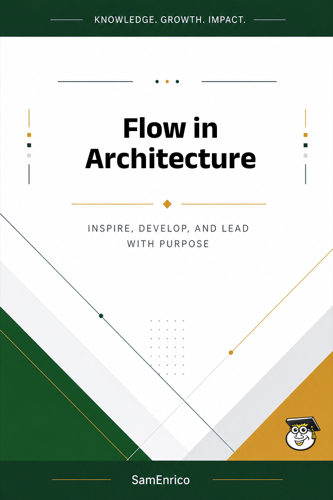
Flow in Architecture eBook
Designers achieving flow during drafting.
Designers achieving flow during drafting.
Formats
Free sample
Chapter 1: The Architect’s Paradox--–- You are sitting in front of a blank screen. The cursor blinks. The client brief sits to your left—square footage requirements, zoning setbacks, a material palette dictated by budget. You know how to draft. You passed the technical exams.
You can model a complex curtain wall in your sleep. And yet, something is wrong. Your hand hovers over the stylus. Your mind races through possibilities, rejects them, races again. An hour passes.
You answer three emails. You adjust a layer naming convention that didn't need adjusting. You close the file and tell yourself you'll start fresh tomorrow.This scene is not a failure of talent. It is not a lack of discipline. It is not even, strictly speaking, procrastination.
It is the result of a fundamental tension built into the very act of architectural drafting—a tension that this book will name, dismantle, and ultimately teach you to harness. That tension is the Architect's Paradox.The Architecture of the Problem Every architectural drawing asks you to hold two opposing mindsets simultaneously. On one hand, you must be precise. Dimensions must close. Layers must follow standards.
Codes must be met. A wall that is off by two centimeters in a construction document becomes a field problem, a change order, a relationship strained. The profession has trained you to value this precision—rightly so. Buildings stand because of exactitude.On the other hand, you must be spontaneous. Great design does not emerge from following rules; it emerges from breaking them in intelligent ways, from seeing connections no one else has seen, from the sudden intuitive leap that reconfigures an entire plan.
Creativity requires looseness, play, the willingness to make a mark that might be wrong.These two demands—precision and spontaneity—are not merely different. They are, in their raw forms, neurologically incompatible. Precision engages the brain's executive functions: the dorsolateral prefrontal cortex, the anterior cingulate cortex, the systems responsible for error detection, rule following, and self-correction. Spontaneity engages the default mode network and the brain's associative regions: the parts that make connections between distant ideas, that allow for metaphor and surprise, that operate best when the internal critic goes silent.You cannot fully activate both systems at the same time. And yet architectural drafting demands exactly that.This is the Architect's Paradox: the profession's core technical activity requires you to be simultaneously free and exact, spontaneous and precise, creative and rule-bound.
Most architects resolve this paradox by default—not by solving it, but by oscillating between the two poles in ways that exhaust them. They start with a burst of creative energy, produce something loose and promising, then spend hours or days tightening it down, only to realize that the tightening has killed what was alive in the sketch. Or they start with the technical requirements—the site survey, the zoning envelope, the structural grid—and find that the building has been solved before they ever asked an interesting question.There is another way. This book exists to teach it.What This Book Is Not Before we go further, let me tell you what this book is not. It is not a drafting manual.
You will find no keyboard shortcuts for Revit, no tutorials for Rhino, no line-weight conventions for hand drafting. Many excellent books already cover those topics. This book assumes you already know how to draft.It is not a design theory text. We will not spend pages debating whether form follows function or function follows form. We will not parse the competing manifestos of modernism and postmodernism.
Those debates have their place, but they do not help you when the cursor is blinking and your mind is blank.It is not a general creativity book. You have read books about "unlocking your creative potential" that promise transformation and deliver vague affirmations. This book is different. It is grounded in a specific, measurable psychological state called flow, and it applies that state to the specific, physical act of architectural drafting.And it is not a book about buildings. This may surprise you.
You picked up a book called Flow in Architecture expecting, perhaps, to learn how to design better buildings. You will. But the central argument of this book—the provocation that shapes every chapter to come—is that the building is merely the residue of the process. The true art lies in the quality of attention the designer pays during the act of drafting.Most architects spend their careers oriented toward the artifact: the built project, the portfolio image, the award citation. This orientation, while understandable, is precisely backwards.
A building conceived in distraction, anxiety, and fragmented attention will carry those qualities into its walls, no matter how technically proficient its detailing. A building conceived in flow—in sustained, joyful, immersive attention—will carry that quality as well. You cannot fake it. The drawing knows.Flow: A Working Definition The psychologist Mihály Csíkszentmihályi spent decades studying when people feel their best and perform their best. He interviewed rock climbers, chess players, surgeons, composers, and assembly line workers.
He asked them to describe the moments when their work felt effortless and excellent at the same time. Despite the vast differences in their activities, their descriptions were remarkably consistent.He called that state flow.Flow is characterized by complete immersion in an activity. Time distorts: hours can feel like minutes, or sometimes minutes like hours. Self-consciousness disappears; you are not worrying about what others think or whether you are good enough. Action and awareness merge; you are not thinking about the next move and then making it—you are simply making it.
The activity feels autotelic, which is a Greek-derived word meaning "having its purpose within itself." You are doing it because the doing itself is rewarding, not because of what it will produce.Flow is not relaxation. In flow, you are working at the edge of your ability, fully engaged, often exhausted afterward. It is not passive pleasure; it is active joy. And it is not hyperfocus. Hyperfocus—the state of being locked onto a task to the exclusion of everything else—can occur without flow.
You can hyperfocus on reorganizing your file folders for three hours. You will feel busy, even absorbed. But you will not feel the particular satisfaction of flow because the challenge-skill balance is wrong: the task is too easy, too mechanical, too disconnected from your deeper intentions.Flow requires a specific set of conditions. Csíkszentmihályi identified nine of them. We will spend all of Chapter 2 breaking them down and mapping them to drafting tasks.
But for now, understand this: flow is not mystical. It is not reserved for geniuses or saints or people with more talent than you. It is a trainable neurological state, as learnable as touch-typing or sight-reading music. The only difference is that no one ever taught it to you in architecture school.Why Architecture School Failed You Let us be honest about what architecture school taught you—and what it did not.It taught you to critique. The jury system, for all its virtues, trains you to see what is wrong.
A line is slightly off. A proportion is inelegant. A concept is insufficiently radical. This evaluative mode—call it the Critic—is…
This is the end of the free sample. Get the eBook to keep going. Buy now
About this book
Details
- Author
- Lehman Elwanda
- Publisher
- SamEnrico
- Language
- English
- Genre
- Non-Fiction, Self-Help, Architecture
- Released
- 2026-06-08
- Pages (approx.)
- 132
- Available as
- eBook, Audiobook

Read better in the ZLOADR app
Your eBooks on your phone or tablet. Sign in with your SamEnrico account and start reading.
More by Lehman Elwanda
 The Senior Comparison TrapLehman Elwanda$11.99
 Butterfly Meadow VisualizationLehman Elwanda$11.99
 Desert Dusk RelaxationLehman Elwanda$11.99
 The Attention Economy DefenseLehman Elwanda$11.99
 Self Talk for Weight LossLehman Elwanda$11.99
 Golfer's Self HypnosisLehman Elwanda$11.99
 Remote Mentorship CommunicationLehman Elwanda$11.99
 The Last Oracle of Delphi: When the Gods Spoke in SmokeLehman Elwanda$11.99
 The Last Dance of the Iron Horse: Lou Brock's 1974 Stealing SpreeLehman Elwanda$11.99
 How to Produce a PitchforkLehman Elwanda$11.99
 A Collector's Handbook to the Wolseley 25 Series IiiLehman Elwanda$11.99
 Micro-Influencer TrackerLehman Elwanda$12.99
You may also like
 Hong Kong Handover 1997Dunn Johnnie$11.99
 Zumba For Postnatal Recovery CourseNeal Christian$11.99
 Zumba for BeginnersLadner Nikia$11.99
 YouTube Comment Mining GuideHumes Pandora$12.99
 Worry Box MeditationCarlin Rudy$11.99
 Workplace Stress MeditationNguyen Lynn$11.99
 Workplace Stress and Sleep RepairHawley Ivory$11.99
 Workplace Perfectionism CureDelaney Jeffry$11.99
 Workplace Injustice Anger GuideWallen Isabelle$11.99
 Work Addiction and Burnout LinkGreenwood Ester$11.99
 Women in Yoga and WellnessBeattie Galina$11.99
 Women in Stand Up ComedyChun Evangeline$11.99