
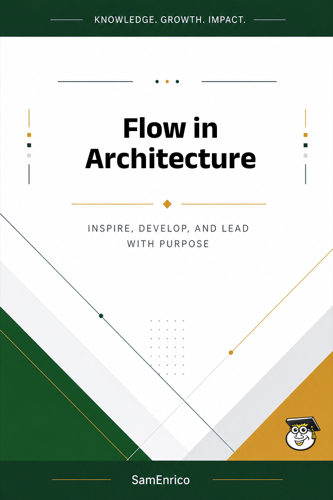
Flow in Architecture
Designers achieving flow during drafting.
Designers achieving flow during drafting.
Formats
About this book
Free sample
Chapter 1: The Architect’s Paradox--–- You are sitting in front of a blank screen. The cursor blinks. The client brief sits to your left—square footage requirements, zoning setbacks, a material palette dictated by budget. You know how to draft. You passed the technical exams.
You can model a complex curtain wall in your sleep. And yet, something is wrong. Your hand hovers over the stylus. Your mind races through possibilities, rejects them, races again. An hour passes.
You answer three emails. You adjust a layer naming convention that didn't need adjusting. You close the file and tell yourself you'll start fresh tomorrow.This scene is not a failure of talent. It is not a lack of discipline. It is not even, strictly speaking, procrastination.
It is the result of a fundamental tension built into the very act of architectural drafting—a tension that this book will name, dismantle, and ultimately teach you to harness. That tension is the Architect's Paradox.The Architecture of the Problem Every architectural drawing asks you to hold two opposing mindsets simultaneously. On one hand, you must be precise. Dimensions must close. Layers must follow standards.
Codes must be met. A wall that is off by two centimeters in a construction document becomes a field problem, a change order, a relationship strained. The profession has trained you to value this precision—rightly so. Buildings stand because of exactitude.On the other hand, you must be spontaneous. Great design does not emerge from following rules; it emerges from breaking them in intelligent ways, from seeing connections no one else has seen, from the sudden intuitive leap that reconfigures an entire plan.
Creativity requires looseness, play, the willingness to make a mark that might be wrong.These two demands—precision and spontaneity—are not merely different. They are, in their raw forms, neurologically incompatible. Precision engages the brain's executive functions: the dorsolateral prefrontal cortex, the anterior cingulate cortex, the systems responsible for error detection, rule following, and self-correction. Spontaneity engages the default mode network and the brain's associative regions: the parts that make connections between distant ideas, that allow…
This is the end of the free sample. Get the eBook to keep going. Buy now
Contents
- Chapter 1
- Chapter 2
- Chapter 3
- Chapter 4
- Chapter 5
- Chapter 6
- Chapter 7
- Chapter 8
- Chapter 9
- Chapter 10
- Chapter 11
- Chapter 12
Details
- Author
- Lehman Elwanda
- Publisher
- SamEnrico
- Language
- English
- Genre
- Non-Fiction, Self-Help, Architecture
- Released
- 2026-06-08
- Pages (approx.)
- 132
- Available as
- eBook, Audiobook

Read better in the ZLOADR app
Your eBooks on your phone or tablet. Sign in with your SamEnrico account and start reading.
More by Lehman Elwanda
 The Senior Comparison TrapLehman Elwanda$11.99
 Butterfly Meadow VisualizationLehman Elwanda$11.99
 Desert Dusk RelaxationLehman Elwanda$11.99
 The Attention Economy DefenseLehman Elwanda$11.99
 Self Talk for Weight LossLehman Elwanda$11.99
 Golfer's Self HypnosisLehman Elwanda$11.99
 Remote Mentorship CommunicationLehman Elwanda$11.99
 The Last Oracle of Delphi: When the Gods Spoke in SmokeLehman Elwanda$11.99
 The Last Dance of the Iron Horse: Lou Brock's 1974 Stealing SpreeLehman Elwanda$11.99
 How to Produce a PitchforkLehman Elwanda$11.99
 A Collector's Handbook to the Wolseley 25 Series IiiLehman Elwanda$11.99
 Micro-Influencer TrackerLehman Elwanda$12.99
You may also like
 Failure Fear in ArchitectureCochran Gilda$11.99
 Work Addiction in ArchitectureDouglas Sheila$11.99
 Procrastination for ArchitectsPage Richard$11.99
 Dream Incubation for ArchitectsBranson Adrianna$11.99
 Imposter Syndrome in ArchitectureNeely Luisa$11.99
 Daily Review for ArchitectsViera Dawna$11.99
 Burnout Prevention for ArchitectsDenton Britt$11.99
 Active Listening For ArchitectsSavage Temple$11.99
 Preventing Architectural BurnoutGetz Cordie$11.99
 Grit for ArchitectsWard Leticia$11.99
 Goal Setting for ArchitectsMcgovern Johna$11.99
 Networking for ArchitectsSwafford Mozella$11.99