
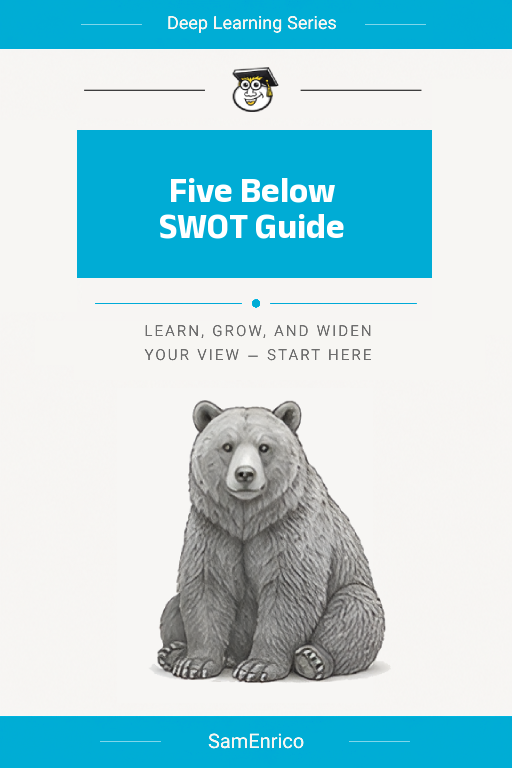
Five Below SWOT Guide eBook
Assess teen focus, extreme value, product rotation
by Jansen Joey
Assess teen focus, extreme value, product rotation, and store expansion runway in new markets.
Formats
Free sample
Chapter 1: The Joy Moat...–- On a humid Tuesday afternoon in a suburban Atlanta strip mall, a thirteen-year-old girl named Maya walks into Five Below with twelve dollars in her pocket—her weekly allowance. She has no shopping list, no specific need, and no parent trailing behind her. Twenty-three minutes later, she exits with a squishy LED mushroom lamp (5),apackofscentedgelpens(5), a pack of scented gel pens (5),apackofscentedgelpens(5), and a small bag of sour gummy worms (1.50,tuckedintothecandybinneartheregister).Shehasspent1.50, tucked into the candy bin near the register). She has spent 1.50,tuckedintothecandybinneartheregister).Shehasspent11.50. She is beaming.
She will return next Tuesday, and the Tuesday after that, not because she needs anything, but because she is chasing a feeling. That feeling—cheap, fleeting, and utterly addictive—is the most misunderstood moat in modern retail.This is not a story about low prices. Dollar stores have low prices. This is not a story about teenage rebellion or the mysterious whims of Gen Z. This is a story about something far more durable: the strategic alchemy of turning fun into a barrier to entry.
For decades, business strategists have worshipped at the altar of functional advantages—supply chain efficiency, economies of scale, proprietary technology, network effects. These are real moats, to be sure. But they are also copyable. Amazon can build a faster supply chain. Walmart can negotiate lower prices.
What Amazon and Walmart cannot do—what no algorithm or bulk purchase order can replicate—is make a thirteen-year-old feel like she just discovered a secret treasure chest that belongs only to her. That feeling is the Joy Moat. And Five Below has spent twenty years digging it.The conventional retail playbook says that teenagers are fickle, disloyal, and allergic to brand commitment. The conventional playbook is wrong—or rather, it is correct about what teenagers do when they are bored, but incorrect about what they do when they are delighted. Delight, not price, is the psychological anchor of Five Below's customer relationship.
This chapter dismantles the lazy assumption that "cheap stuff for kids" is a simple value proposition. It reveals, instead, a meticulously engineered ecosystem of emotional spending, stage-of-life targeting, and what behavioral economists call "affordable indulgence." We will dissect the three life stages that fuel Five Below's repeat traffic, explain why the "lipstick effect" works differently for a thirteen-year-old than for a thirty-year-old, and confront the genuine weakness that keeps executives awake at night: the terrifying speed at which a viral trend can become dead inventory. By the end of this chapter, you will understand that Five Below's strength is not its price point but its psychological positioning—and that its greatest vulnerability is not competition from Amazon, but the simple, brutal fact that teenagers eventually grow up.The Myth of the Rational Teenage Consumer Let us begin by discarding a persistent fallacy: the assumption that teenagers are purely price-driven shoppers. This belief is widespread among retail analysts who have never actually watched a teenager shop. If price were the primary driver, Five Below would compete directly with Dollar Tree, and the two chains would be locked in a death spiral of margin erosion.
They are not. Dollar Tree's core customer is an adult household earning under $40,000 per year, buying essentials like cleaning supplies, paper towels, and canned goods. Five Below's core customer is a teenager or tween with disposable income that is almost entirely discretionary—money that does not need to be spent on survival, and therefore seeks emotional rather than utilitarian returns.The distinction is critical. When a Dollar Tree customer buys a 1.25sponge,theyaresolvingaproblem:dirtydishes.Whena Five Belowcustomerbuysa1.25 sponge, they are solving a problem: dirty dishes. When a Five Below customer buys a 1.25sponge,theyaresolvingaproblem:dirtydishes.Whena Five Belowcustomerbuysa5 LED mushroom lamp, they are solving a different problem: the existential boredom of a Tuesday evening.
The lamp serves no practical function. It emits a soft, color-changing glow that does not illuminate a room sufficiently for reading or homework. Its sole purpose is to be cute, to sit on a nightstand, to be photographed for a Snapchat story, to signal to peers that the owner has discovered something slightly magical. This is not a commodity. It is a totem.Behavioral economists call this "affective consumption"—purchases driven by emotional states rather than utility maximization.
Affective consumption is famously resistant to price elasticity because the emotional benefit is not linear. A 5lampthatsparksjoyisnot"fourtimesworse"thana5 lamp that sparks joy is not "four times worse" than a 5lampthatsparksjoyisnot"fourtimesworse"thana20 lamp that sparks slightly more joy; it is a binary proposition. Either the item triggers a dopamine hit, or it does not. And at $5, the barrier to that dopamine hit is low enough that the decision to purchase is almost automatic. This is the psychological engine of the entire Five Below model: price is not the feature; price is the permission slip.Consider the internal calculus of a fourteen-year-old with ten dollars.
If she spends that ten dollars at a convenience store on a snack and a soda, she receives perhaps ten minutes of consumption pleasure, followed by nothing—no object, no memory, no social currency. If she spends it at Five Below on two small decorative items, she receives days or weeks of ambient enjoyment (the lamp glows every night), plus the social utility of showing her purchase to friends. The value comparison is not 10vs.10 vs. 10vs.10; it is ten minutes of sugar rush vs. weeks of aesthetic pleasure.
Five Below wins that comparison even if its items are objectively lower quality than a specialty retailer's offerings, because the alternative is not a $30 lamp from Urban Outfitters—the alternative is nothing.The Three Life Stages of the Five Below Customer Understanding the emotional driver is necessary but insufficient. To truly grasp the durability of the Joy Moat, we must disaggregate the customer base into three distinct life stages, each with its own spending patterns, social dynamics, and vulnerability to competitive disruption. These stages are not arbitrary demographic buckets; they are psychographic segments that correspond to specific developmental milestones in the journey from childhood dependence to young adult autonomy.Stage One: The Allowance Architect (Ages 6–12)This group is the entry point to the Five Below ecosystem. Children in this age range typically have small, regular allowances—often in the range of five to fifteen dollars per week—and are just beginning to make independent purchasing decisions without direct parental veto at the point of sale. However, their autonomy is constrained in two critical ways.
First, they are usually accompanied by a parent during shopping trips, which introduces a layer of social negotiation: the child must convince the parent that the purchase is "worth it" or at least "not a complete waste." Second, their spending is heavily influenced by peer observation but not yet by direct peer pressure; they want what their friends have, but they are not yet shopping to project a specific social identity.For the Allowance Architect, Five Below serves three functions. The first is a safe training ground for financial independence. A $5 mistake—a fidget toy that breaks after three days—is a learning experience, not a crisis. Parents are willing to tolerate these small losses because the stakes are low. The second…
This is the end of the free sample. Get the eBook to keep going. Buy now
About this book
Details
- Author
- Jansen Joey
- Publisher
- SamEnrico
- Language
- English
- Genre
- Non-Fiction, Strategic Atlas, Youth Retail
- Released
- 2026-06-01
- Pages (approx.)
- 141
- Available as
- eBook, Audiobook

Read better in the ZLOADR app
Your eBooks on your phone or tablet. Sign in with your SamEnrico account and start reading.
More by Jansen Joey
 Every Character is MeJansen Joey$11.99
 Attempt Survivor Disability StoryJansen Joey$11.99
 Metta for Radiation TherapyJansen Joey$11.99
 Non Discrimination Testing 401kJansen Joey$11.99
 Adoption Disruption Loss SupportJansen Joey$11.99
 The Silk Road’s Last Emperor: The Untold Story of a Trade DynastyJansen Joey$11.99
 Head of PR and CommunicationsJansen Joey$11.99
 Excel for Environmental Economics ExamsJansen Joey$12.99
 Understanding Nephropathy, Familial With GoutJansen Joey$17.99
 A Beginners Guide to Game of the Generals (Volume 1)Jansen Joey$11.99